
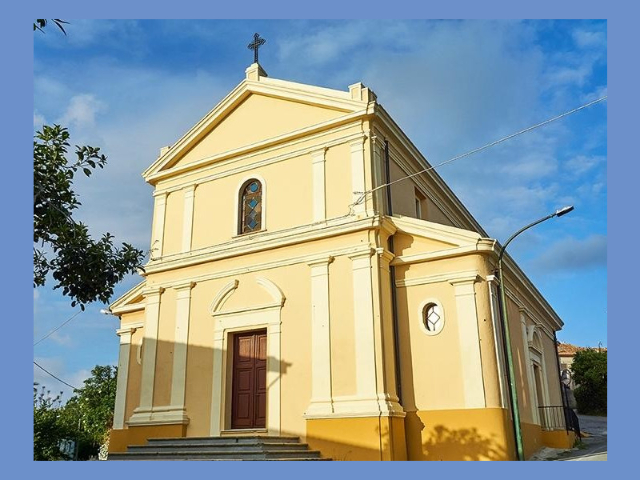

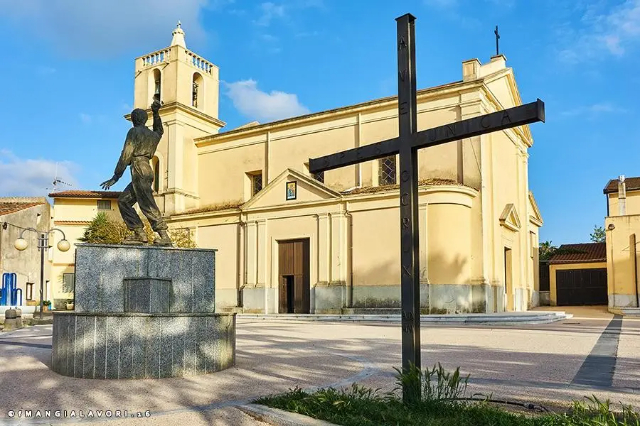
The building, spacious and solemn, presents itself in the architectural lines reconstructed after the earthquake of 1905: the bell tower and the main facade, completely rebuilt, have respected the entirely new layout that the temple had in the second half of the 19th century. Inside, the large presbytery area is under the gaze of the Madonna di Romania, a 17th-century icon reproducing the original panel from the Cathedral Church of Tropea.
Noteworthy is an ancient canvas of the Madonna del Rosario, attributed to G. Grimaldi, a Tropean painter of the 18th century, and a Resurrection by Agostino Petracca, a 19th-century painter from Ricadi. The positive organ by Domenico Pitillo (1837) has been restored and is functional. An ancient canvas depicting St. Peter is attributed to Jacopo Negretti, known as Palma il Vecchio (1480-1528), and is placed at the end of the side nave, where there are also the statues of the Madonna del Carmine (19th century), St. Joseph (19th century), and the Assumption (Chiarello, 1929). The 18th-century polychrome marble tabernacle and the holy water font are two valuable documentary relics. The Stations of the Cross plaques are plaster casts of the work by the Roman sculptor Angelo Fattinnanzi (20th century).
The church also houses a canvas of St. Nicholas (1849) and a wooden sculpture of the sleeping Infant Jesus (18th century).


