
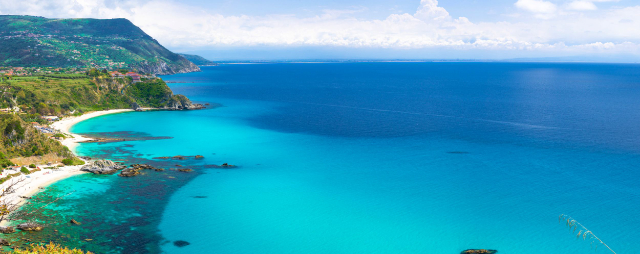

The stretch of coastline that culminates in Capo Vaticano is steeped in history and beauty. It could be aptly called "Costabella" with a hint of regret and nostalgia.
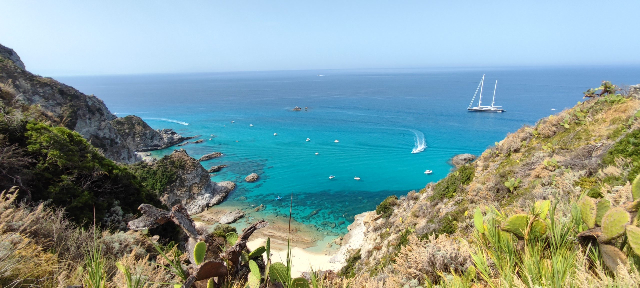
Venetian writer Giuseppe Berto celebrates the beauty of Capo Vaticano with these words, where he chose to settle after extensive travels.
The captivating succession of breathtaking landscapes makes Capo Vaticano one of the most precious gems of Calabria.
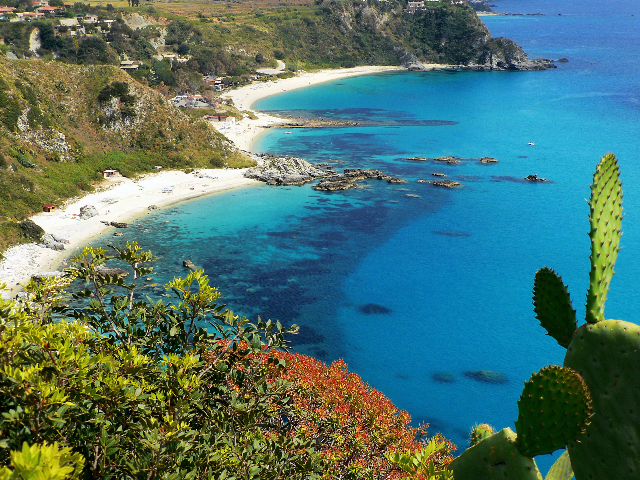
Located facing Stromboli and the Aeolian Islands, the promontory of Capo Vaticano divides the Gulf of Sant'Eufemia from that of Gioia Tauro, encompassing the coastal area stretching from Baia del Tono to Baia di Santa Maria, up to the last ramifications of Monte Poro.
The crystal-clear waters, the secluded white sandy beaches, and a fascinating succession of breathtaking views overlooking a sea with the most intense shades make Capo Vaticano one of the most precious gems of the Tyrrhenian Calabria. A renowned French magazine did not hesitate to declare it the third most beautiful beach in Italy and to include it in the list of the hundred most beautiful beaches in the world.
Majestic rocks rising from the sea, unspoiled landscapes covered with a rich variety of rare and fascinating vegetation, populous seabeds, and panoramic views extending as far as the eye can see to Sicily and the Aeolian Islands make it a destination to be seen at least once in a lifetime.
The world-renowned fame acquired long ago by the promontory from which the tourist resort takes its name is not only due to its enviable geographical position or its history with mythological implications, which tells of an oracle dwelling in a cave long ago, offering answers to the requests of sailors setting sail. The beautiful cliff towering above the sea also arouses considerable academic interest among scholars worldwide, attracted by the geological nature of the magnificent white-gray granite of which it is composed.
Even the rocks at Capo Vaticano, like its sea, assume unique shades and extremely particular shapes mirrored in the waters enclosed in remote coves, often accessible only by sea. Delimiting them are only smooth tuff cliffs, or rugged granite cliffs, or massive spurs that sometimes conceal gorges and caves reachable only aboard the boats of the most experienced fishermen. All framed by an extremely varied Mediterranean vegetation, in which rare species of prehistoric ferns and dwarf palms stand out among brooms, myrtles, prickly pears, and heathers, as well as the famous ancient olive trees, maritime pines, oaks, cork oaks, figs, and ancient vineyards on the terraces of land that farmers have torn from the rock, building dry stone walls that gently slope down to the sea.
The bay generally considered the most beautiful is Grotticelle, formed by three contiguous beaches, but worth a stop are also those of Tono, Praia di Fuoco, Santa Maria, and even those of Torre Ruffa, Formicoli, and Riaci. To all this, add pleasant walks to the Lighthouse at the top of the promontory and to the belvederes, from which to enjoy the most beautiful views and sunsets over the Stromboli volcano.
Coast of the Gods A truly wonderful experience is a boat trip along the entire coast from Capo Vaticano to Tropea. The entire coastline is so splendid that it is known as the "Coast of the Gods," and through small boats, you can discover small bays of the whitest sand and breathtaking seabeds, suitable for both snorkeling and diving.
The Beaches of Capo Vaticano The rocky promontory of Capo Vaticano offers small and secluded beaches, often accessible only through narrow paths, some even reachable only by sea. Among these, the most renowned and popular is Grotticelle beach, a long shoreline made of the whitest sand and actually consisting of three contiguous beaches. The incredibly blue and transparent sea and the shallow waters make this beach a true paradise, one of the absolute must-sees in Capo Vaticano. Most of Capo Vaticano's beaches are backed by wild vegetation, making the environment even more suggestive. Some of the best-known beaches in Capo Vaticano are Tono beach, Santa Maria beach, Torre Ruffa beach, Praia di Fuoco beach, Formicoli beach, and Riaci beach. If you love scuba diving, Capo Vaticano offers incredibly charming seabeds, rich in flora and fauna. Especially around the rocks of Mantineo, Vadaro, and Galea, you can notice a great variety of fish.
The Sea of Capo Vaticano The sea surrounding Capo Vaticano is the ideal place for scuba diving, where you can discover rich seabeds inhabited by the most numerous and varied fish population in Italy, all thanks to a play of currents coming from the two gulfs of Sant'Eufemia from the north and Gioia from the south.
Gastronomy Also, Capo Vaticano, like all the locations of the Capo, from a gastronomic point of view, is among the top producers, nationally, of the famous red onion of Tropea with a particularly sweet taste, requested all over the world and sought after by many international markets for its nutritional and therapeutic qualities derived from a particular morphology of the territory and the particularly stable climate of this area. The gastronomy of Ricadi is made up of simple combinations and strong flavors, genuine in the choice of foods and consolidated for centuries by the poor and peasant economy, by the role of women in the kitchen, by the patriarchal family, by the rhythm of work in the fields. Among the first courses are maccheroni with 'nduja (a sausage made with pork and red pepper), while tourists show a particular preference for "Filea," which are usually a fixed dish in all local restaurants. It is a typical pasta of the Vibonese prepared at home, made with a simple mixture of water and flour and rolled around the "dinaculo" or sparto stick to give it a curved shape.


