
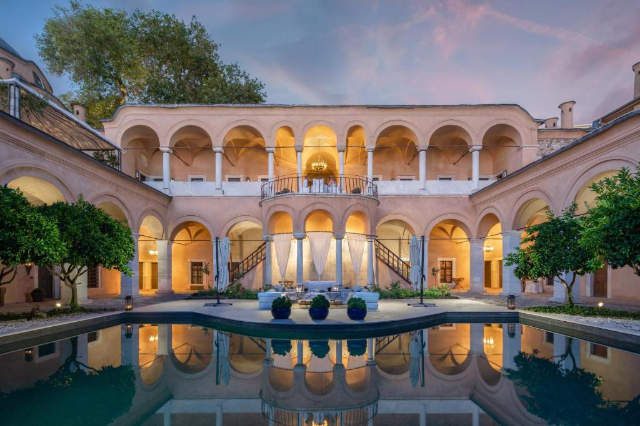

In the heart of Kavala, a city steeped in history and cultural diversity, stands the Imaret—an architectural and historical monument that serves as a vivid testament to the vision of Mohammed Ali, the founder of the last Egyptian dynasty. Built in the early 19th century, the Kavala Imaret is an amalgamation of various functional spaces, encapsulating the Islamic principle of community service under one roof.

The term "Imaret" has its roots in the Arabic word "imara," signifying "construction." The word expands from the Arabic root AMR, comprising 'amr (life) and isti'mar (development or cultivation of a region). In essence, an Imaret, also known as a külliye in Turkish, is a multi-purpose community center that traditionally includes a mosque, educational institutions like medreses (Islamic seminaries), a market, and other charitable entities. Notably, the kitchens attached to the Imaret were vital institutions that provided meals to the underprivileged, irrespective of religious background.
Thus, the Imaret serves as a powerful symbol of social consolidation and growth, aptly described by Muslim scholars as "the heart of Islam’s growth, around which culture blossoms."

The Kavala Imaret is a sprawling complex with diverse architectural elements and functions. It comprises two medreses, two large dershane-mescit (domed prayer and study rooms), a maktab (elementary school for boys), and, of course, an Imaret—a soup kitchen and shelter for the poor. Additionally, administrative offices were integrated into the complex, ensuring its smooth operation.
Originally, the Imaret functioned as an Islamic seminary until 1902, reflecting the intimate relationship between Islamic education and religious practice that existed until 1846. However, the building’s role evolved over the years, adapting to the changing socio-political landscape of Greece.
After 1922, the Imaret's facilities were repurposed to shelter refugees, a significant shift from its original function. Over time, it underwent further transformations, becoming a museum, cafeteria, and restaurant. In a momentous decision in 2001, the Egyptian government handed over the Imaret to a private entrepreneur, allowing for its full restoration and conversion into a luxury hotel.
Today, the Kavala Imaret stands as a fascinating layering of history, architecture, and cultural practices, appealing to a wide range of visitors, from historians and architects to tourists seeking luxury accommodation. Its enduring legacy is a blend of philanthropy, education, and community building—a tribute to the multi-faceted genius of Mohammed Ali and the cultural richness of Kavala.


