
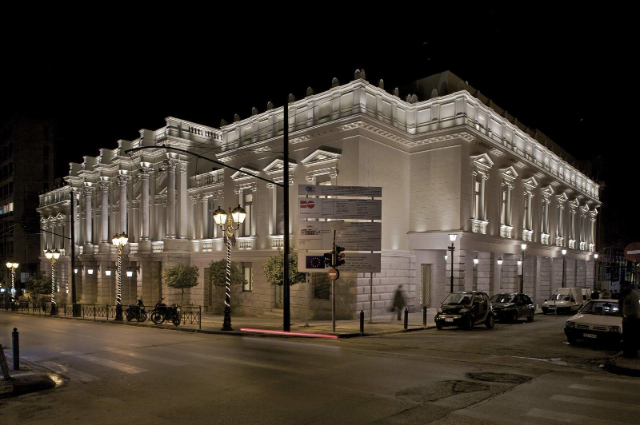

The National Theatre of Greece, located at 22 Aghiou Konstantinou Street in the heart of Athens near Omonoia Square and the metro station, stands as an architectural masterpiece designed by the renowned German architect Ernst Ziller. Ziller drew inspiration from the Renaissance style, and his creation is nothing short of spectacular.
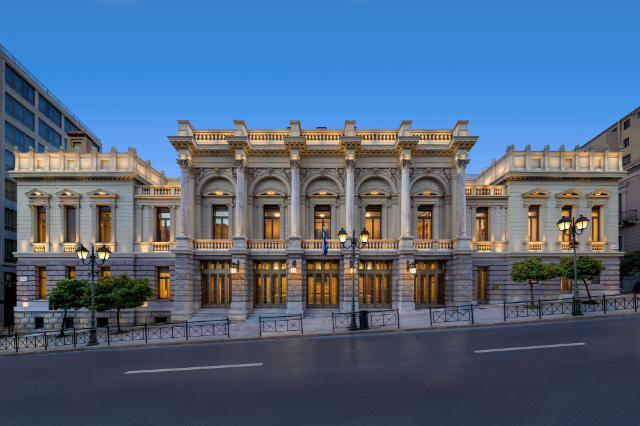
The facade of the theatre is a testament to its grandeur, taking cues from the grandeur of Hadrian's Library in Athens. It comprises a central section adorned with opulent decorative elements, a row of Corinthian-style columns, and two lateral sections that conform to the neoclassical design principles of the era. The theatre boasted state-of-the-art indoor facilities, with advanced scene lighting and heating systems, both of which were engineered in Vienna and produced in the factories of Piraeus.
The funding for this remarkable building came primarily from a generous donation of 10,000 pounds from Stephanos Rallis, a prominent member of the Greek community in London. Contributions from others, like Korialenes and Eugenides, further supported the project.
The theatre's history is a fascinating journey. Established in 1900, it initially served as the Royal Theatre for the King's exclusive guests until 1908 when it was opened to the public. In 1924, its name changed from the "Royal Theatre" to the "National Theatre." The first renovation took place in 1930-31, overseen by the renowned screenwriter Kleovoulos Klonis. Subsequently, in 1960-63, the Messina Hotel, located on the corner of Menandrou Street adjacent to the theatre, was demolished, making way for the construction of the new wing, known as the "New Stage."
Both the National Theatre and the National Drama School have been pivotal in nurturing the development of modern theatrical art. Notably, some of Greece's finest actors have graduated from the National School of Drama.
Beyond being a prominent theatrical institution, the National Theatre also serves as a living museum. It houses a rich theatrical library, an extensive photo archive, valuable recordings, intricate models, scenography designs, and an extensive wardrobe comprising approximately 20,000 theatrical costumes. This multifaceted institution stands as a testament to Greece's enduring love for the performing arts and its dedication to preserving the cultural heritage of theatre.


