
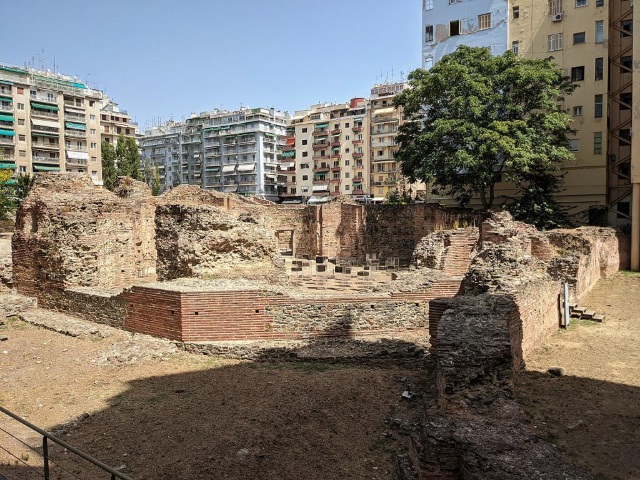

The Octagon Palace in Thessaloniki is a site of historical wonder that carries a fascinating past etched into its very walls. Its name is a nod to its distinct architectural design—shaped precisely like an octagon, with semicircular niches adorning seven of its sides, and one side serving as its entrance. This intricate layout lends the palace a unique allure. Originally intended as the throne room or formal audience hall of the Galerian Palace, the Octagon was conceived on a grand scale.
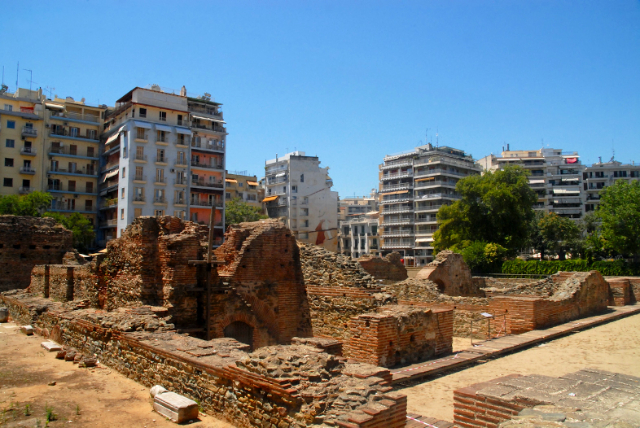
Covering an impressive 875 square meters, this space was meant to be a place of power and prestige for the rulers of the time. However, the grand vision was left incomplete when Galerius, the driving force behind it, passed away. Just like the nearby Rotonda, the Octagon never fulfilled its intended purpose. Instead, it took on a new life as a Christian church, which was likely completed during the first half of the 4th century.
The church must have been a sight to behold, with a towering ceiling that soared to a height of 29 meters, almost akin to the Rotonda. The interior of the Octagon was adorned with a breathtaking array of colors and textures. Colored marble enveloped the walls, and intricate inlaid decorations featuring vegetal and geometric motifs, known as opus sectile, graced the central panels. The floors were equally spectacular, with complex geometric patterns that combined a dozen distinct types of marble, granotem, and stone.
These materials were sourced from various corners of Greece, including the islands, and even Egypt. The floors provide a glimpse of the palace's opulence, now lost to the ages. Tragically, the grandeur of the Octagon met its match in a devastating earthquake during the 7th century.
The once-splendid church was reduced to ruins, and these remnants were repurposed as a reservoir, serving a very different role than originally intended, for centuries. It wasn't until 1950 that the Octagon's historical significance was rediscovered. Today, as you wander through the Octagon Palace, imagine the echoes of the past reverberating within its walls. The grand space that once bore witness to power and prestige, the vibrant hues of its marble-clad walls, and the intricate patterns of its floors all offer a window into a bygone era. The Octagon Palace is a testament to the enduring resilience of history, rising from obscurity to tell its stories to those who pause to listen.


