

Nestled quietly at the foot of Mount Calvario, the village of Terranova rises like a forgotten hymn above the High Sarmento Valley, a stone jewel weathered by centuries but alive with stories. Though its official roots stretch back to the 15th century, when it was a fief under the ‘Stato di Noia’ (now Noepoli), everything about this place feels older — as if the rocks, woods, and trails have seen the world long before names were given.
But here, in this remote corner of Basilicata, Italy, history and nature don’t just coexist — they whisper to each other.
Sacred Stones, Painted Saints
Terranova’s modest façades conceal artistic and spiritual treasures. In the Church of the Madonna delle Grazie, an 18th-century painting of the Madonna delle Grazie alongside San Lorenzo Vinovo glows with warm, human devotion. Meanwhile, the Parish Church of San Francesco da Paola, built in the 16th century and renovated in the 1930s, cradles a 17th-century altarpiece and an 18th-century canvas showing the Virgin Mary flanked by San Domenico and Santa Caterina — saints of contemplation and action, perhaps mirroring the nature of the village itself.
⛰ The Gateway to Italy’s Oldest Forests
Terranova is no ordinary village. It sits within the Parco Nazionale del Pollino, Italy’s largest national park and a UNESCO Global Geopark, where time breathes through leaves and stone.
From here, trails lead to Serra Dolcedorme, the tallest peak in Southern Italy (2,267 m), the wild Serra delle Ciavole, and the iconic Monte Pollino. These mountains are more than just panoramic wonders — they host one of the most extraordinary living organisms in Europe.
“Italus” — The Oldest Tree in Europe (That We Can Date)
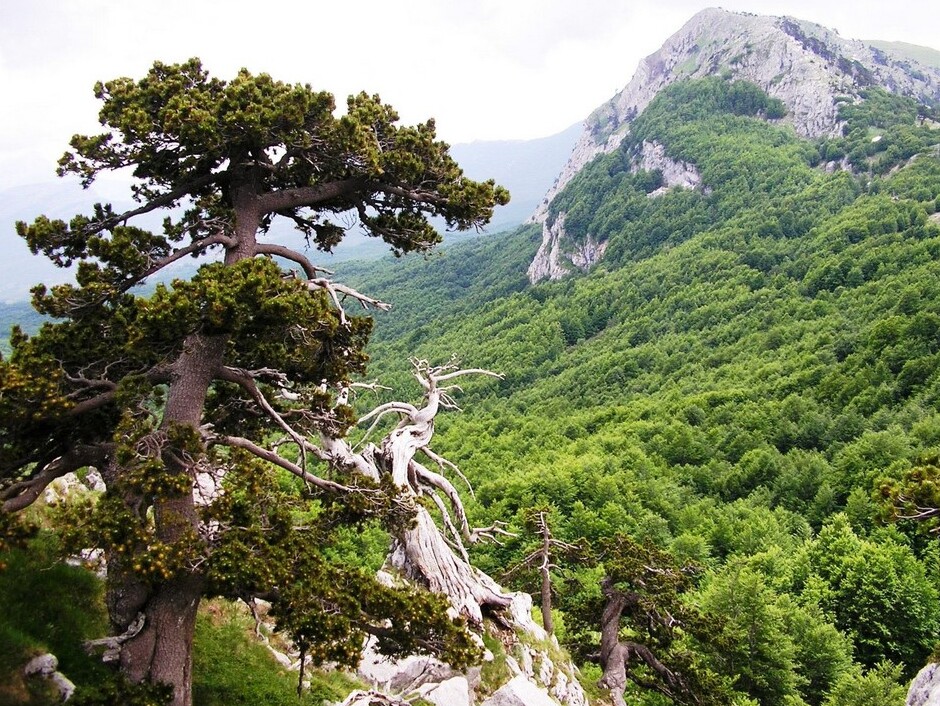
High in the folds of the Pollino range stands a pino loricato (Pinus heldreichii), a tree twisted by wind and whitened by time. Named "Italus", this living relic was discovered in 2017 and dated — with dendrochronology and carbon analysis — to be around 1,230 years old.
This makes it the oldest scientifically dated tree in Europe, a title it holds not through legend, but through science. Italus predates the Holy Roman Empire, Charlemagne, and even the Arab-Norman age of Sicily. Its species, the pino loricato, is itself a rarity, surviving only in a few Balkan regions and this remote corner of Italy. Its bark resembles ancient armor, earning it the name loricato (from lorica, Latin for cuirass or breastplate).
It doesn’t grow in forests. It grows like a sentinel, alone or in silent clusters, on limestone ridges above 1,800 meters, where lightning, ice, and silence rule the rhythm of time.
A Forest Older Than Memory
But Italus is not alone. The Pollino forests — especially above Terranova — are filled with ancient beech, chestnut, and hornbeam trees. The chestnuts here were once life-givers, harvested for food and fuel; today, they offer welcome shade in summer when Terranova fills with holidaymakers.
In autumn, these woods explode in color, while shepherd paths and rock sanctuaries hide between mossy stones and ruins. Each step here carries a whisper: a poem written by roots and leaves instead of ink.
A Culture of Earth and Fire
And then there's the food. Terranova’s culinary traditions reflect its geography — mountainous, resourceful, simple but flavorful. Handmade pastas, chestnut flour dishes, cured meats, and sheep cheeses — all tell the story of a land that demanded work and rewarded patience.
Even the pane di castagne (chestnut bread), sometimes sweetened with local honey, reflects the deep link between forest and table. Add a glass of Aglianico del Vulture or a local rosso from the Sarmento Valley, and you’re not just eating — you’re experiencing the very memory of the land.
Final Thoughts: Why Terranova Matters
Terranova is not on most tourist maps. And that’s the point.
It’s not a museum, but a living threshold — between history and myth, between what we remember and what the earth has never forgotten.
Here, a 1,200-year-old tree grows on the same mountain where shepherds still walk. Here, 18th-century paintings survive in tiny churches barely large enough for a dozen parishioners. Here, you don’t just travel — you listen.
And if you’re lucky, the trees might answer.


