
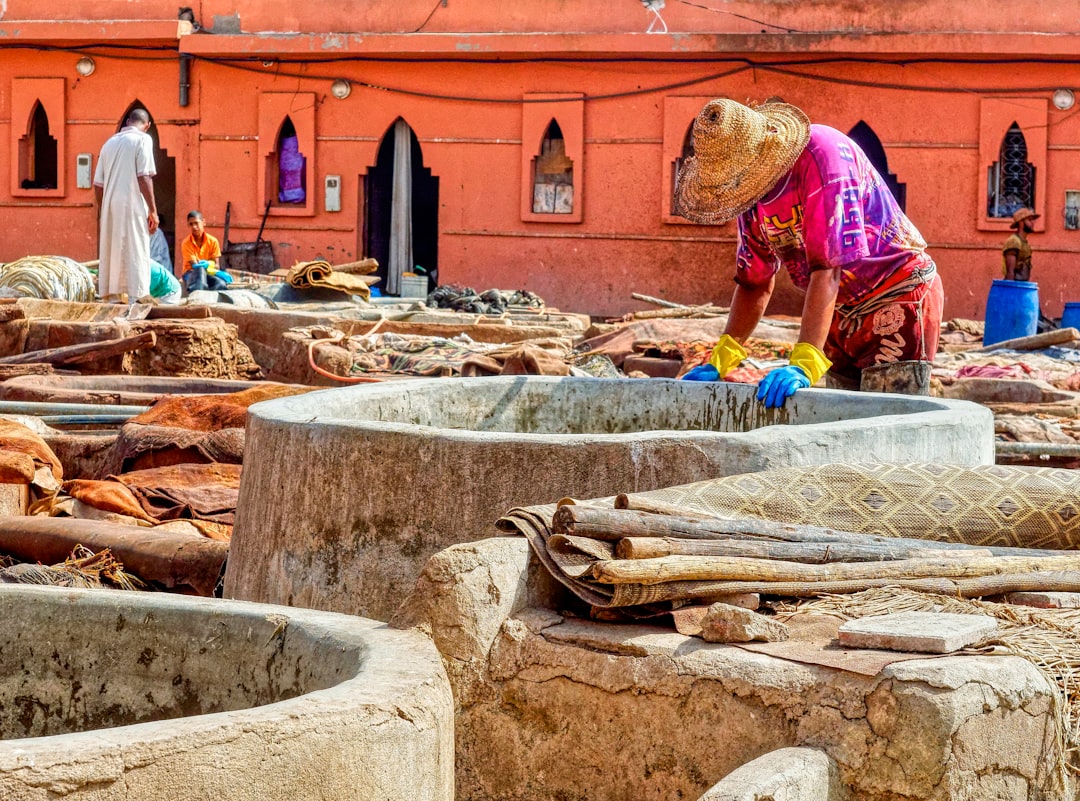

The smell arrives before the sight. A pungent mix of ammonia, tannin, and wet leather that weaves through the narrow alleys of the medina of Marrakech, guiding you towards one of the oldest artisan workshops in Morocco. The tanneries of Chouara — the name of the neighborhood — are not a museum, they are not a reconstruction: they are a living workplace, where dozens of artisans work every day immersed up to their thighs in stone basins filled with natural dyes.
The leather processing in Marrakech dates back to the medieval period, when the city was a crucial trade crossroads between sub-Saharan Africa and the Mediterranean. The techniques used today — soaking in pigeon water, softening with egg yolk and animal fat, dyeing with plant pigments such as saffron for yellow, mint for green, poppy for red — have remained substantially unchanged over the centuries. It is this continuity, concrete and observable, that makes the place extraordinary.
The view from above: the vats seen from the terraces
To truly see the tanneries, one must go up. The leather shops surrounding the area offer free access to their terraces to visitors, provided — almost always — that they endure a few minutes of product presentation for sale. It is worth accepting. From above, the circular vats carved into the stone form an irregular grid of colors: ochre, burgundy, olive green, lime white, alternating according to the processing cycle taking place that day. The number of vats varies, but the overall area of the main tanneries extends over several hundred square meters, enough to completely fill the field of vision.
The morning light, when the sun hits the vats from the east, returns the colors in their maximum saturation. The artisans — predominantly young men, often from families that pass down the trade from generation to generation — move between the vats with precise and repeated movements, turning the hides with long wooden sticks. Viewed from above, they appear as figures inserted into an abstract mosaic.
Inside the neighborhood: sounds and stories among the alleys
Descending from the terrace and entering the neighborhood is a different, denser experience. Hand-pulled carts transport fresh hides or already dyed leather to the finishing workshops. You can hear the dull thud of the hides hitting the edges of the vats, the voices of artisans calling to each other in darija — the Moroccan Arabic dialect — and the creaking of the pulleys used to lift the loads.
Many of the workers in the tanneries come from families that have practiced this trade for generations. It is not uncommon to meet men who tell, through gestures and a few words of French or Spanish, that they learned to work with leather from their fathers or grandfathers. The work is physically hard: hands and arms remain colored for days, and prolonged exposure to natural chemicals leaves evident marks on the skin. No romanticization is necessary: it is a real trade, with real toil.
What is sold and how to navigate the shops
Around the tanneries, the concentration of leather goods shops is very high. Bags, babouche (the typical Moroccan leather slippers), belts, wallets, and jackets are displayed in abundance. Prices vary enormously and haggling is expected, almost required. A medium-sized bag made of processed leather can cost between 150 and 400 Moroccan dirhams (around 15 to 40 euros), but the initial figures proposed by sellers are often double or triple the final price that can be reached.
It is worth visiting multiple shops before making a purchase, not only to compare prices but also to assess the quality of the leather: genuine vegetable-tanned leather has a characteristic smell, a firm texture, and a slightly irregular coloration, a sign of artisanal dyeing. Chemically treated leather, which is cheaper, tends to have uniform and artificial colors.
Practical tips for the visit
The best time to visit the tanneries is early in the morning, between 9 and 11, when the processing is in full swing and the light is favorable for photography. In the afternoon, many vats are already empty or resting. The tanneries are located in the Bab Debbagh neighborhood, reachable on foot from Djemaa el-Fna square in about twenty minutes through the medina, or by taxi for a few dirhams by indicating the name of the neighborhood.
The shop terraces generally offer a sprig of mint to hold under your nose to mitigate the smell: it is advisable to accept it, especially on hot days. Wearing closed shoes is practical if you intend to go down the alleys closest to the vats. The average visit time, including a stop on the terraces and a walk in the neighborhood, is around one to one and a half hours.


