
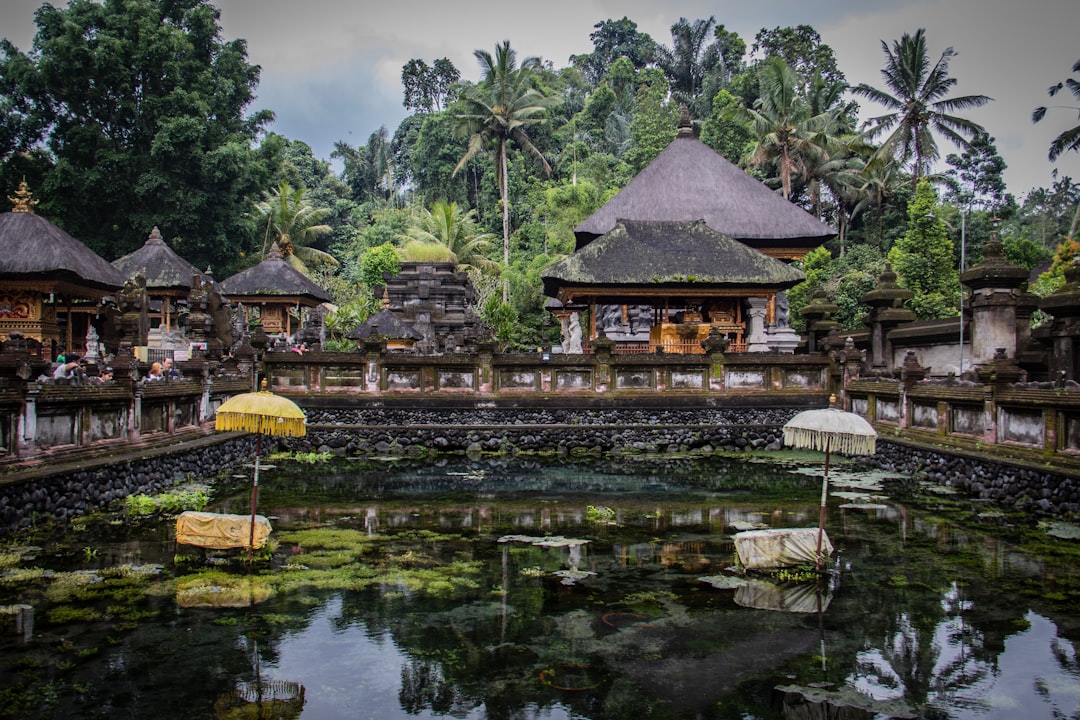

Gray basalt stones emerge from the emerald green water like a path suspended between two worlds. Walking on the stepping stones of Tirta Gangga means balancing each step over ornamental pools populated by golden koi carp, while sculptures of nāga — the mythological Hindu serpents — spout water in precise arcs from multi-tiered fountains. In the background, the silhouette of Gunung Agung, Bali's sacred volcano, looms with that silent presence that the Balinese consider the home of the gods.

The complex was built in 1948 at the behest of Anak Agung Anglurah Ketut Karangasem, the last raja of the kingdom of Karangasem. The name itself reveals the intention: tirta means sacred water in Sanskrit, while Gangga refers to the Ganges River, a source of purification in Hindu cosmology. Therefore, it is not just a simple water garden, but a theological space built of stone and spring water, where aesthetics and ritual merge in an architecture that is impossible to separate from its spiritual function.
The architecture of water: fountains, pools, and sculptures

The palace is organized on three levels sloping down towards the valley, each with pools of different sizes connected by carved stone channels. The upper level houses the main swimming pool, still usable by visitors for swimming — a detail that surprises and transforms the visit into something physically memorable. The water comes from natural springs that flow directly within the complex, maintaining a cool temperature even during the hottest hours of the day.
The multi-level fountains are the visual heart of the site: statues of deities and mythological creatures — Garuda, elephants, demons with wide-open mouths — serve as nozzles from which water cascades down into the underlying pools. Each sculpture is intricately crafted, with facial expressions that change meaning depending on the angle from which they are viewed. The local volcanic stone, dark and porous, has over time absorbed the green moss that makes it even more integrated into the surrounding landscape.

The path among the stones: a physical and visual experience
The most photographed — and most tactilely engaging — moment of the site is the path on the stepping stones that cross the main pools. The stones are arranged in irregular rows, spaced apart enough to require attention at every step, with water flowing just a few centimeters beneath the soles. Walking slowly on this path, with the carp moving in the water beneath you and the fountains playing around, produces an involuntary concentration that feels more like a meditative practice than a tourist stroll.

Around the pools, the gardens are tended with palms, frangipanis, and tropical ornamental plants that create corridors of intense green. Some areas of the complex include open pavilions — bale — where it is possible to sit and observe the movement of the water. The royal family of Karangasem still uses some structures of the palace for private ceremonies, which gives the place a living continuity rather than a museum-like quality.
How to get there and when to visit

Tirta Gangga is located in the district of Kecamatan Abang, in the regency of Karangasem, in the eastern part of Bali. The most common route to reach it starts from Amlapura, the capital of Karangasem, about 6 kilometers away. By scooter or with a private driver from Ubud, the journey takes about an hour and a half, passing through roads that ascend towards the slopes of Gunung Agung with views of the rice terraces.
The most useful practical advice: arrive by 8 in the morning. In the early hours, the light is side and soft, ideal for photographing the sculptures and fountains, and the number of visitors is still low. Between 10 and 13, the site becomes quite crowded, especially on weekends. The entrance ticket is around 50,000 Indonesian rupiah for foreigners — less than four euros at the current exchange rate — with an additional fee if you wish to use the upper pool. A complete visit takes about 60-90 minutes, but those who want to sit and observe calmly can easily spend two hours there.
The context: sacred art in Hindu Indonesia
Bali is the only island with a Hindu majority in Indonesia, and Tirta Gangga reflects that tradition directly. The sculptures are not decorations: each figure — the Garuda carrying Vishnu, the nāga protecting the sacred water, the demons Kala at the entrances — is part of a coded iconographic system that the Balinese read as a text. Visiting the site with a local guide allows one to decipher these references, transforming what might seem like an exotic garden into a three-dimensional mythological narrative.
The palace suffered significant damage during the eruption of Gunung Agung in 1963, one of the most devastating of the 20th century in Bali, and was subsequently restored. This story of destruction and reconstruction is an integral part of the meaning of the place for the Balinese: the water that continues to flow, the reassembled sculptures, the garden that regrows — all tell a resilience that goes beyond aesthetics.


