
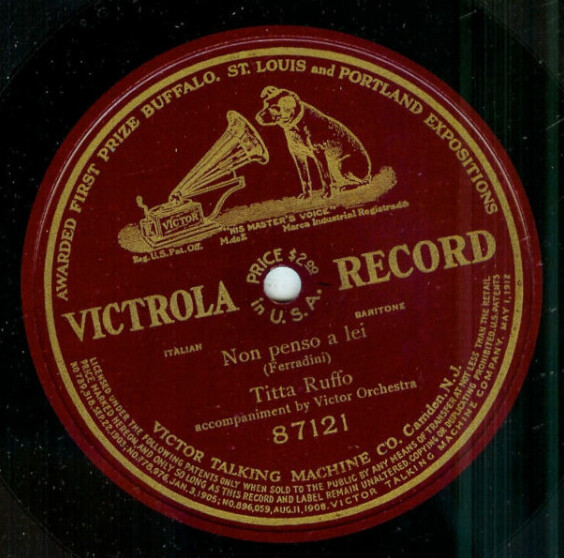

The Titta Ruffo Collection is a collection of costumes and props that belonged to the famous baritone Titta Ruffo, donated to the City of Pisa by his son, after the death of his father. The material is exhibited in the second gallery of the Teatro Verdi in Pisa. itta Ruffo was born in Pisa on June 9, 1877, in the popular Via Carraia (now Via Volturno), by a family of iron craftsmen. At the age of eighteen he discovered he had uncommon singing skills and moved to Rome where his brother Ettore studied music and the flute. He was admitted to the Conservatory of Santa Cecilia, in the singing class of Wenceslas Persichini, one of the most illustrious masters of Umbertine Italy, but growing misunderstandings and disagreements with teachers led him to leave the Conservatory after seven months.
titta_ruffoIn the autumn of 1897 he went to Milan where his fellow baritone Lelio Casini welcomed him affectionately and gave him fruitful lessons. After his debut, at only twenty-one years old, in the role of the Herald in Lohengrin at the Teatro Costanzi in Rome, he soon became a protagonist in the greatest opera houses in the world: in Italy and Europe, in Egypt, Russia and the Americas, from New York to Buenos Aires. Just over thirty years old, in the first decade of the century he already enjoys a solid international reputation: he is the baritone par excellence: an interpreter with a marked personality and incisive language, he has an unmistakable voice for enamel and color, dark and bronze throughout the range, and in addition to the extension capable of embracing as many as seventeen notes including the tenor C. In Pisa debuts in August 1898 at the Teatro Politeama as the Count of Luna in Verdi's Trovatore and those of Lord Ashton in Donizetti's Lucia di Lammermoor. He returned to Pisa in 1901, at the Teatro Nuovo (then Verdi) as Jago in Otello and Don Carlo in Ernani, and finally in 1925 for two extraordinary charity performances with Thomas's Hamlet reporting a great success. With this opera he greets his fellow citizens and this event is immortalized on a plaque placed in the atrium of the Theatre. There are 43 costumes in all, to which accessories, stage guns, jewellery, wigs, caricatures, photographs, scores, books, etc. must be added. Since 1999 the materials have been restored, studied and catalogued by the Ente del Teatro Verdi of Pisa. The exhibition for conservation reasons rotates periodically (about every two years) and the costumes on display are currently sixteenColpitated by the murder of his brother-in-law Giacomo Matteotti, boycotted several times by the fascist regime, reported abroad as subversive, Titta Ruffo decided to leave Italy to never sing there again. He still performed abroad, until his last opera, Tosca, in Buenos Aires in 1931, and his farewell concert in Nice in 1935. In October 1937, in Rome, where he returned for a visit to his family, he was arrested and deprived of his passport. Released after three days.


