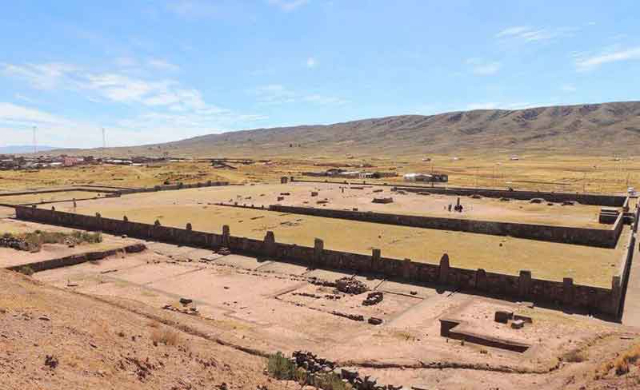


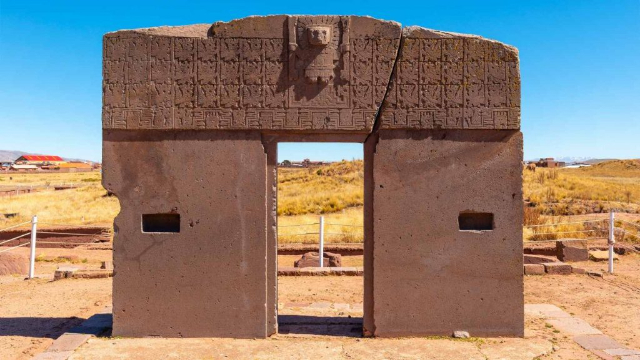
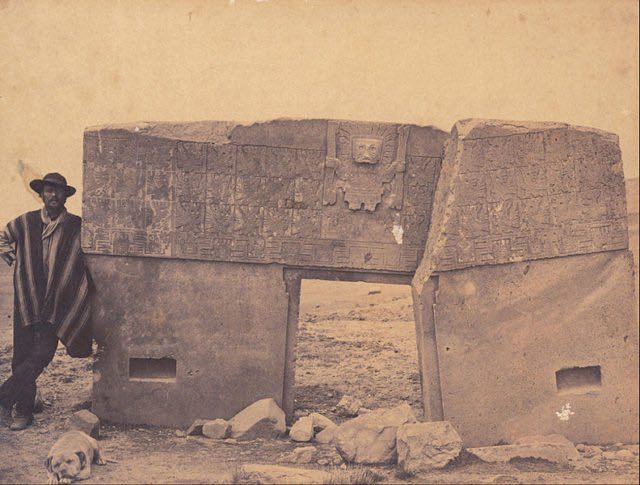
Among the many little-known pre-Columbian civilizations, partly because they disappeared before the arrival of the colonizers, there is one particularly mysterious one that left the first modern visitors, around the mid-19th century, bewildered: it is the Tiwanaku culture, whose people occupied territory that is now divided between Bolivia, Chile and Peru. The capital of this empire, Tiwanaku, was probably one of the most important cities in ancient South America, reaching its peak between 300 and 1,000 AD. Its remains can be found today about 70 kilometers from La Paz (Bolivia), on the shores of Lake Titicaca, at an elevation of 3850 meters, evocative and mysterious ruins of a city that, in addition to being the seat of political power, was the spiritual center of the empire, where the ceremonial space was organized with impressive technique and precision, oriented according to the cardinal points, and equipped with a complex drainage system that controlled the flow of rainwater. The monumental Gate of the Sun is the most famous symbol of the Tiwanaku archaeological site, one of the most important specimens of the art of that ancient people, found inside the great Kalasasaya temple. The gateway, carved from a single slab of andesite, was found by European explorers in the mid-19th century lying broken on the ground. The Gateway features distinctive bas-reliefs that form a mysterious inscription. Some scholars believe that the central figure is a representation of the Inca deity Viracocha, creator of all things. Other experts, however, believe it is the "Sun God" because of the twenty-four linear (solar) rays surrounding the head of the representation. Forty-eight winged effigies surround the central figure; they are supposed to represent chasquis (messengers serving the Inca empire) or messenger deities. Some of them have human heads, others raptor heads.
If we stand in front of the Sun Gate of Tiwanaku at the beginning of spring, we will see the sun rise just above the middle of the gate itself. Reason this from which it derives its name.