


At the first light of dawn, when the fog still floats on the surface of the water, the three Vermilion Lakes transform into one of the most extraordinary landscapes in Canada. Mount Rundle, with its nearly 2,950 meters in height, perfectly reflects in the still waters like in a mirror, creating that natural symmetry that has made these lakes one of the most photographed places in the entire country. This is not a lucky coincidence: the geographical position of the lakes, nestled in a flat depression just outside the center of Banff, favors conditions of almost absolute calm in the early morning hours.

The Vermilion Lakes are actually three distinct and shallow basins, connected to each other and fed by waters coming from the surrounding mountains of Banff National Park, established in 1885 as Canada’s first national park. This seniority ensures that the area is protected and managed rigorously by Parks Canada, the federal agency that oversees the conservation of the ecosystem. The road that runs alongside the lakes, Vermilion Lakes Drive, extends for about five kilometers and remains accessible year-round, offering ever-changing perspectives depending on the season.
A rich ecosystem along the shores

What makes the Vermilion Lakes truly special is not just the photogenic landscape, but the density of wildlife that inhabits them. The shallow waters and surrounding wetlands are ideal habitats for beavers, otters, great blue herons, and ducks of numerous species. Beavers in particular have built visible dams along the shores, gradually altering the morphology of the lakes themselves. It is not uncommon to spot moose drinking during twilight hours, especially in transitional seasons like spring and autumn.
Birdwatching enthusiasts will find fertile ground here: the area is noted as an important ornithological site, with migratory species stopping during seasonal passages. Along the road, it is possible to stop at several viewpoints equipped with rest areas, from which to observe wildlife without disturbing it. It is essential not to approach the animals and not to leave food unattended, as reminded by the Parks Canada signs placed along the route.

The magic of light and reflection
The true spectacle of the Vermilion Lakes unfolds at dawn. When the sun rises behind the visitor looking east, the first warm lights hit the rocky wall of Mount Rundle and are duplicated in the still water. The result is an almost unreal image, where the boundary between sky and earth seems to dissolve. Landscape photographers from around the world include this location among the must-see stops on any trip to the Canadian Rockies.

The sunset also offers memorable scenes, with the peaks tinged in orange and pink as darkness advances from the east. In winter, when the lakes freeze partially or completely, the landscape changes radically: snow covers the shores, ice reflects the cool tones of the sky, and silence becomes absolute. It is a completely different version of the same place, equally powerful.
How to get there and when to visit
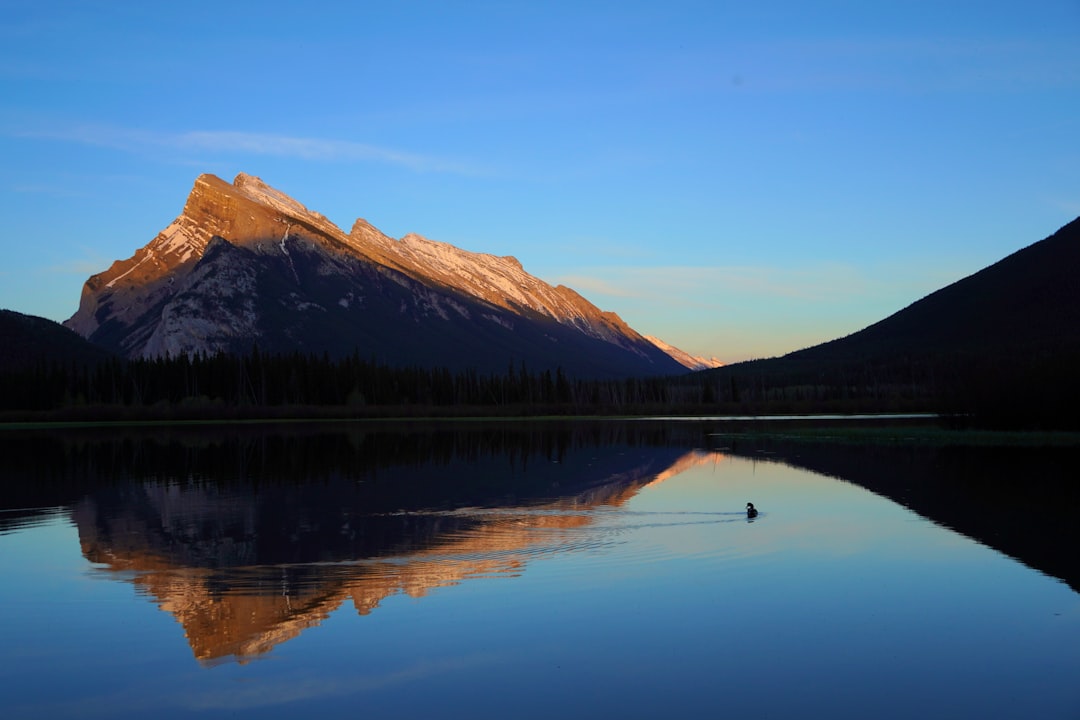
The Vermilion Lakes are located less than two kilometers from the center of Banff, accessible by foot or by bicycle along a convenient flat trail that starts from the town. By car, you access it via Vermilion Lakes Drive, which you enter just after crossing the bridge over the Bow River when leaving Banff heading west. No separate ticket is required to visit the lakes, but to circulate in Banff National Park, a daily or annual pass from Parks Canada is required, which in 2024 had an indicative cost of about 10-11 Canadian dollars per person per day for adults.
The best time to visit is undoubtedly at dawn, especially on windless days when the water's surface is completely flat. Arriving at least thirty minutes before sunrise allows you to find a good observation point before other visitors crowd the scenic areas. In summer, parking fills up quickly, especially on weekends. Autumn, between September and October, offers the advantage of colorful foliage and a slightly reduced tourist presence compared to the summer months. A complete visit along the entire Vermilion Lakes Drive takes between one and a half to two hours, depending on how many stops you make.
The Context of Banff National Park
The Vermilion Lakes are not an isolated attraction, but part of a vast mountain ecosystem that includes glaciers, coniferous forests, and glacial valleys. Banff National Park, with its over 6,600 square kilometers, has been a UNESCO World Heritage site since 1984 as part of the serial site of the Canadian Rocky Mountains. This classification has helped to preserve an intact natural environment that could otherwise have faced much more invasive tourist pressures.
The town of Banff, with its established tourist infrastructure, offers everything needed to organize a comfortable visit: accommodations of all categories, restaurants, bicycle rentals, and naturalist guides. The Vermilion Lakes often represent the first contact for visitors with the park's wilderness, precisely because of their immediate accessibility. Yet, despite their proximity to the town, just a few minutes on the shores of these lakes is enough to feel how thin the boundary is between the man-made world and the one that existed here long before it.


