
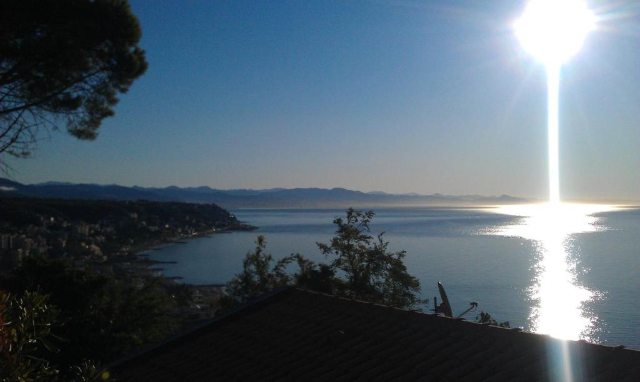

The Villa Beuca Botanical Garden, located on the western slope of Beuca Hill, was built in 2002 by the Municipality of Cogoleto in order to safeguard the typical plant environments of Liguria. It covers an area of 34,000 square meters and is divided into three main zones-the Educational Frame, the Spontaneous Frame and the Ligurian Environments-that allow, in a small space, an exhaustive view of Ligurian flora.
The Garden also includes a Herbarium, which can be viewed upon specific request: started in 2003, it currently includes more than 80 taxonomic entities arranged according to the canonical criteria of conservation and classification.
The Botanical Garden is also very rich in fauna and in particular avifauna, so it is a very suitable place for birdwatching.
Its management was entrusted by the municipality to the Cooperativa Sociale Il Giunco Onlus, later merged into the Cooperativa Sociale Il Rastrello, which employs in part disadvantaged workers with mental and social distress.
Fora. The Ligurian Environments of the Botanical Garden consist of the reconstructions of the characteristic environments of the different elevation bands, from sea level to the mountains: the sea cliffs, Mediterranean scrub and garrigue, wild orchids, wet environments, Ligurian pine forests, thermophilic chestnut forests, mountain forests, cliffs and rockeries, serpentine flora, and the anthropogenic olive zone.
The Spontaneous Cornice covers an area of about 11,000 md in which the vegetation is left in a spontaneous condition and only minor maintenance work is carried out there, including the removal of pines that have died from disease, the improvement of paths, and the cartenillation of the most interesting species. These include the two that make up a special plant association: the black rush (Schoenus nigricans) and the aphyllant (Aphyllanthes monspeliensis), which in Italy is encountered only on the stony, well-drained soils of the Riviera di Ponente, as far as Cogoleto, and in a few other localities in the Apennines and the Brescian area.
The Educational Frame occupies about 3,500 sq. m. and is dedicated to various in-depth studies, such as species with Mediterranean characters but coming from distant lands, such as California and Australia; ornamental species widespread on the Ligurian Riviera; palms, so-called primitive plant species ("the living fossils") and more; here is the Library containing the herbarium and a collection of books on naturalistic themes, used for exhibitions, public lectures, courses, book presentations, and educational workshops.
Fauna. Due to the presence of various plant microenvironments with different plants, the Botanical Garden is populated by a very rich small wildlife. Among Insects, it is interesting dragonfly population around the two wetlands, visible in summer, with a dozen entities, including Calopteryx virgo, Coenagrion tenellum, Lestes viridis, Orthetrum cancellatum, Anax parthenope and A. imperator, Sympetrum fonscolombei, Crocothemis erythraea. Mediterranean esculent frogs and tree frogs are also found here, and, among Reptiles, the Warty Gecko.
Charaxes jasius, a butterfly rather uncommon along the Ligurian Riviera, is also widely present in the Garden, thanks to the existence of some strawberry trees (Arbutus unedo), on which it carries out its larval cycle.
The wild avifauna is also very varied: nesting birds include the Common Magnanina (which breeds in the heather shrubland), the Moltoni´s Tern, the Lonely Sparrow (in the cliff below), and the Nightjar, while the Common Reed Warbler (in the adjacent thermophilic thickets), the Little Shrike and the remarkable Calander (in 2003) have nested occasionally. Nearby, i.e., in the lower valley of the Arrestra Creek, Kestrel, Sparrowhawk, Bee Buzzard, Wild Turtle Dove and Moorish Bunting also nest more or less regularly; also common in the area are Finches with Goldfinch, Black Bunting, Sable, Greenfinch and Chaffinch.
In winter, during the fall migration and even more so during the spring migration, many other birds are also observed: on migratory stopover, skylarks, Song Thrushes, Pronghorns, Whinnies, wheatears, whitethroats, Woodcocks, Green and Big Loons, Black Buzzards on migratory stopover; in transit only, Hoopoes, Bee-eaters and many others. There are also numerous passages of swallows, house martins, common swifts, and migratory raptors, including the Honey Buzzard, Short-toed Eagle (which also nests there), and Marsh Harrier.


