
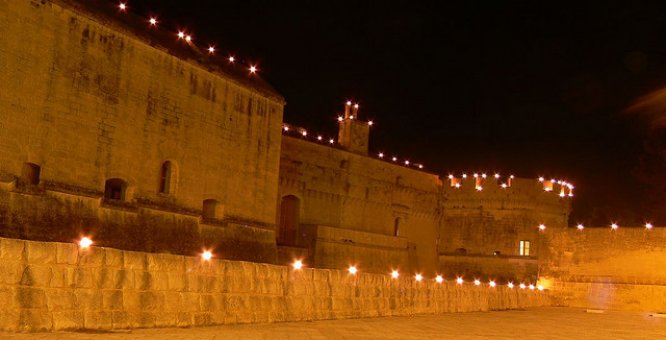

That inhospitable and unfertile land, donated in 1294 by Emperor Charles II of Anjou to the Spanish noble family De Laya (which over time became Dell'Acaya), became in the Renaissance the place where the concept of the ideal city, understood as a space to be designed in such a way that one could live there in harmony, as a place of social encounter, a space congruous to man, designed to his measure and capable of guaranteeing civilized living, took place luxuriantly.
A unique fortress-city, designed to counter the bloody Turkish invasions of the 16th century, the last and irreplaceable defensive bulwark protecting Lecce.
It was Alfonso dell'Acaya, seventh baron of Segine, who in the late 1400s began the construction of the imposing defensive work, building the two circular towers located at the northeast and southwest corners of the castle. Gian Giacomo, who became the fief's eighth baron in 1521 upon his father's death, soon realized that these isolated towers would not protect the land and people for long, partly because it was during those years that firearms began to spread. Segine was thus transformed militarily: he built the town within high bastioned walls with a quadrangular plan, where the castle replaces the bastion at the southwest corner. map of acaya The lanceolate bastions with a pentagonal plan and withdrawn flanks, the presence of the "treacherous thrones" (holes in the walls from which the cannon mouths came out, hidden in the withdrawn flanks and not visible) combined with a double-register masonry system (of which, the lower part is scarp), a patrol walkway along the entire perimeter and a deep moat that entirely surrounds the village, soon made this fortress-town an impregnable place.

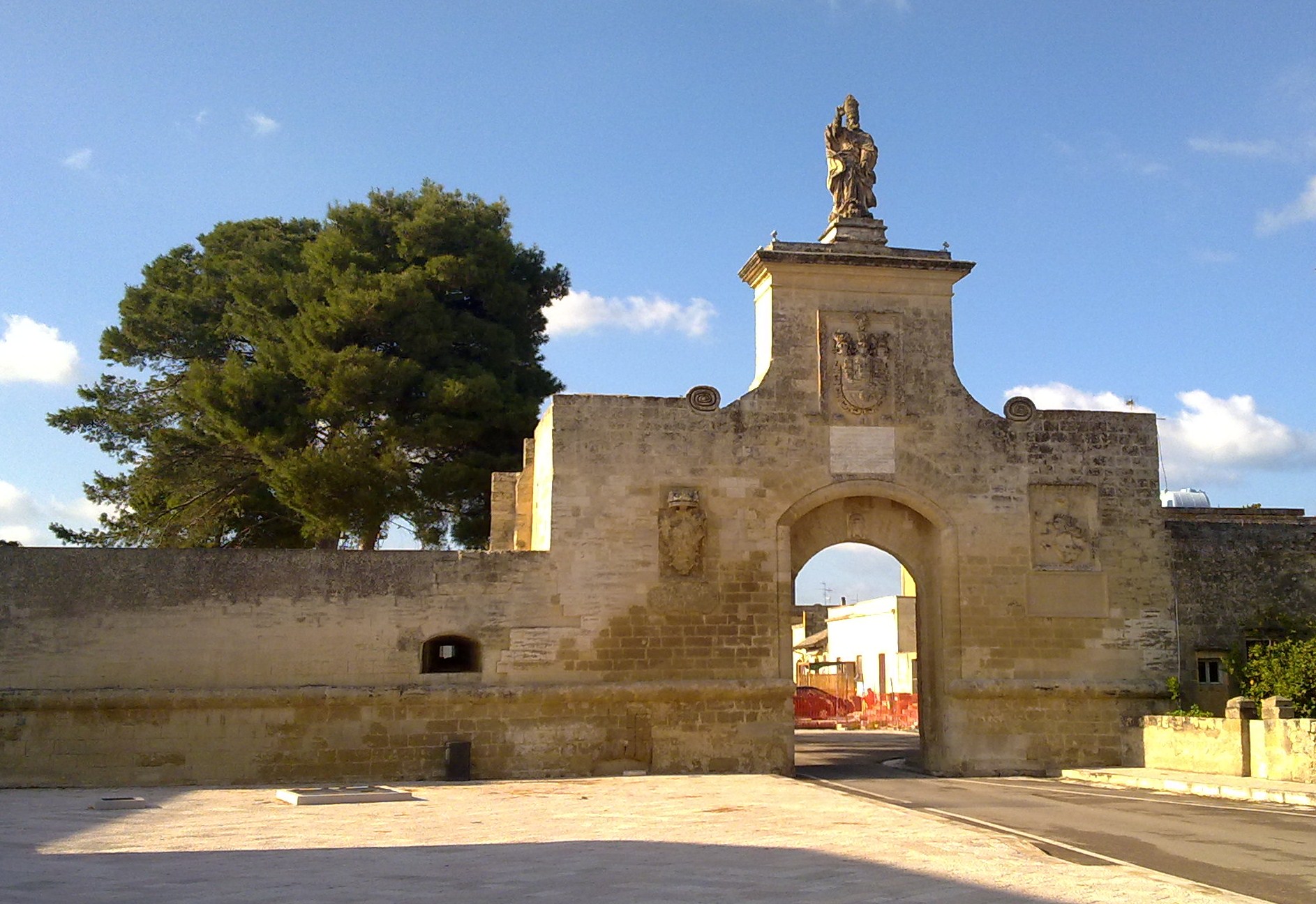
But in the concept of an ideal city, military life had to be totally integrated with civilian life, and it was precisely on these concepts that Gian Giacomo made Acaya an extraordinary suburb: an urban complex organized on regular orthogonal street axes, cut diagonally by three squares (Piazza d'Armi, in front of the castle's only entrance; Piazza Gian Giacomo, in the center of the suburb, where the Church of the Madonna della Neve stands, built in the early 1500s and completely restored in 1865; Piazza Convento, at the northeast corner, where the Convent of S. Maria degli Angeli, which he himself had built), which still retains its original layout. The only access to the village was the Porta Monumentale, built by Gian Giacomo in 1535 and restored by the Vernazza family, the last feudal lords of Acaya, in 1792. garitta walls
A totally self-sufficient ideal city, which within its walls included: a deep well of spring water for sustenance, located in the center of Piazza d'Armi; an underground oil mill of exquisite workmanship; dozens of silos dug into the rock, for the collection and storage of foodstuffs (still visible today thanks to careful paving, which brings out the original design of the layout of the village).

It was on the basis of these radical changes that Baron Gian Giacomo, in 1535, imposed his own name on the village he designed and built.
But Acaya goes beyond its Renaissance history. Outside the walls stands the Chapel of St. Paul, dating from the mid-18th century, the oldest pilgrimage destination (along with Galatina) for victims of the tarantula bite. According to popular belief, tarantism, caused by the bite of the tarantula (Lycosa tarentula), provoked a state of general malaise - a state of catalepsy, sweating, palpitations - in which music, dance and colors represented the basic elements of therapy, which consisted of musical exorcism. At this point, the tarantata, pardoned by St. Paul, was led to the saint's chapel and drank the sacred water from the well adjacent to it.
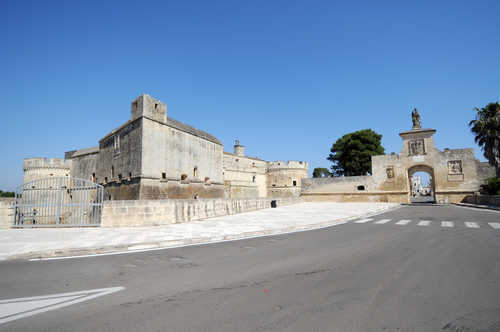
Acaya is a piece of history that comes to us intact, a memory of the splendor of times past, a place of stories, people and architecture that not even time has managed to conquer. (A.Potenza)


