
🎄 Win a month in Italy for two — €10,000 · The Secret Italy Prize GO →
Archaeological excavations of Stabiae : Villa Ariadne — Castellammare di Stabia
← Back
Historical Sites 📍 Castellammare di Stabia, Italy 445 views

Archaeological excavations of Stabiae : Villa Ariadne

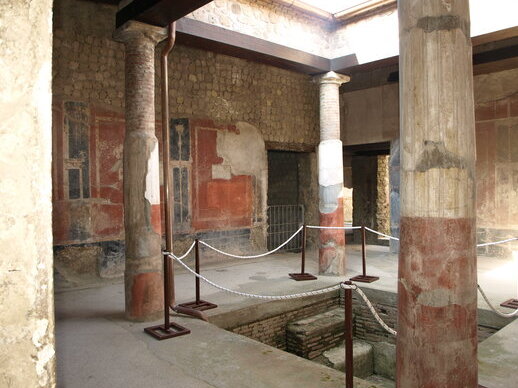
The villa, which takes its name from a painting depicting abandoned Ariadne, was initially excavated in the Bourbon Age, in the second half of the 18th century, by Carlo Weber. The overall appearance can now be reconstructed by integrating the Bourbon plans of the excavated and t...

Archaeological excavations of Stabiae : Villa Ariadne — Castellammare di Stabia, Italy.

Location
Castellammare di Stabia
Type
Historical Sites
Opening hours
Weather now
↗ Directions

About Archaeological excavations of Stabiae : Villa Ariadne

Archaeological excavations of Stabiae : Villa Ariadne - Castellammare di Stabia | Secret World Trip Planner

The villa, which takes its name from a painting depicting abandoned Ariadne, was initially excavated in the Bourbon Age, in the second half of the 18th century, by Carlo Weber. The overall appearance can now be reconstructed by integrating the Bourbon plans of the excavated and then buried areas with those of the parts brought to light. The most consistent nucleus includes the sequence of the entrance, the square peristyle and the atrium according to the Vitruvian succession typical of suburban residences. The residential structure dates back in its original nucleus to the late Republican period, but was later enlarged, with the addition of a series of panoramic rooms, during the first century AD. In the archaeological area it is possible to identify the thermal district, with praefurnium and calidarium (for hot water baths) apsidal, originally decorated in opus sectile. Among the visible frescos there are the painting of Ariadne abandoned in Naxos, on the back wall of the wide triclinium; Ganymede kidnapped by the eagle, in the annexed vestibule, Perseus and Andromeda, in an adjoining room. Along the portico, on which the summer triclinium opens, there are residential rooms, some of them enriched by wall decorations with white and yellow background. A little further on is the wide peristyle, which extends for a total length of 370 metres and repeats the canon indicated by Vitruvius. On the opposite side there is the republican nucleus of the villa: in it cubicles with valuable mosaic decorations are articulated around the atrium-peristyle canonical axis, typical of the Vesuvian residences of the first century BC.

Archaeological excavations of Stabiae : Villa Ariadne - Castellammare di Stabia | Secret World Trip Planner
✦ Secret World · suggested day

A perfect day in Castellammare di Stabia

Start with Archaeological excavations of Stabiae : Villa Ariadne, then continue with nearby places selected by Secret World.

  1. 01
    Morning
    Archaeological excavations of Stabiae : Villa Ariadne
    📍 Castellammare di Stabia
    Start here
  2. 02
    Afternoon
    📍 0 km away
  3. 03
    Evening
    📍 0.5 km away

Collect this place

Turn places you discover into stamps in your Secret Passport.

Open Secret Passport →

Keep exploring · Castellammare di Stabia

Frequently Asked Questions

The villa takes its name from a famous fresco depicting the abandoned Ariadne on Naxos, which decorates the back wall of the wide triclinium. This mythological painting is one of the most significant artworks visible in the villa today and gives the entire residence its distinctive name.
Villa Ariadne was initially excavated during the Bourbon Age in the second half of the 18th century by Carlo Weber, a pioneering archaeologist. The original excavations were later filled in, but modern archaeologists have reconstructed the villa's layout by combining Bourbon-era plans with newly discovered sections.
Key features include the entrance sequence, square peristyle, and atrium arranged according to Vitruvian principles typical of Roman suburban villas. Notable rooms include the wide triclinium with the Ariadne fresco, a thermal district with hot water baths decorated in opus sectile, a summer triclinium, and residential cubicles featuring white and yellow wall decorations and valuable mosaic floors.
The villa showcases three significant mythological frescoes: the painting of abandoned Ariadne in the triclinium, Ganymede kidnapped by the eagle in an annexed vestibule, and Perseus and Andromeda in an adjoining room. These well-preserved artworks provide insight into the refined cultural tastes of Roman villa owners during the first century AD.
The villa's original nucleus dates back to the late Republican period, making it quite ancient, but it was significantly enlarged during the first century AD with the addition of panoramic rooms and luxurious decorations. This development reflects the property's evolution from a Republican-era residence into an elaborate imperial-period villa showcasing Roman architectural sophistication.

Experiences nearby · Castellammare di Stabia

Powered by Viator

See more on Viator.com

Secret World Hidden places, real stories — plan your trip
Get the app
