
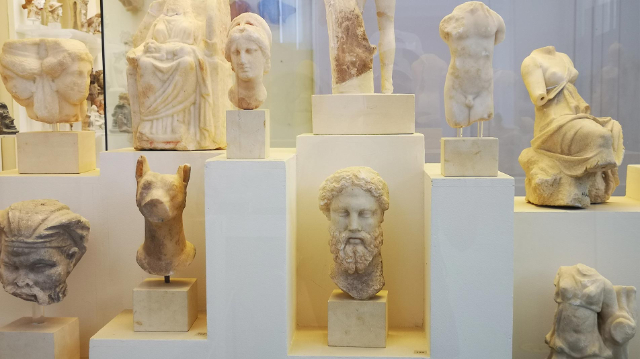

The Archaeological Museum of Mykonos was erected in 1902. The Museum was set up primarily to preserve the vestiges recovered from the Purification Pit which dates back to 426-425 B.C. This pit was unearthed in the year 1898 by renowned scholar D. Stavropoulos from the picturesque islet of Rheneia. The museum's elegant architectural feature was designed by the renowned architect, Alexandros Lykakis. The idea of the construction of the building which houses the museum was born by the Ministry of Education in collaboration with the Archaeological Society of Athens. The collection of vases belonging to the Hellenistic period are also noteworthy by their presence. One of the museum's principal attractions is the rather artistically done up pithos skillfully depicting the scenes from the Capture of Troy. This remarkable pithos was unearthed in the year 1961 while diggers were digging a well in Mykonos.
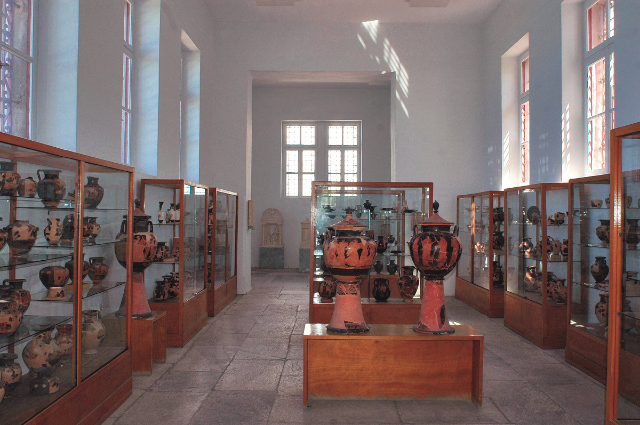
The pithos artistically portray the fall of the Trojan army from the quintessential Wooden Horse. The body of the pithos is enclosed with panels depicting soldiers going on an offensive against innocent women and children. Scholars believe the pithos is dated back to the 7th century BC. There is also the massive Archaic amphora that is conspicuous with intricately designed embellishment. Of particular significance is a statue with a sphinx on the neck and a horse's head on the body.
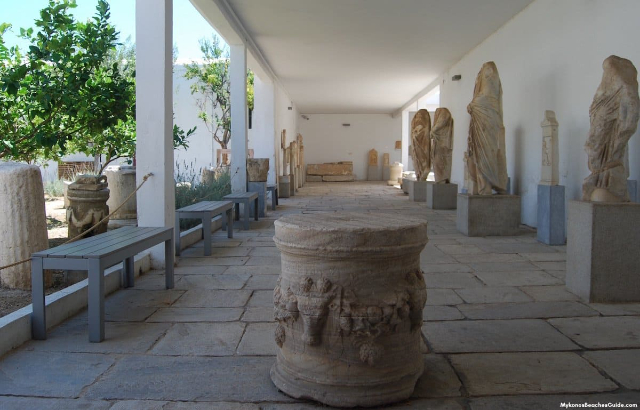
The Grave stele of Glykon too is conspicuous by its presence which was incidentally discovered in the sea. The victim is seen seated on the rocks, in a poignant and thoughtful mood staring blankly in the direction of the ship's prow. On the pedestal there is an inscription with these words Glykon, son of Protogenis, virtuous, fare thee well. This grave stele is one of the priceless collections of the museum.

Apart from Glykon's Grave stele, there is also the Grave stele of Tertia Horaria. The deceased woman is seen seated and extending her parting hand to her husband who is positioned right in front. There is also an image of a slave child with the jewelry container of her deceased lady. This grave stele was positioned on top of a marble sarcophagus with the inscription Tertia Horaria written on it at the renowned Hellenistic cemetery located in Rheneia. It is believed to belong to the 2nd century BC.
There is also the statue of Heracles from Rheneia. This priceless statue was found in 1899 inside safe heaven of Heracles. The brave man is depicted nude and holds a club and a lion skin in his left hand. This exquisite statue is made of the finest variety of Parian marble and is believed to belong to the 2nd century. The quintessential Cycladic frying-pan with its intricate adornment which is inclusive of female genitalia on the lower portion was unearthed from a Mykonos grave and is believed to belong to the early Cycladic era.
One of the museums best-known artifacts is the Archaic Hydria which is embellished with intricately designed floral pattern and images of horses. It is just one among the many vases that were unearthed from the Purification Pit. The marvelous red-figure hydria too is well worth a look and is conspicuous by the stature of a flying Nike. A deer is seen scampering towards the left-hand side.
Ancient Greek civilization was known to use clay for giving shape to artistic figures. The Archaeological Museum of Mykonos has on display a superb Clay figurine of a beautiful woman who is depicted as wearing the traditional chiton and himation. This rare clay figurine was discovered at Rheneia and dates back to the 2nd century. Also conspicuous by its presence is the statue of a dead man wearing the traditional dress. Like the Clay figurine of the beautiful woman, this statue of the dead man too was unearthed from the locality of Hellenistic Rheneia.


