
← Back

Basilica Santa Margherita - Cortona

piazzale Santa Margherita, 1, 52044 Cortona AR, Italia ★★★★☆ 283 views
Rossella Milone
Cortona
🏆 AI Trip Planner 2026

Get the free app

Discover the best of Cortona with Secret World — the AI trip planner with 1M+ destinations. Get personalized itineraries, hidden gems and local tips. Free on iOS & Android.

🧠 AI Itineraries 🎒 Trip Toolkit 🎮 KnowWhere Game 🎧 Audio Guides 📹 Videos
Scan to download iOS / Android
Scan for AppGallery Huawei users

About Basilica Santa Margherita - Cortona

Basilica Santa Margherita - Cortona - Cortona | Secret World Trip Planner

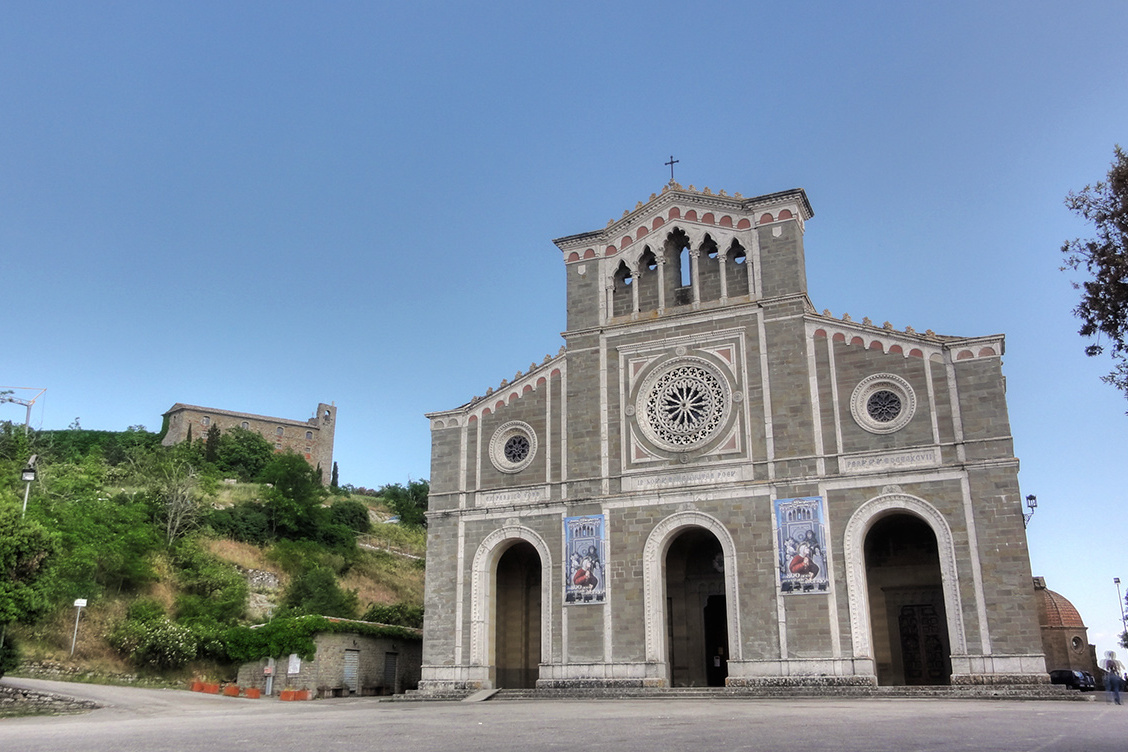
The church rises at the top of the hill in an enchanting position. On the site of the present church there was a small church built by the Camaldolese monks in the 11th century and dedicated to St. Basil. The church was damaged during the Sack of Cortona in 1258 and rebuilt in 1288 by Santa Margherita and dedicated to St. Basil, St. Egidio monk and St. Catherine of Alexandria. Santa Margherita, in a room at the back of this church lived the last years of her life and died there in 1297. She was buried in the church of St. Basil. Immediately after the death of Margherita, the people of Cortona, next to the church, built a larger church designed by Giovanni Pisano and in 1330 they moved the body of the Saint. Of the fourteenth-century building remain only the rose window on the facade, the bell tower and the outer walls of the choir. Throughout the fourteenth century the church continued to be embellished with important frescoes. Only a few fragments of this mural cycle have come down to us, preserved in the Diocesan Museum, but there is evidence of it in a 17th century codex that documents with twenty-one watercolour scenes the mural paintings lost in 1653 when, due to their poor state of preservation, they were faded out. Analysis of the surviving fragments leads us to date them to around 1335 and attribute them to the workshop of one or both of the Lorenzetti brothers. In 1385 the church was entrusted to the Olivetan monks, who were replaced in 1389 by the Minor Observants who still take care of it and welcome visitors. The church underwent successive transformations in modern times, of which the seventeenth-century altars remain, but the most important transformation, although it has completely disappeared, was the one ordered in the mid-1800s by John V, King of Portugal, who had received a grace from the Saint. The present church is instead the result of the 19th century reconstruction, entrusted first to the architect Enrico Presenti, who replaced the original single-nave plan with a basilica structure, then to the architect Mariano Falcini, who finished the sacred building without satisfying the Cortonese. Therefore, in 1896 the architect Giuseppe Castellucci was commissioned to redo the façade, which bears the fourteenth-century rose window of the ancient demolished church. In August 1927, it was elevated to the dignity of a minor basilica. In the chapel of the left transept there is the fourteenth-century marble sepulchral monument of Saint Margherita; the venerated remains rest in the silver urn (1646) on the high altar.

Basilica Santa Margherita - Cortona - Cortona | Secret World Trip Planner
🗺 AI Trip Planner

Plan your visit to Cortona

Suggested itinerary near Basilica Santa Margherita - Cortona

MAJ+
500.000+ travelers worldwide
  1. 🌅
    Morning
    Basilica Santa Margherita - Cortona
    📍 Cortona
  2. ☀️
    Afternoon
    Basilica of Santa Margherita in Cortona
    📍 0 km · Cortona
  3. 🌆
    Evening
    The Monumental Church of San Niccolò is a very small church located in the heart of the city.
    📍 0.2 km · Cortona

Buy Unique Travel Experiences

Powered by Viator

See more on Viator.com

Explore nearby · Cortona

Frequently Asked Questions

Santa Margherita was a saint who lived in a room at the back of the original church and spent her final years there, dying in 1297. After her death, the people of Cortona built a larger basilica next to the original church to honor her, and her body was moved there in 1330, making it one of the most important pilgrimage sites in the region.
The 14th-century rose window on the facade, the bell tower, and the outer walls of the choir remain from Giovanni Pisano's original design. These historic elements offer a glimpse into the medieval architecture that has been preserved through centuries of renovations and transformations.
The church was embellished with important frescoes throughout the 14th century, attributed to the workshop of the Lorenzetti brothers and dating around 1335. Most were lost in 1653 due to poor preservation, but surviving fragments are housed in the Diocesan Museum, and a 17th-century codex documents 21 watercolor scenes of the lost murals.
The Minor Observants (Franciscan friars) have been responsible for the church since 1389 and continue to maintain it and welcome visitors today. They provide an authentic spiritual atmosphere and can offer insights into the church's history and significance.
King John V of Portugal ordered significant transformations to the church in the mid-1800s after receiving what he believed was a grace or blessing from Santa Margherita. This royal patronage demonstrates the saint's widespread veneration beyond Italy and resulted in major architectural changes, though most of these modifications have since disappeared.
