
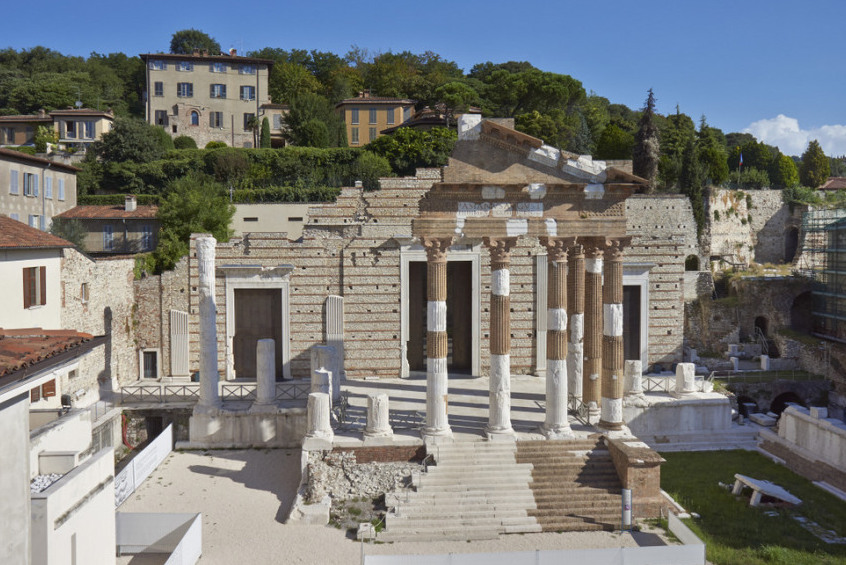

In the historical heart of Brescia there are substantial archaeological remains of monumental buildings in the Capitoline area of the ancient city. In Roman times Brescia - Brixia - was in fact one of the most important cities in northern Italy, situated along the so-called Via Gallica (an artery that connected some of the most significant centres of Celtic origin north of the Po), at the mouth of the Alpine valleys of ancient settlement (the Camonica Valley and the Trompia Valley), between Lake Iseo and Lake Garda, and immediately north of a fertile and extensive plain area, enhanced from the Augustan age with impressive agricultural organization works (centuriazioni). In the archaeological area located in the center of the urban fabric are still visible the oldest and most significant buildings of the city: the Sanctuary of the Republican age (first century BC), the Capitolium (73 AD), the Theatre (I-III century AD), the section of the pavement of the decumanus maximus, on which stands today Via dei Musei. The area also opens onto today's Piazza del Foro, which preserves vestiges of the Roman age square (1st century A.D.). Archaeological remains (forum and thermal baths; basilica) can also be visited under Palazzo Martinengo, today the seat of the Province. In addition to these buildings of Roman times, the area also includes noble palaces of medieval, Renaissance and modern times, which "climb" directly from the ancient ruins (Palazzo Maggi Gambara and Casa Pallaveri, both owned by the municipality). In this well-circumscribed area of the city one can therefore read an uninterrupted stratigraphy of evidence extending from the 2nd century B.C. to the 19th century. In 1830, following excavations undertaken in this area, the Capitolium was the site of the Museo Patrio, the first city museum to inaugurate the museum vocation of this area. Since 1998, an organic project for the recovery of the Capitolium archaeological site has been underway. It consists in the deepening of the knowledge about the area in its complete archaeological and architectural recovery, in its valorization and in the complete and definitive opening to public fruition. This opening, as well as giving back to the public the most important urban portion of the city of ancient times, is the completion of the museum itineraries of the City Museum, set up in the nearby monumental complex of Santa Giulia, and of one of the most significant and best preserved archaeological itineraries in Italy, recognized as a World Heritage Site by UNESCO with the site The Lombards in Italy. The places of power (568-774 A.D.).


