
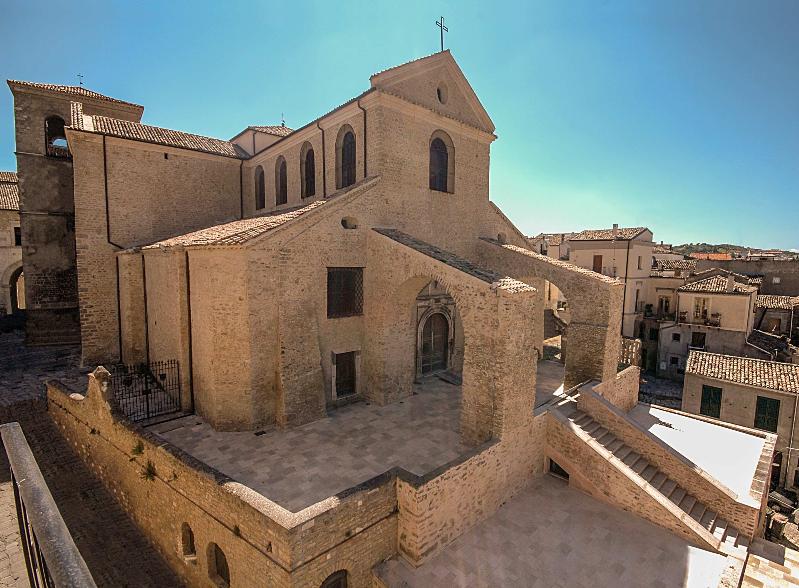

Its primitive Romanesque structures, similar to those of Aderenza and Venosa, were obliterated by a series of Baroque renovations by bishops Settimio de Robertis (1609-1611), Pier Luigi Carafa senior in 1638 and his nephew Pier Luigi Carafa jr. after the plague of 1657. It took on its present architectural and decorative appearance with the work commissioned by Bishop Antonio del Plato and carried out between 1774 and 1777, by Neapolitan workers led by the royal engineer Carlo Brancolino and the architect Domenico Sannazzaro, who took care of the stucco work. In the 1st millennium of the diocese (1968), Bishop Bruno Maria Pelaia endowed it with a bronze door with a commemorative epigraph Convent of St. Anthony of Padua. It was Gerolamo Sanseverino, prince of Bisignano and count of Tricarico, who on September 27, 1479 obtained from Sixtus IV the faculty to erect outside the walls of the town, this convent of the Friars Minor of the Observance, one of the first five in Basilicata. Completed in 1491 with contributions from the Tricaricese community and from the prince himself, it was for centuries a center of the most genuine Franciscan spirituality and of apostolate in the missions, as attested by Father Michelangelo Pacelli of Tricarico, among the first missionaries to Ethiopia, about whom he wrote a work (1797). Endowed with a good library, he had important study for theology. Some of his friars, of more popular extraction, distinguished themselves in the field of crafts and art, with works still usable today in the convent. In its church existed the tomb of the Albanian nobles Giovanni Mattes, his wife Porfida Mosaccia Scanderberg and their son, captain of 300 Albanian stradiots, in the service of the Sanseverino family (1576). After abandonment in the late 1800s, it was entrusted by the municipal administration to Bishop Raphael delle Nocche and was formed into the Mother House of the Disciples of Eucharistic Jesus (1923) and the "Pia Opera di S. Antonio" home for the poor and elderly, founded in 1926 by priest Fr. Pancrazio Toscano.


