
← Back

Church and Cloister of Sant'Orso

Via Sant'Orso, 14, 11100 Aosta AO, Italia ★★★★☆ 160 views
Belen Martinez
Aosta
🏆 AI Trip Planner 2026

Get the free app

Discover the best of Aosta with Secret World — the AI trip planner with 1M+ destinations. Get personalized itineraries, hidden gems and local tips. Free on iOS & Android.

🧠 AI Itineraries 🎒 Trip Toolkit 🎮 KnowWhere Game 🎧 Audio Guides 📹 Videos
Scan to download iOS / Android
Scan for AppGallery Huawei users

About Church and Cloister of Sant'Orso

Church and Cloister of Sant'Orso - Aosta | Secret World Trip Planner

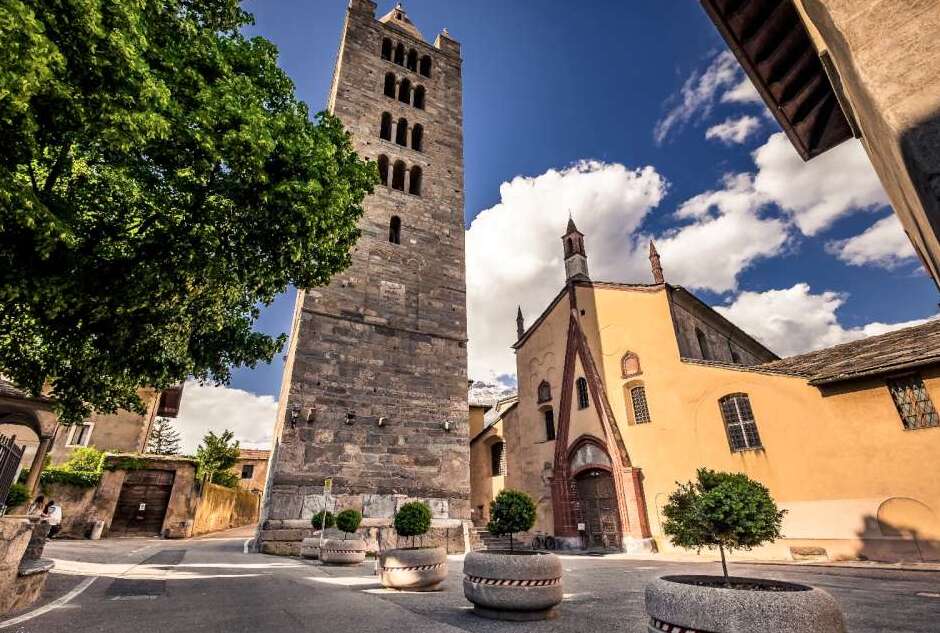
The monumental complex of Sant'Orso is located in an area once occupied by a necropolis outside the Roman walls. During the 5th century, in the immediate vicinity, the early Christian Basilica of San Lorenzo was built, consisting of an apsidal hall that was the destination of privileged burials. Because of fires and floods that destroyed San Lorenzo and Sant'Orso, the latter church was rebuilt and enlarged in the ninth century, becoming the most important of the complex. It was Bishop Anselm at the beginning of the 11th century who promoted a building campaign in the Romanesque style. The cloister is the real jewel of the monumental complex of Sant'Orso, which is accessed through an open hallway on the right of the facade. The primitive Romanesque structure almost certainly dates back to 1132 and was the work of Provençal or Lombard masters; when the bull of Pope Innocent II imposed the rule of Saint Augustine on the canons of Sant'Orso, the cloister already existed, as is shown by an inscription above a capital. The capitals, sculpted in marble but already covered in dark varnish in ancient times, complete simple and paired columns of different shapes and admirably depict symbolic scenes from the New and Old Testament, from the life of Saint Ursus, fantastic characters and animals or contain various decorative elements. They are considered among the highest expressions of Romanesque religious sculpture. The important cycle of Ottonian frescoes which can be visited in the attic also dates back to this period: one of the best preserved examples in Europe of the pictorial art of the 11th century, together with the frescoes of Aosta Cathedral, they depict the Stories of the Life of Christ interspersed with decorative elements. These pictorial testimonies have been fortunately preserved until today "hidden" in the attic thanks to a construction intervention commissioned by Prior Giorgio di Challant in late Gothic style. Next to the church you can admire the Priory, a building built at the behest of Giorgio di Challant and characterized by terracotta tiles that recall the Issogne castle and the interventions wanted by the prior himself for that family residence. On the first floor of the building you can visit the private chapel of Giorgio di Challant, enlightened patron of the period.

🗺 AI Trip Planner

Plan your visit to Aosta

Suggested itinerary near Church and Cloister of Sant'Orso

MAJ+
500.000+ travelers worldwide
  1. 🌅
    Morning
    Church and Cloister of Sant'Orso
    📍 Aosta
  2. ☀️
    Afternoon
    Museum of the Cathedral Treasury
    📍 0.6 km · Aosta
  3. 🌆
    Evening
    Pautasso Collection
    📍 0.7 km · Aosta

Buy Unique Travel Experiences

Powered by Viator

See more on Viator.com

Explore nearby · Aosta

Frequently Asked Questions

The cloister is the real jewel of the Sant'Orso complex, dating back to 1132 and featuring stunning marble capitals sculpted by Provençal or Lombard masters. These capitals depict symbolic scenes from the Bible, the life of Saint Ursus, and fantastic characters, representing some of the highest expressions of Romanesque religious sculpture.
The important cycle of Ottonian frescoes is located in the attic of the church and dates back to the 11th century, making it one of the best preserved examples of this pictorial art in Europe. The frescoes depict the Stories of the Life of Christ interspersed with decorative elements and were preserved by being hidden during a late Gothic construction intervention commissioned by Prior Giorgio di Challant.
The cloister is accessed through an open hallway located on the right side of the church's facade. This direct access makes it easy for visitors to explore this magnificent Romanesque structure and its sculptural details.
Sant'Orso is built on a site that was once a Roman necropolis and includes remnants of the early Christian Basilica of San Lorenzo from the 5th century. The current Sant'Orso church was rebuilt and enlarged in the ninth century to become the most important structure in the complex, with major Romanesque additions commissioned by Bishop Anselm in the early 11th century.
The capitals are sculpted masterpieces that depict a remarkable variety of subjects including biblical scenes, the life of Saint Ursus, fantastic creatures, and decorative elements, showcasing the highest level of Romanesque religious sculpture craftsmanship. Though they were already covered in dark varnish in ancient times, these intricate carvings paired with simple and varied columns create an exceptional artistic achievement.
