
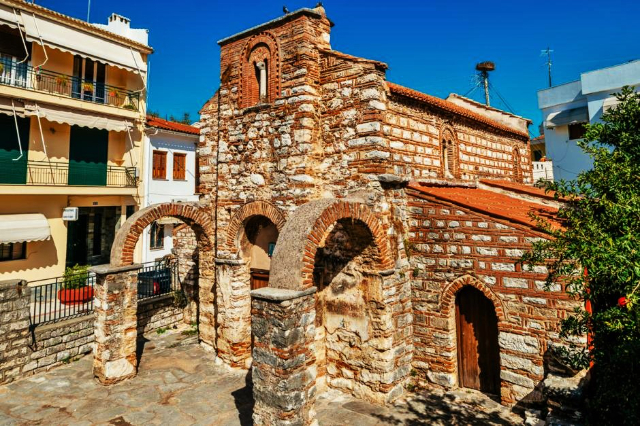

The Church of Saint Vassilios, or "tis agoras," is a historical gem located in Arta, Greece. Situated in the market district just north of Agia Theodora church, it has a rich history and architectural significance.
Dating back to the end of the 13th century, this church stands as a testament to Byzantine architecture. Originally a single-room, wooden-roofed basilica, it later saw extensions that transformed it into a three-part structure. The central section features a three-sided arch with a niche for the deaconry built into the wall's thickness. Architectural nuances like protruding east pediments and west walls, resembling other contemporary monuments of the era, are notable features.
The entrance to the church is from the west, allowing communication between the main church and its chapels. Externally, the masonry showcases intricate Byzantine cloisonné work, with rich ceramic decorations adorning the east and north sides. Glazed clay icons from the 14th century grace the east pediment, depicting scenes like the Crucifixion and the three Hierarchs.
While the sculptural adornments are limited, you can spot Corinthian capitals decorating the colonnades in the bifora windows on the far sides of the main temple. Additionally, a reused marble capital on the east side of the north chapel is embellished with a relief cross and thorn leaves, likely originating from an early Christian building in the area.
The interior of the church is adorned with a diverse iconographic program organized in four zones. The sanctuary's niche features depictions of Panagia Platytera, evangelical scenes, and symbolic representations. The church walls display various representations of saints, scenes from the Christological cycle, the Passion cycle, and episodes from the life of the Virgin Mary. The frescoes, dating to the 17th century, bear the marks of time but reveal a preference for naturalistic traits and realistic facial features, showcasing Western influences.
Today, the Church of Saint Vassilios "tis agoras" is not only a place of historical significance but also a cultural and artistic treasure, a testament to the enduring influence of Byzantine art and architecture in the region.


