
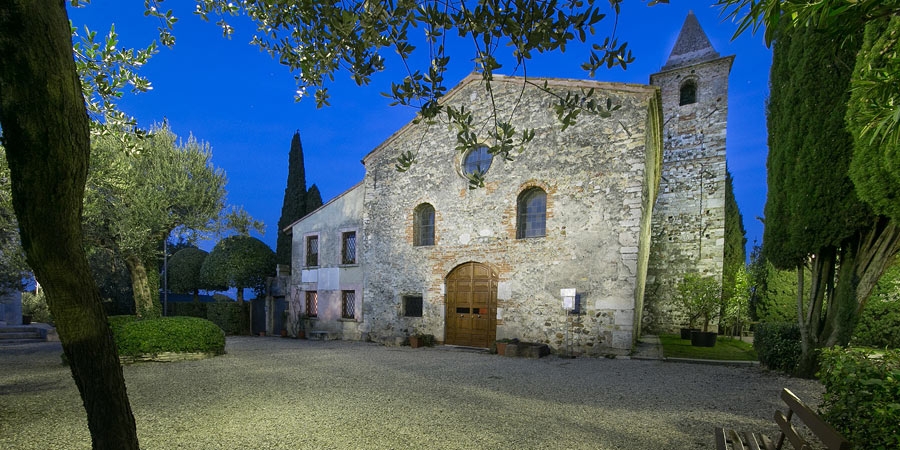

The church of San Pietro in Mavino, in Sirmione, has very ancient origins, according to tradition it was built by local fishermen. The first documents that mention the church of S. Pietro in Mavino date back to the eighth century, in a manuscript of 756.
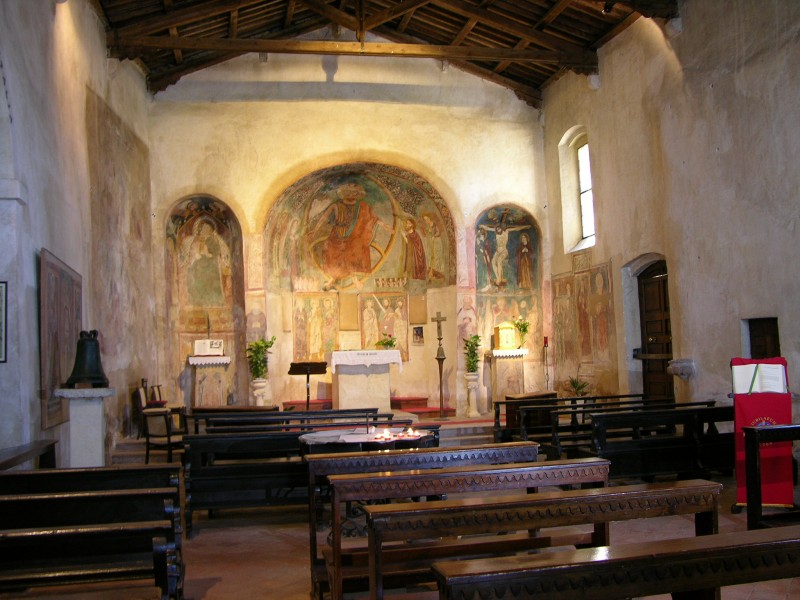
The building underwent several renovations, both in the Romanesque period, of which the bell tower dating back to 1070, and in 1300. Other interventions on the church occurred in the seventeenth and eighteenth centuries, when they were opened the two ogival windows of the facade and the door inserted on the longitudinal south.
The masonry texture of the building is composed of elements of various types: lake pebbles, ashlars just squared, bricks and bricks. In the upper parts of the masonry of the building it is possible to notice the remaking due to the restoration of the XIV century, with the raising of the roofs, intervention that probably determined also the occlusion of the windows.
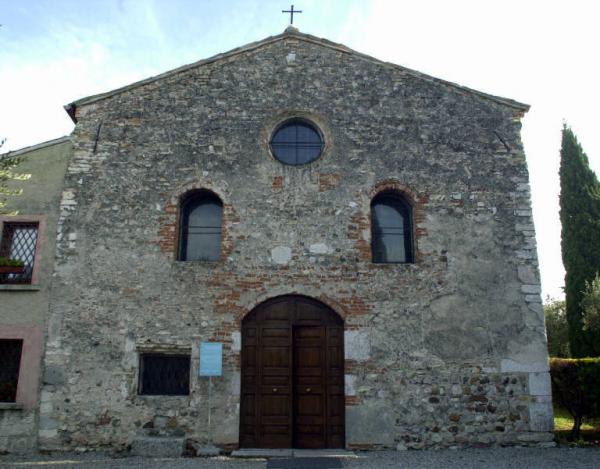
façadeThe façade is hut-shaped and presents a portal with a lowered arch of the XIV century, while the rose window situated in the center of the façade and the squared window on the left of the portal date back to the XV century.
Moreover, on the façade, it is possible to notice the insertion in the masonry of two elements in sculpted stone that refer to the pre-Romanesque period. bell tower The quadrangular bell tower is placed on the south side of the church and, according to historians, it results to have been probably realized in two building phases dating back to the XI century (1070), XII century and a third phase in the XIV century, when the double lancet windows were walled in and the new belfry was built.
exteriorThe church has a rectangular plan, with a single nave ending with three semicircular apses, of which the central one is larger than the others, animated by single-lancet windows with double splay and characterized by fragments of frescoes.
Inside you can admire the frescoes of the XII-XVI centuries.
On the wall to the left of the entrance it is possible to admire a detached fresco with a series of holy apostles, among which San Simone.
In the chapel dedicated to the fallen one can admire a fresco divided into three sections with St. Michael, who with his lance pierces a dragon or the devil, a saint with the palm of martyrdom in his hand who, under his left arm, holds a book and a nobleman identifiable as St. Rocco. fresco The hemicycle of the north apse is completely painted: there are depicted a Madonna with Child and figures of saints. In the central apse the decoration develops on two levels: in the upper one are painted the souls of the damned and those of the blessed praying with the Christ Pantocrator in mandorla, the Virgin and the Baptist and angels, while in the lower register there are six figures of saints inside frames, among which St. James and St. Paul.
frescoIn the south apse the frescoed wall is divided into two sectors, in which there is a depiction of a Crucifixion, with Mary and weeping women and a figure of a saint in prayer. In the remaining frescoes we recognize S. Antonio Abate, San Pietro, Maria Maddalena, a Madonna in trono con Bambino.
The church of S. Pietro is visible from the outside only on three sides, in fact the north side, enlarged with the addition of recent residential rooms, cannot be visited, as it remains inside a private property.


