
The stones are perfectly fitted, without mortar, and yet they have withstood centuries of earthquakes that have caused the colonial buildings built on top of them to collapse. Walking through the complex of Coricancha, in the heart of Cusco, one immediately understands why the Incas were considered unparalleled master builders: each block of andesite is cut with millimetric precision, the curved surfaces fit the foundations as if the stone had been hand-shaped. What you see today is a powerful stratification — the most sacred temple of the Inca empire literally supports the colonial church of Santo Domingo, built by the Spanish conquistadors after 1534.
The name Coricancha in Quechua means enclosure of gold, and the choice was not poetic but literal. Before the Spanish conquest, the inner walls of the temple were covered with sheets of solid gold, and inside were statues and precious objects that the Incas dedicated to the worship of Inti, the Sun god. According to Spanish historical chronicles, Francisco Pizarro and his men stripped the temple of all its gold to pay the ransom for Atahualpa in 1532-1533 — a treasure estimated in tons of precious metal that was melted down and shipped to Europe, forever erasing the original form of these works.
The history written in stones
The Coricancha was probably built during the reign of the Inca Pachacuti, the ninth Inca sovereign who ruled from around 1438 to 1471, the same one who initiated the construction of Machu Picchu and transformed Cusco into the capital of an empire that extended over four thousand kilometers along the Andes. The temple was the religious and cosmological center of the entire Tawantinsuyu, the empire of the four suyos: from here, the sacred lines called ceques departed, radiating towards the places of worship scattered throughout the territory.
After the conquest, the Dominican friars received the site in 1534 and began to build the church of Santo Domingo above and around the existing Inca structures. The earthquake of 1650 severely damaged the colonial part, while the Inca foundations remained almost intact — an architectural proof that visitors can still observe today in the places where the Spanish masonry has detached or crumbled, revealing the perfection of the pre-Columbian base.
What to observe during the visit
Upon entering the complex, the first thing that strikes is the visual contrast between the Inca stones — dark, smooth, perfectly aligned — and the more irregular and plastered colonial masonry. In the areas of the inner garden, it is possible to see the remains of what is believed to have been a ceremonial fountain, and some original trapezoidal niches in the walls, typical features of Inca architecture, still perfectly intact. The niches likely served to host idols and votive offerings.
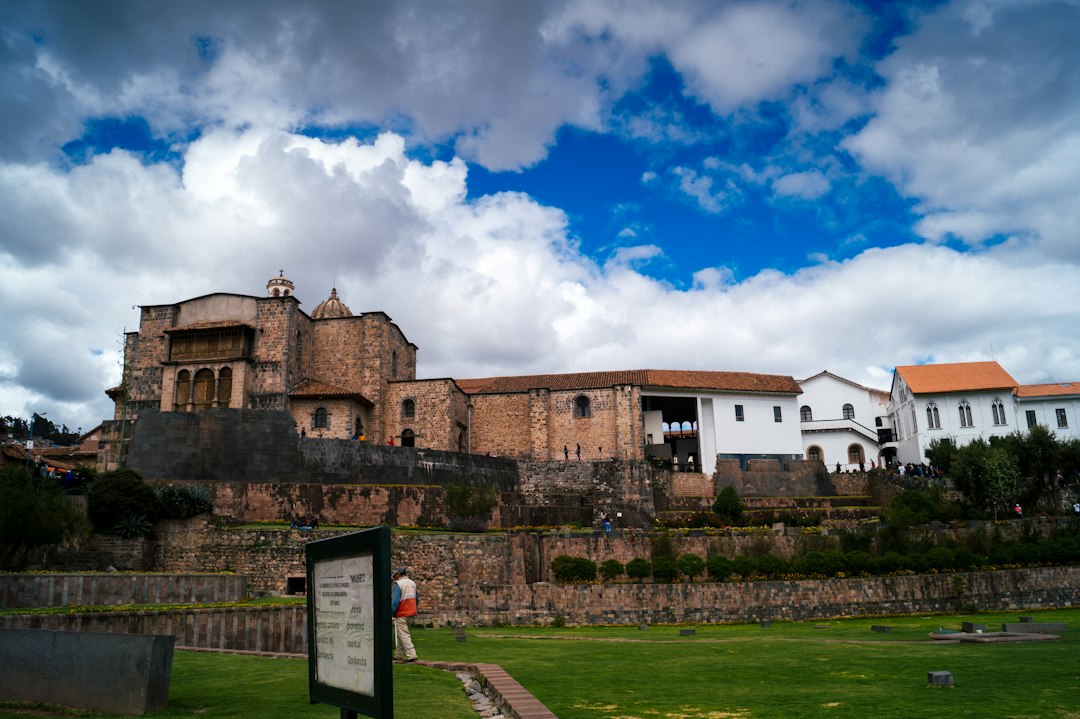
A detail worth looking for is the point where the curve of an Inca wall flows under the apse of the colonial church: it is one of the physical places where the overlap between the two worlds is most evident and almost dramatic. Some halls of the complex today house a small museum with ceramic artifacts and explanations of the Inca cosmological system, useful for contextualizing what one sees.
Practical Information for the Visit
The Coricancha is located in the historic center of Cusco, on Avenida El Sol, just a few minutes' walk from the Plaza de Armas. The entrance ticket to the museum of the complex is separate from the general city tourist ticket (boleto turístico), so it is advisable to check in advance what is included in your package. The indicative cost of a single ticket is around 15-20 Peruvian soles, but prices may vary.
The best time to visit is early in the morning, preferably just when it opens — around 8:30 — when organized groups have not yet invaded the spaces and natural light enters the courtyards in a particularly evocative way. Allow at least an hour and a half to visit the complex carefully, two hours if you want to linger in the internal museum. Avoid late afternoon, when tour operators bring numerous groups simultaneously and the spaces become crowded. The altitude of Cusco exceeds 3,400 meters above sea level: if you have just arrived in the city, take a day to acclimatize before walking around the streets.
Why the Journey is Worth It
Coricancha is not simply an archaeological site: it is a physical document of one of the most violent and transformative moments in American history. Every stone tells two overlapping stories — that of a people who had developed an extraordinary civilization, and that of a conquest that sought to erase its memory by building over it. The fact that the Inca foundations have endured while the colonial church has succumbed to earthquakes has something symbolically powerful about it, almost a silent revenge of stone over history.
For those traveling in Peru with an interest in pre-Columbian history, this site offers something that Machu Picchu, while extraordinary, cannot provide: the opportunity to be in the midst of a living city, in a neighborhood frequented by residents and tourists, and to touch — literally, where permitted — the boundary between two epochs of the world.