
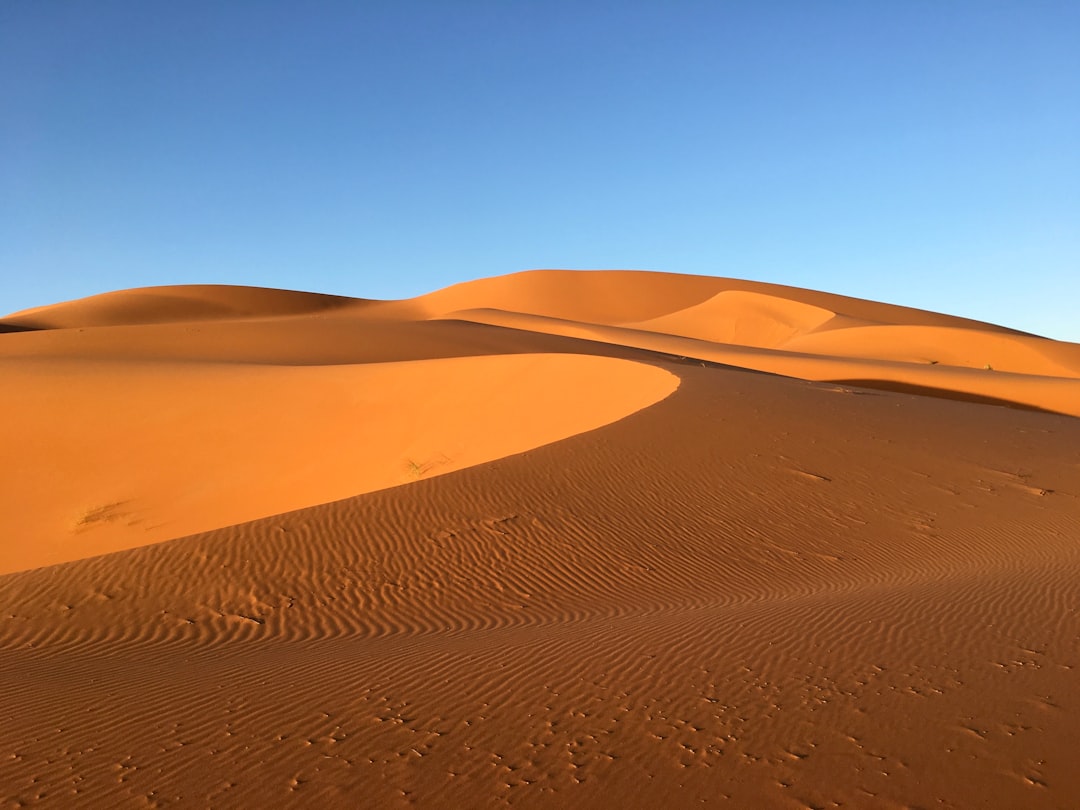

The silence comes first of all. When the engine of the off-road vehicle stops at the edge of Merzouga and feet are placed on the fine sand of Erg Chebbi, the Sahara desert presents itself with an almost physical quiet, as if the air itself had stopped moving. The dunes rise suddenly and almost incredibly before the eyes: walls of orange sand reaching 150 meters in height, among the tallest in Morocco, shaped by the wind into sharp crests that change shape every day.

Merzouga is a small village in the southeast of Morocco, near the Algerian border, in the Drâa-Tafilalet region. It is not a destination reached by chance: one arrives intentionally, traveling roads that cross hammada — the stony plains of the desert — until the sand takes over everything. Erg Chebbi extends for about 22 kilometers in length and 5-8 kilometers in width, a compact and spectacular sea of sand that surprises with its chromatic intensity, especially at sunset.
The dunes at sunset: light and color

The best time to observe the Erg Chebbi is in the last two hours before sunset. The slanting light of the sun transforms the sand into something almost unreal: the dunes turn to gold, then burnt orange, then brick red, while the shadows cast by the crests draw precise geometries on the sides of the sandy walls. Each dune has one face exposed to the light and one in deep shadow, and the contrast between the two creates a three-dimensionality that photographs struggle to capture.
Climbing on foot to one of the main dunes requires effort — the sand gives way under each step and one moves at half the normal speed — but from the top, a panoramic view opens up over the entire dune field and, on clear days, over the Anti-Atlas mountains on the horizon. It is one of those landscapes where one realizes how small one's physical presence is compared to the surrounding environment.

The camel and the camp in the desert
Most visitors choose to cross a part of the erg on the back of a camel — the dromedary, to be precise, the one-humped animal typical of North Africa. The ride to the tent camp generally lasts about an hour and often takes place at sunset, so as to arrive at the camp when the sky begins to color. The swaying gait of the camel and the soft sound of its steps on the sand contribute to creating a sense of slowness and distance from the ordinary world.
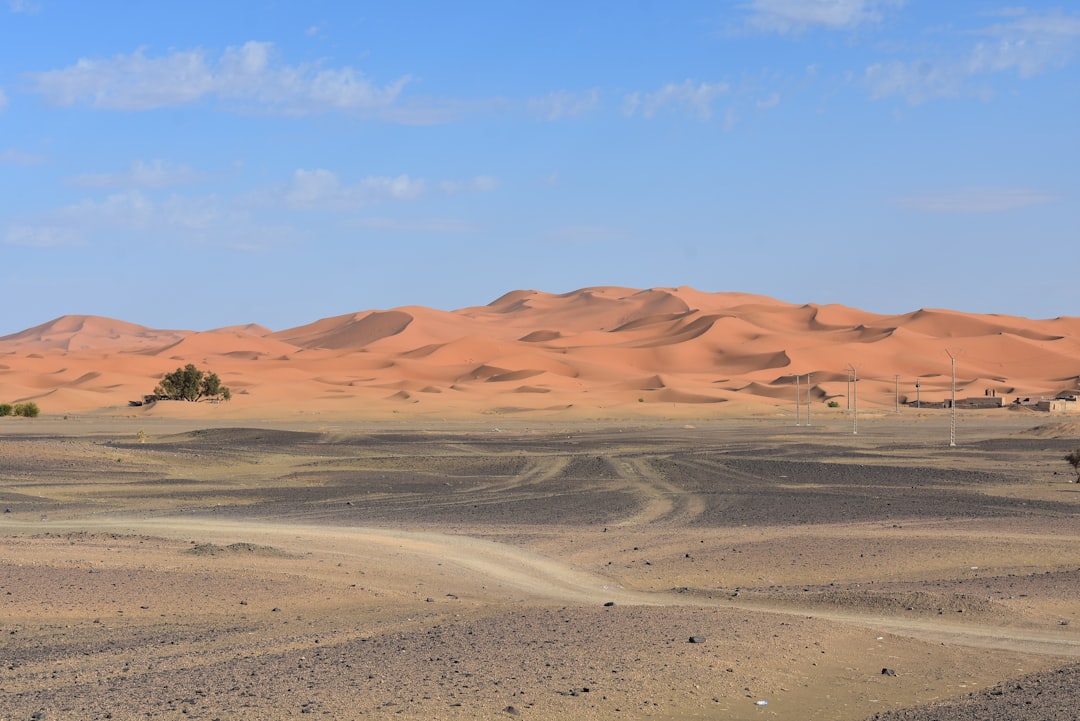
Desert camps vary greatly in quality and price: there are simple options with traditional Berber tents up to luxury structures with real beds, private bathrooms, and elaborate decorations. Even in the most basic versions, the central experience remains the same: dinner around a fire, Berber music played with percussion instruments, and then the night. The sky of Erg Chebbi, far from any light pollution, is one of the most starry that can be seen. The Milky Way appears as a concrete band of light, not as an abstract idea.
How to get there and when to go

Merzouga is typically reached from Errachidia or Ouarzazate, both connected by paved roads that can be traveled by car or by regular buses. From Marrakech, the distance is about 560 kilometers, a journey of about seven or eight hours by car that many take through the Tichka Pass and the Dadès Valley. There is no nearby airport: the closest airport is in Errachidia, with limited flights.
The best time to visit Erg Chebbi is from October to April, when daytime temperatures are bearable, between 20 and 30 degrees. In summer, the thermometer regularly exceeds 45 degrees, making any outdoor activity exhausting and potentially dangerous. Winter nights, between December and February, can be cold — even below zero — so it is useful to bring a heavy layer for the overnight camp.
Practical tips for the visit
Anyone sleeping in the desert must know that sand gets everywhere: in the suitcase, in the shoes, in the camera. Bringing a waterproof case for electronic devices is a sensible precaution. Sneakers are fine for walking on the dunes, but many prefer to take them off completely — the sand is fine and the feeling of being barefoot is part of the experience.
An essential practical tip: negotiate the price of the camel and the camp before leaving, preferably through the hotel or riad where you are staying in Merzouga. Prices vary greatly and having a written agreement avoids misunderstandings. For one night in the camp with dinner, breakfast, and camel transfer, prices typically range between 40 and 150 euros per person depending on the level of comfort chosen.


