


At the first light of dawn, the dunes of Erg Chebbi transform into a palette of burnt red, ochre, and ancient gold. The night wind has reshaped the profiles of the crests, erasing every footprint, and the silence is so total that one can hear their own breath. We are in Merzouga, a small village in the southeast of Morocco, about 340 kilometers from Ouarzazate, on the eastern edge of the Algerian Sahara. Here lies one of the most spectacular dune fields in all of North Africa.
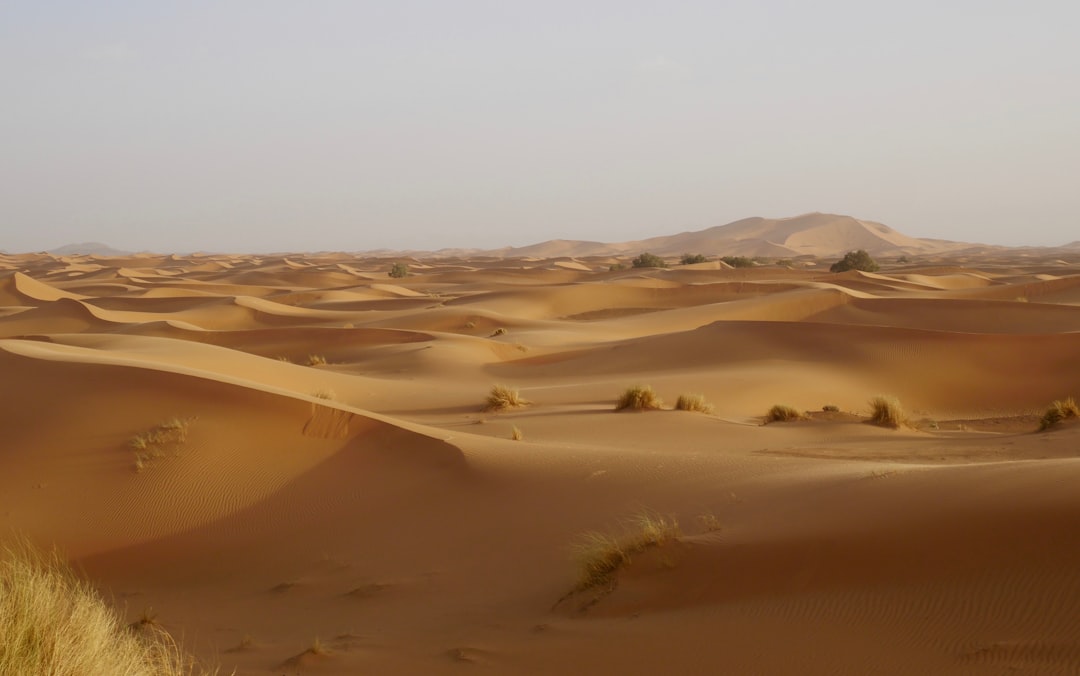
Erg Chebbi is a sea of sand that covers an area of about 22 kilometers in length and 5 in width, with dunes reaching 150 meters in height. These are not gentle hills: they are vertical walls of fine sand, shaped by the Saharan wind into forms that resemble ocean waves frozen in time. The sand here has a particular hue, almost rusty, which reacts differently to light at various times of the day, creating scenes that change completely within a few hours.
The colors of the dunes at different times of the day

At dawn, when the sun rises from the direction of Algeria, the dunes take on a deep orange hue on the exposed side and a cool gray-purple on the shaded side. The contrast is sharp, almost unreal, and lasts only twenty or thirty minutes before the light evens out. This is the most photographed moment, and for a specific reason: the low angle of the sun highlights every single crack in the sand, every slight undulation, creating a visual texture impossible to replicate during the central hours of the day.
At noon, under the vertical sun of the desert, the sand becomes almost white and blinding. Shadows disappear, the dunes lose depth, and the landscape visually flattens. It is the least interesting moment from a photographic point of view, but also the hottest: summer temperatures can exceed 45 degrees Celsius. At sunset, however, the cycle reverses: the same dunes that were illuminated from the east in the morning become dark silhouettes against a sky shifting from orange to purple, while the sand on the western side glows with a nearly purple-red hue. The color sequence of the sunset lasts longer than that of dawn and offers a softer light, ideal for those who simply want to sit atop a dune and watch.

The experience of the Berber camp and the night sky
Many visitors choose to spend at least one night in one of the Berber camps set up among the dunes. These are temporary structures with fabric tents, some very simple, others equipped with beds, carpets, and gas lamps. The difference between the budget options and the more refined ones is significant in terms of comfort, but not in the night experience: the starry sky of Erg Chebbi is accessible to everyone in the same way.

Far from the light pollution of any urban center, the desert sky of Merzouga is one of the clearest in Morocco. The Milky Way is visible to the naked eye on moonless nights, and the density of stars is such that it can disorient those used to urban skies. Local Berber guides, many of whom belong to the Ait Atta community or other nomadic groups in the region, often accompany visitors explaining the constellations according to Saharan astronomical tradition.
The sunrise camel trek

The most common way to reach the highest dunes is on the back of a dromedary camel, following paths that start from the lodges on the outskirts of the village of Merzouga. A standard trek lasts about one and a half hours round trip and allows you to reach the top of one of the main dunes just as the sun rises. The camels are guided by local handlers on foot, and the slow pace of the animal perfectly matches the still landscape.
Those who prefer to walk can do so without problems, but it is important to know that climbing a fine sand dune is physically demanding: each step sinks, and the slope of the main crests is considerable. Wearing closed shoes is strongly recommended, as the sand during the central hours can reach very high surface temperatures.
Practical tips for visiting Erg Chebbi
The best time to visit Erg Chebbi is between October and April, when daytime temperatures range between 15 and 25 degrees. July and August are technically possible but discouraged due to the extreme heat. From Marrakech, the most common route goes through the Tizi n'Tichka Pass and Ouarzazate, with a drive of about 8-10 hours or regional flights to Errachidia, the nearest airport about 80 kilometers from Merzouga.
It is advisable to book the camp or lodge in advance during peak season, especially around European holidays. Bringing a scarf or a tagelmust, the traditional Tuareg headdress, is useful not only for photos but also to protect oneself from the sandy wind that can suddenly rise in the afternoon. Finally, leaving electronic devices in the tent overnight and moving a few hundred meters away from the camp is the simplest way to enjoy the absolute silence of the Sahara.


