


The silence comes before everything else. When the engine of the off-road vehicle stops at the edge of Merzouga, a village in the southeast of Morocco about 50 kilometers from Erfoud, what remains is an absence of sound so total that it seems physical. In front of you rise the dunes of the Erg Chebbi, a sea of sand that reaches heights of up to 150 meters and extends for about 22 kilometers in length and 5 in width. It is not a flat and monotonous expanse: it is a landscape in perpetual motion, shaped by the wind into sharp crests that change shape every day.

Merzouga is the privileged access point to this section of the Moroccan Sahara. The village itself is small, dusty, with a handful of guesthouses and riads built at the foot of the dunes. There is nothing monumental to see in the village, and this is exactly its strength: all the interest is focused outside, in the sand, in the sky, and in the time that flows differently when there is nothing on the horizon except other dunes.
The camel, the slowest and most just way
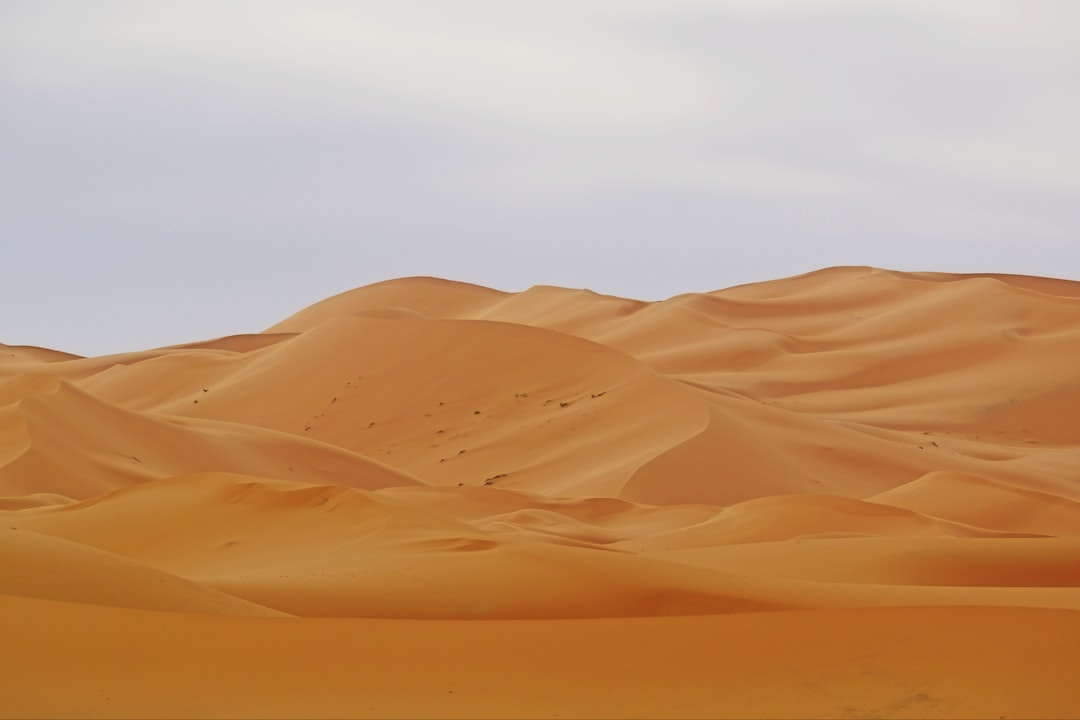
The ascent to the Berber fields in the heart of Erg Chebbi traditionally takes place on the back of a dromedary, the one-humped camel typical of North Africa. The journey lasts about an hour and a half, the time needed to move far enough away from the village to lose any urban reference. The dromedary's gait is undulating, almost hypnotic, and forces the body to slow down along with the mind. The Berber guides who lead the caravans know the routes by heart, orienting themselves on the crests of the dunes as if on invisible roads.
Along the way, one observes how the sand changes color with the light: burnt orange in the late afternoon, almost red at sunset, then gray and cold when the sun disappears. The temperature in the evening drops rapidly, even in summer, and at night it can reach values that surprise those who associate the desert only with heat. Bringing a warm layer is essential, not optional.

The Berber Camps and the Night Under the Stars
The Berber camps set up among the dunes vary greatly in quality and comfort: from simple tents with mattresses on the ground to more elaborate structures with private bathrooms and raised beds. What unites all the experiences is the dinner around the fire, often accompanied by music played with traditional instruments like the guembri, a three-string bass typical of the Gnawa culture of southern Morocco.

The night is the moment that makes the journey worthwhile. Far from any light pollution, the sky above Erg Chebbi displays the Milky Way to the naked eye with a clarity that is hard to describe to those who have never seen it in these conditions. The celestial dome appears so dense with stars that it seems three-dimensional. Waking up before dawn to climb to the crest of a nearby dune and watch the sunrise is an experience that many visitors describe as the most intense moment of their journey in Morocco.
How to Organize the Visit in a Concrete Way

The best time to visit Merzouga is from October to April, when daytime temperatures are manageable, between 20 and 30 degrees, and the nights are cool but not prohibitive. The summer months, from June to August, bring temperatures that regularly exceed 40 degrees during the day, making the camel trek a tiring and potentially risky experience.
To reach Merzouga, one usually departs from Marrakech, with a bus or shared taxi journey that lasts about 9-10 hours through the High Atlas mountains and the valleys of Draa and Ziz. Many travelers choose an organized three-day tour that includes transportation, one night in the desert, and the return trip, with prices typically ranging from 150 to 300 euros per person depending on the level of comfort. Those who prefer to move independently find guesthouses in Merzouga with very affordable prices and the possibility to organize the excursion directly on-site, often at lower costs compared to packages booked online.
What to bring and what to really expect
The sand of Erg Chebbi gets everywhere: in your shoes, in your bag, in your camera. Protecting photographic equipment with airtight bags is not an excess of precaution. A scarf or a wide shawl serves both to protect against the sun during the day and to cover your nose and mouth if the wind picks up. The highest dunes, those that exceed 100 meters, require real physical effort to be climbed on foot: the sand gives way with every step and you ascend slowly, but the view from the crest fully rewards the effort.
What no photograph can convey is the silence. Not the absence of noise, but something more active: a silent presence that the desert imposes and that, for those who spend even just one night there, leaves a lasting impression that is difficult to explain upon returning.


