
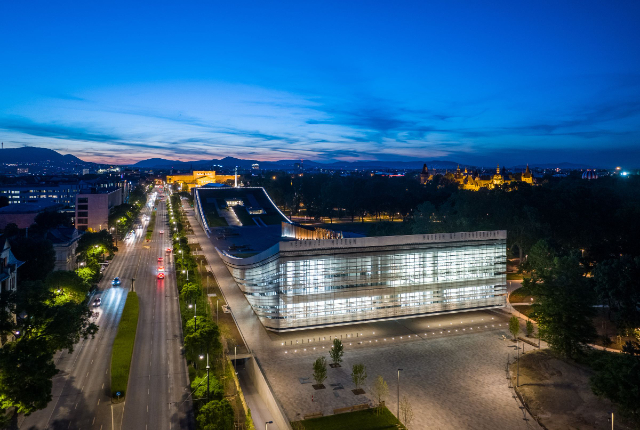

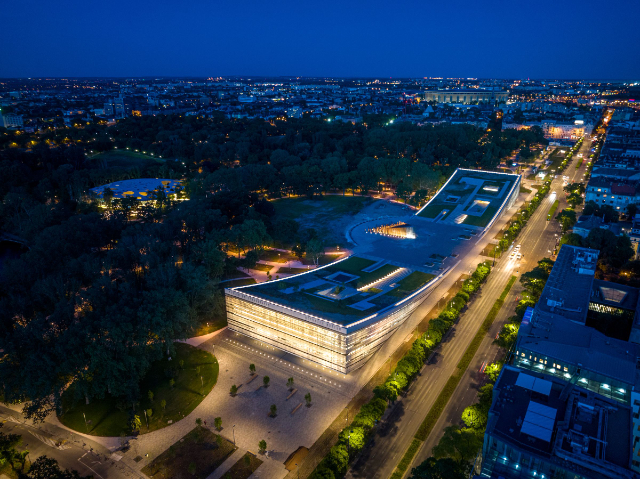
The new home of the Museum of Ethnography, realised as part of the Liget Budapest Project, opened its doors to the public on 23 May and welcomes visitors with its spectacular exhibitions. The building, designed by Marcel Ferencz (NAPUR Architect) is the first purpose-built facility with its concept tailored to the needs of an ethnographic museum. Now the City Park houses one of Europe’s most modern museum buildings, located on the site of the former Felvonulási Square, where a collection of unrivalled diversity is displayed on a floor space three times larger than in its previous venue on Kossuth Square. The spectacular building with its design evoking a pair of nearly embracing hillsides is distinguished by its unique facade decoration of almost half a million pixels presenting a contemporary adaptation of twenty Hungarian and twenty international ethnographic motifs, as well as by its more than seven-thousand-square-metre roof garden from the highest point of which a stunning panorama opens up. One of the most prestigious competitions of the international property business, the International Property Awards in London, the Museum of Ethnography was selected in 2018 as the world’s best public architecture based on its architectural design alone, and it was also recognised with the Best Architecture main prize.” The Ethnographic Museum in Budapest allows visitors to learn about Hungarian folklore and everyday life in Hungary from the end of the 18th century to the Second World War. The museum's exhibits come from Hungary, Slovakia and Romania. The museum has one permanent exhibition, besides, there are numerous temporary exhibitions on very diverse topics, as well as various educational events for children and young people.
The permanent exhibition of the Ethnographic Museum presents all aspects of the life of the inhabitants of the Pannonian Basin, both material and spiritual. Here we will see a model of the kitchen and church from the beginning of the 20th century. The exhibition allows visitors to familiarize themselves with the crafts and tools used by representatives of various professionals, such as blacksmithing, pottery and tailoring. In addition, the exhibition presents various rituals, customs and superstitions accompanied Hungary in everyday life and on special occasions such as weddings, baptisms and funerals.


