

The Feast of Lilies originates from the regained freedom of the Nola people taken hostage by the barbarians between 409 and 410 A.D. thanks to the intervention of Bishop Paulinus.
All the way, regarding the origins of the feast, there are different opinions, among which is the one that states that the feast of the originates from the transformation of a pagan ritual according to which large trees, adorned with various symbols, were carried in procession and had protective power, with the advent of Christianity these trees were stripped of their pagan significance, adding sacred images and saints.
The people of Nola remain well aware of the authentic roots of this festival, managing to preserve over time the joyful air of jubilation typical of the original feast, even today the festival is a time of faith and folklore at the same time.
Legend has it that in 431, the people of Nola welcomed Bishop Paulinus on his return with flowers, lilies, and that the faithful escorted him to the bishop's seat, accompanying him with the banners of the guilds of arts and crafts.
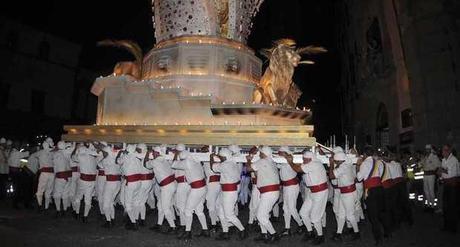
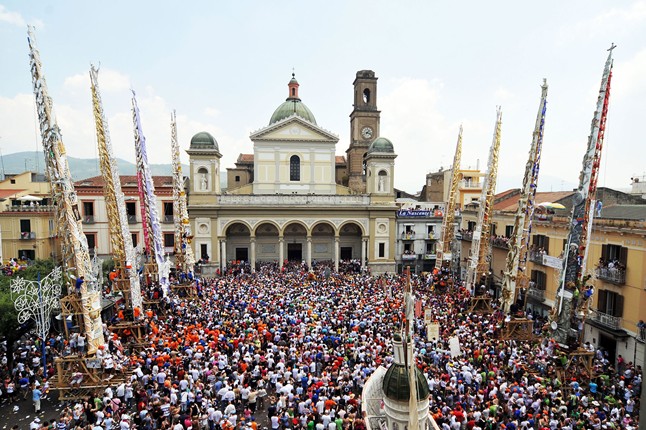
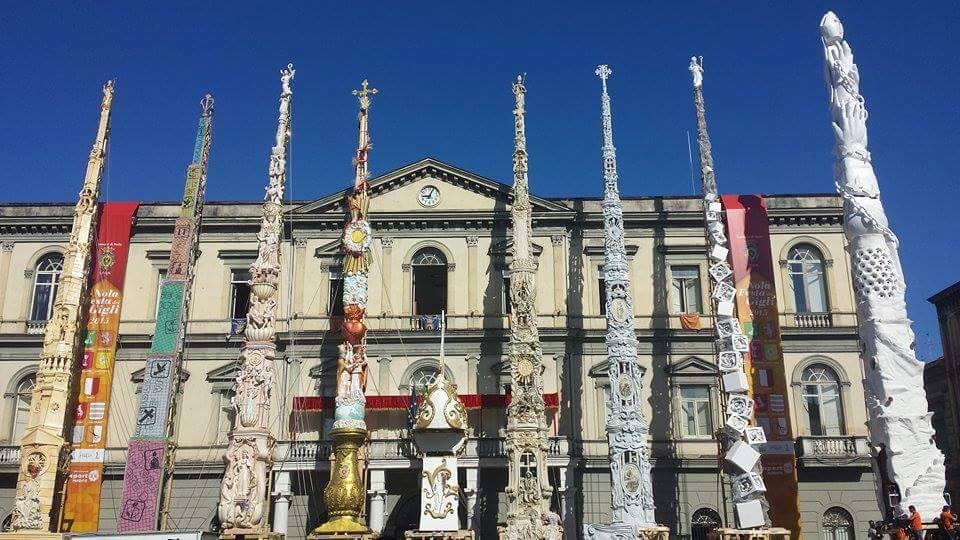
Held on the Sunday following June 22 each year, the 8 dancing towers parade through the streets of the city in procession following a specific order. The obelisks are named after the ancient guilds of arts and crafts, in historical order Ortolano, Salumiere, Bettoliere, Panettiere, Beccaio, Calzolaio, Fabbro and Sarto. The obelisks are joined by a lower structure in the shape of a Boat, symbolizing the return of St. Paulinus to his homeland. These wooden constructions, called precisely "lilies," assumed in the 1800s their present height of 25 meters with a cubic base of about three meters on each side, with a total weight of more than twenty-five quintals. The load-bearing element is the "borda," a central axis on which the entire structure is articulated. The "bars" and "barrette" (varre and varritielli in Neapolitan) are the wooden planks through which the Giglio is lifted and maneuvered on the shoulders of the transport workers. These take the name "cullatori" (in Neapolitan cullature), a name probably derived from the swinging motion produced similar to the act of cradling. The group of cradlers, usually 128 in number, takes the name "paranza."
The Lilies are adorned by local artisans with decorations in papier-mâché, stucco or other materials according to religious, historical or topical themes. They renew a tradition clearly identifiable since the last decades of the 1800s, which extends the historical roots identifiable in Lecce's Baroque architectural decorations and thus represent a form of votive machine on the shoulder.
All the lilies and the Boat are transported on Sunday morning to Piazza Duomo, where they will receive the Bishop's blessing, and then depart after a stop of a few hours to parade along the historic route of the city center.


