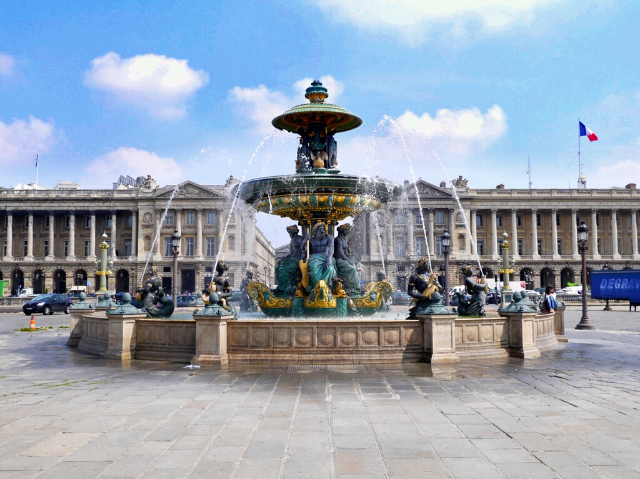

In the heart of Paris, nestled within the historic expanse of the Place de la Concorde, lies the stunning Fountain of River Commerce and Navigation. This masterpiece of 19th-century artistry not only reflects the city's deep connection with its rivers but also stands as a testament to France's rich maritime heritage.
### History and Origins
The Fontaines de la Concorde were conceptualized during a period of transformation in Paris. In 1836, architect Jacques Ignace Hittorff was commissioned to redesign the Place de la Concorde. By 1840, his vision materialized with two monumental fountains flanking this iconic square. The south fountain, dedicated to maritime commerce, celebrates France's naval prowess and its bustling ports, while the north fountain honors the rivers that crisscross the nation, vital arteries of trade and travel.
### Art and Architecture
Hittorff's design elegantly marries Neoclassicism with the exuberance of the Second Empire style. The fountains are adorned with richly detailed sculptures, including allegorical figures that represent rivers such as the Rhône and Rhine. Each element is crafted from bronze and stone, embodying both the strength and grace of France's waterways. The intricate carvings and figures are not mere decoration; they are a tribute to the gods of the sea and river, with tritons and nymphs encircling the base, their fluid forms echoing the movement of water.
### Local Culture and Traditions
The fountains, particularly during Bastille Day and other national celebrations, become central to the festivities, illuminated against the night sky. Parisians and visitors alike gather here, their reflections mingling with the water, creating a living tapestry of culture and history. The site is more than just a visual feast; it's a convergence point where the city's past and present flow seamlessly together.
### Gastronomy
While exploring the fountains, indulge in the culinary delights of nearby Café de la Paix or enjoy a traditional French crêpe from a local vendor. The area is replete with bistros offering classic coq au vin or a delicate tarte Tatin, perfectly paired with a glass of crisp Loire Valley white wine.
### Lesser-Known Curiosities
Though admired by many, the fountains hide a secret: their design was influenced by the Trevi Fountain in Rome, a nod to the shared artistic heritage across Europe. Moreover, the fountains' orientation aligns with the Champs-Élysées, creating a harmonious axis that extends all the way to the Arc de Triomphe.
### Practical Visitor Information
For the best experience, visit during the early morning or late afternoon when the light dances off the water, offering perfect photographic opportunities. Don't forget to explore the nearby Jardin des Tuileries and the Louvre, both a short stroll away. Look for the hidden details in the carvings, such as the tiny ships and intricate shields, which are easy to overlook in the splendor of the whole.
Visit Paris with a personalized itinerary using the Secret World app and uncover the city's hidden gems just like this one.
