
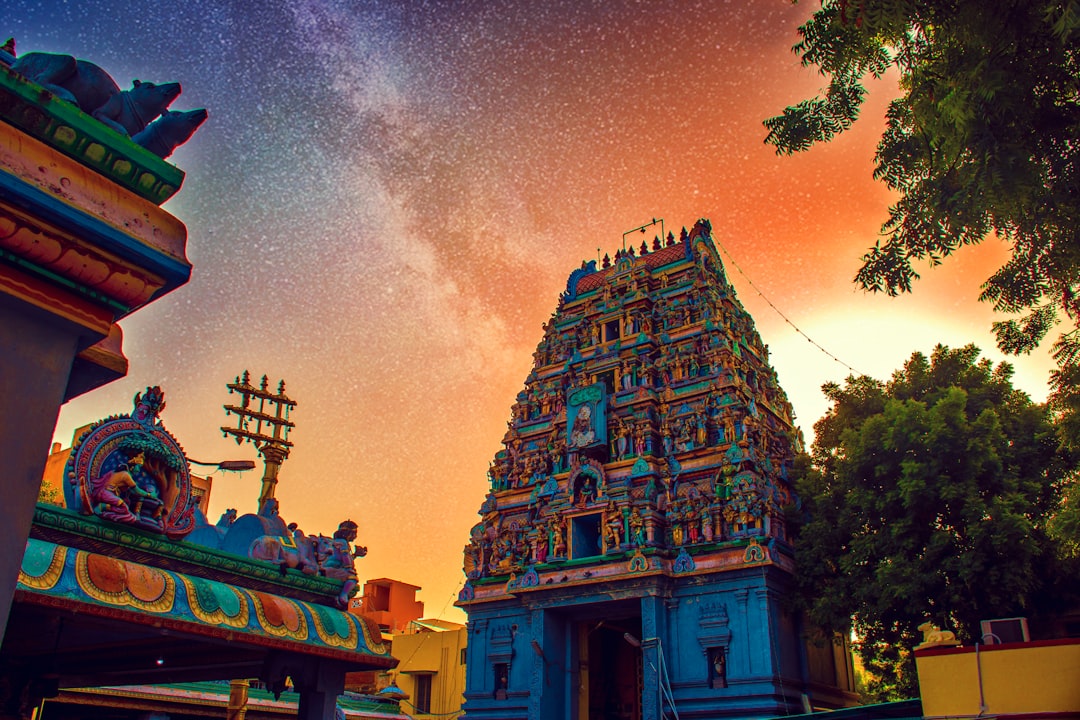

Thousands of painted figures climb along the towers of the Kapaleeshwarar Temple, the great Shaivite temple of Mylapore, one of the oldest neighborhoods in Chennai. The main gopuram — the pyramid-shaped tower that marks the entrance — rises about 37 meters and houses hundreds of polychrome sculptures depicting deities, epic heroes, and scenes from the Ramayana and the Mahabharata. It is not a museum: it is a living building, frequented every day by devotees who bring jasmine flowers, light oil lamps, and circumambulate the inner sanctuary following the ancient rhythm of Dravidian rituals.

The temple seen today mainly dates back to the 16th century, reconstructed by the Vijayanagara kings after the original structure — probably much older, perhaps from the 7th or 8th century AD — was destroyed during the Portuguese colonial period. This historical stratification is readable in the architecture itself: the layout and stylistic canons follow the classical Dravidian tradition, while the towers and many sculptural decorations bear the imprint of the Vijayanagara revival, with its preference for intense polychromy and almost baroque figurative density.
The gopuram towers: a mythological atlas in the open sky
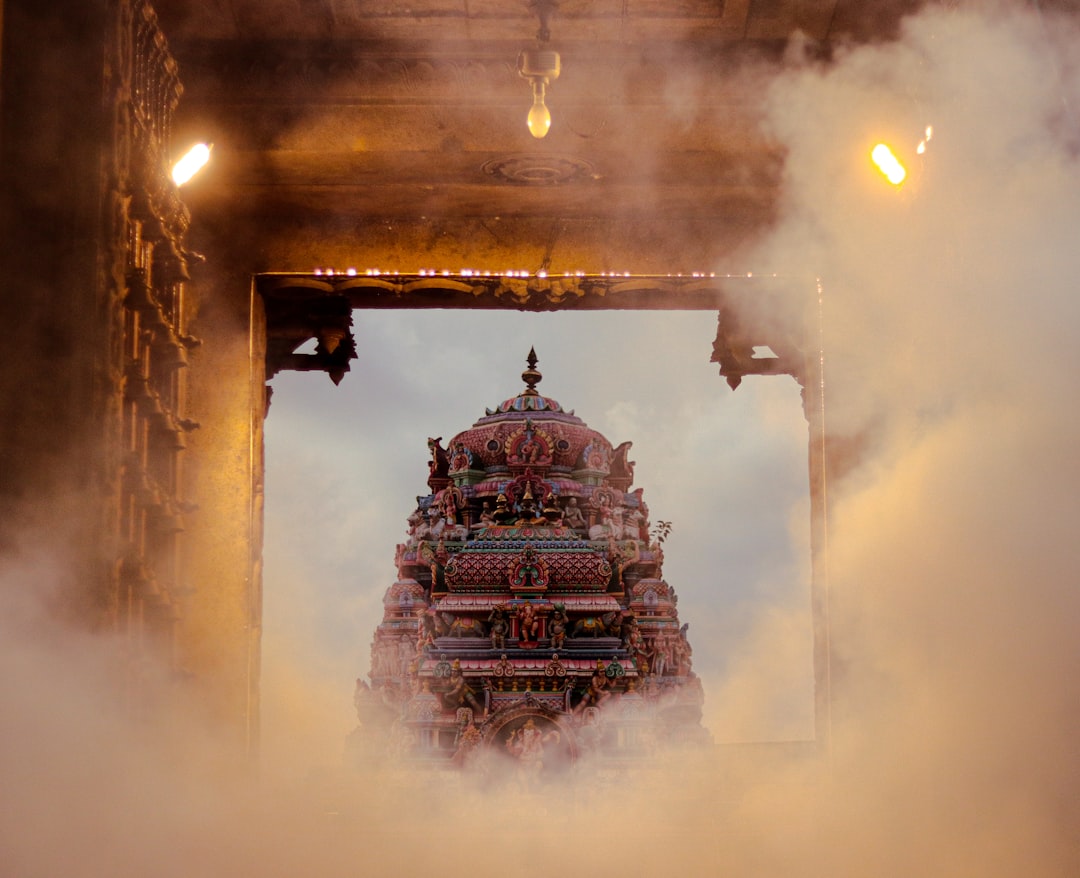
Approaching the eastern gopuram means finding oneself in front of a vertical wall of visual narration. The sculptures are organized in overlapping registers: at the bottom, the figures are larger and more legible, as one ascends they become smaller but no less detailed. One can recognize Shiva in the form of Nataraja, the cosmic dancer, accompanied by Parvati and the ganas, the creatures of his retinue. Higher up, scenes of battle appear, avatars of Vishnu, saints of the Tamil bhakti movement such as the Nayanmars, the sixty-three poet-mystics who sang devotion to Shiva in Tamil between the 6th and 9th centuries.
The colors — crimson red, ochre yellow, emerald green, lime white — are periodically retouched by the temple restorers, which gives the sculptures an almost jarring vibrancy for the eye accustomed to the gray stone of European temples. It is precisely this chromatic intensity that makes the gopuram immediately recognizable: it does not imitate stone, it openly celebrates painting as a devotional tool.

The sacred tank and the inner sanctuary
Inside the enclosure opens the Kapali Theertham, the basin of sacred water that according to tradition has purifying properties. Its dimensions are considerable — a rectangle of about one hundred meters by seventy — and its banks are animated every morning by devotees who immerse themselves before entering the sanctuary. Around the tank runs a porticoed gallery with further sculptures and small cells dedicated to secondary deities.

The main sanctuary houses the lingam of Kapaleeshwarar, the aniconic form of Shiva, and the image of Karpagambal, the divine consort worshipped with separate rites. Access to the sancta sanctorum is reserved for Hindus, but non-Hindu visitors can observe the internal architecture of the mandapam, the hypostyle halls with sculpted columns, and watch from the outside the puja, the offering ceremonies that take place several times a day accompanied by nadaswaram music.
Works of art to observe carefully

Those who approach the temple with an artistic eye should take time to admire the sculptures of the Nayanmars arranged in the outer corridor: there are sixty-three individual statues, each with precise iconographic attributes that allow for the identification of each saint. This gallery is a sort of pantheon of Tamil bhakti, a religious movement that has profoundly influenced the literature and classical music of Tamil Nadu.
Equally remarkable are the carved pillars of the thousand-column mandapam — in reality, the exact number is lower, but the traditional denomination conveys the idea of decorative density. Each pillar is intricately carved with figures of rearing lions, mythological creatures called yali, and female figures in dance postures that evoke the gestural codes of Bharatanatyam, the classical Tamil dance.
Practical information for the visit
The temple is located in the neighborhood of Mylapore, accessible by the Chennai metro (Mylapore station on the Green Line) or by auto-rickshaw from the center. Entrance is free for all visitors, although some special ceremonies may require a voluntary contribution. The best time to visit is in the early morning, between 6 and 8, when the pujas are more frequent and the natural light illuminates the gopuram from the east with an intensity that fades in the afternoon. Avoid noon: the heat is intense and some sections of the temple are closed for the ritual break.
It is mandatory to remove shoes before entering the premises — there are secure deposits at the entrance. Covered clothing on shoulders and legs is required and respected by the majority of local visitors. Allow at least an hour and a half for a thorough visit, two hours if you intend to follow a complete puja.


