


The Retiro Park in Madrid is located on an area of 120 hectares. It is famous for fancy fountains, e.g. in the shape of an artichoke. Various cultural events are organized here, such as the annual book fair. Tourist attractions include: the colonnade surrounding the monument to Alfonso XII, the Crystal Palace, Fisherman's House and eighteenth-century sculptures depicting Spanish rulers. The park belonged to the Spanish Monarchy until the late 19th century, when it became a public park.

In 2021, Buen Retiro Park became part of a combined UNESCO World Heritage Site with Paseo del Prado
Initially, they were royal gardens surrounding the no longer existing Buen Retiro Palace from the 17th century. Access to part of the royal gardens was given to subjects at the request of King Charles III, who was very well liked and valued.
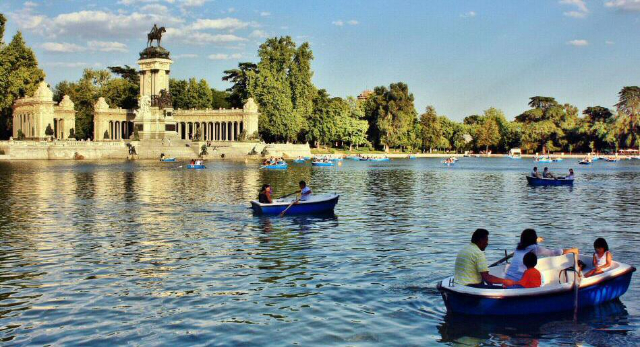
In the nineteenth century, it was the headquarters of the Napoleonic army, the park was devastated, trees were cut down and beautiful pavilions were destroyed. During the reign of Queen Isabella II, it was restored to its original appearance. Close to the northern entrance of the park is the Estanque del Retiro ("Retirement Pond"), a large artificial pond. Next to it is the monument to King Alfonso XII, featuring a semicircular colonnade and an equestrian statue of the monarch on the top of a tall central core.
The Rosaleda (rose garden) is an early 20th century feature inspired by the Bagatelle rose garden in the Bois de Boulogne. Near the roses stands the Fountain of the Fallen Angel, erected in 1922, whose main sculpture El Angel Caído (at the top) is a work by Ricardo Bellver (1845–1924) inspired by a passage from John Milton's Paradise Lost, which represents Lucifer falling from Heaven. It is claimed that this statue is the only known public monument of Satan.


