
← Back

Pilgrimage Church of Wies

Wies 12, 86989 Steingaden, Germania ★★★★☆ 149 views
Carla Bormann
Steingaden
🏆 AI Trip Planner 2026

Get the free app

Discover the best of Steingaden with Secret World — the AI trip planner with 1M+ destinations. Get personalized itineraries, hidden gems and local tips. Free on iOS & Android.

🧠 AI Itineraries 🎒 Trip Toolkit 🎮 KnowWhere Game 🎧 Audio Guides 📹 Videos
Scan to download iOS / Android
Scan for AppGallery Huawei users

About Pilgrimage Church of Wies

Pilgrimage Church of Wies - Steingaden | Secret World Trip Planner

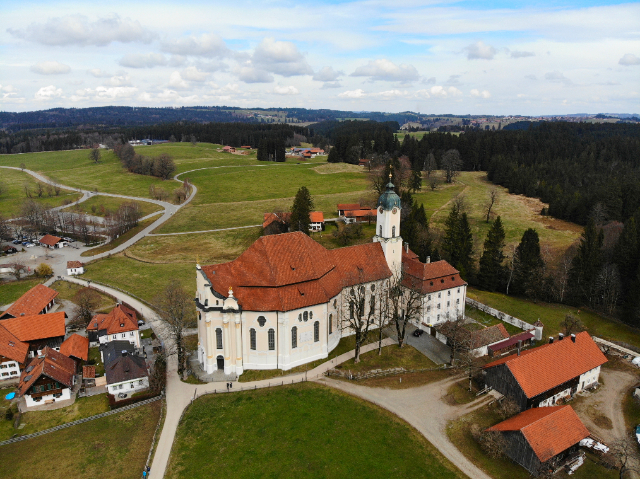
Miraculously preserved in the beautiful setting of an Alpine valley, the Church of Wies (1745–54), the work of architect Dominikus Zimmermann, is a masterpiece of Bavarian Rococo – exuberant, colourful and joyful. in short Wieskirche or just "The Wies" - near Steingaden is a true rococo jewel and to this day a popular destination for pilgrimages in the Pfaffenwinkel. The hamlet of Wies, in 1738, is said to have been the setting of a miracle in which tears were seen on a simple wooden figure of Christ mounted on a column that was no longer venerated by the Premonstratensian monks of the Abbey. A wooden chapel constructed in the fields housed the miraculous statue for some time. However, pilgrims from Germany, Austria, Bohemia, and even Italy became so numerous that the Abbot of the Premonstratensians of Steingaden decided to construct a splendid sanctuary. Consequently, work began in 1745 under the direction of the celebrated architect, Dominikus Zimmermann, who was to construct, in this pastoral setting in the foothills of the Alps, one of the most polished creations of Bavarian Rococo. The choir was consecrated in 1749, and the remainder of the church finished by 1754. That year, Dominikus Zimmermann left the city of Landsberg to settle in Wies near his masterpiece, in a new house where he died in 1766.
Pilgrimage Church of Wies - Steingaden | Secret World Trip Planner

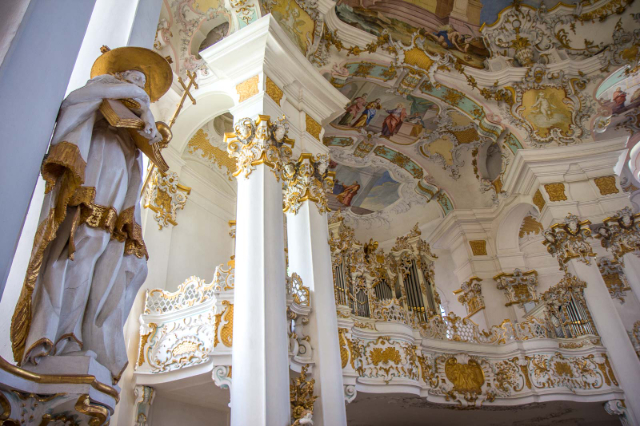
The church, which is oval in plan, is preceded to the west by a semi-circular narthex. Inside, twin columns placed in front of the walls support the capriciously cut-out cornice and the wooden vaulting with its flattened profile; this defines a second interior volume where the light from the windows and the oculi is cleverly diffused both directly and indirectly. To the east, a long deep choir is surrounded by an upper and a lower gallery.

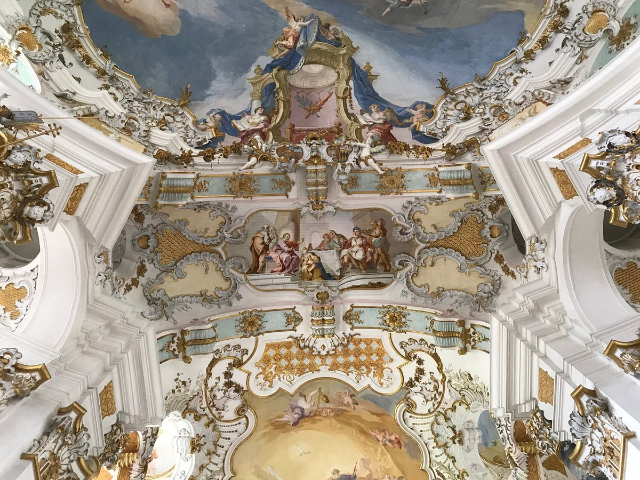
A unique feature is the harmony between art and the countryside. All art forms and techniques used - architecture, sculpture, painting, stucco work, carving, ironwork, etc. - were melded by the architect into a perfect, unified whole, in order to create a diaphanous spatial structure of light and form. The remarkable stucco decoration is the work of Dominikus Zimmermann, assisted by his brother Johann Baptist - who was the painter of the Elector of Bavaria, Max-Emmanuel, from 1720. The lively colours of the paintings bring out the sculpted detail and, in the upper areas, the frescoes and stuccowork interpenetrate to produce a light and living decor of unprecedented richness and refinement. The abundance of motifs and figures, the fluidity of the lines, the skilful opening of surfaces, and the 'lights' continually offer the observer fresh surprises. The ceilings painted in trompe-l'œil appear to open to an iridescent sky, across which, angels fly, contributing to the overall lightness of the church as a whole. The Wieskirche was declared a UNESCO World Heritage Site in 1983.
Pilgrimage Church of Wies - Steingaden | Secret World Trip Planner
🗺 AI Trip Planner

Plan your visit to Steingaden

Suggested itinerary near Pilgrimage Church of Wies

MAJ+
500.000+ travelers worldwide
  1. 🌅
    Morning
    Pilgrimage Church of Wies
    📍 Steingaden
  2. ☀️
    Afternoon
    Church of Wies
    📍 0 km · Steingaden
  3. 🌆
    Evening
    Wieskirche: A Bavarian Rococo Gem to Discover
    📍 0.7 km · Steingaden

Buy Unique Travel Experiences

Powered by Viator

See more on Viator.com

Explore nearby · Steingaden

Frequently Asked Questions

The Church of Wies was built following a miracle in 1738 when tears were reportedly seen on a wooden Christ figure in the hamlet of Wies that was no longer venerated by monks. The miraculous statue attracted so many pilgrims from Germany, Austria, Bohemia, and Italy that the Abbot of Steingaden commissioned architect Dominikus Zimmermann to build a grand sanctuary, which was completed between 1745 and 1754.
The Church of Wies was designed by celebrated architect Dominikus Zimmermann and is located near Steingaden in the Pfaffenwinkel region, nestled in an Alpine valley in Bavaria. The architect was so devoted to his masterpiece that he moved to Wies in 1755 and lived there until his death in 1766.
The Church of Wies is considered a masterpiece of Bavarian Rococo architecture, renowned for its exuberant, colourful, and joyful design. The oval-shaped church features unique elements like twin columns, capriciously cut-out cornices, flattened wooden vaulting, and clever light diffusion through windows and oculi that create multiple interior volumes.
The church's interior is extraordinary for its harmonious blend of art forms including architecture, sculpture, painting, stucco work, carving, and ironwork that are unified into a single aesthetic vision. Twin columns support intricately designed cornices and vaulting, while the strategic placement of windows and oculi creates a sophisticated system of both direct and indirect lighting throughout the space.
The Church of Wies is a year-round pilgrimage destination that showcases exquisite Rococo artistry with its ornate interior decoration and sculptural details. Visitors can admire the unique oval floor plan, the long deep choir with upper and lower galleries, and the seamless integration of the stunning building with its beautiful Alpine valley setting.
