
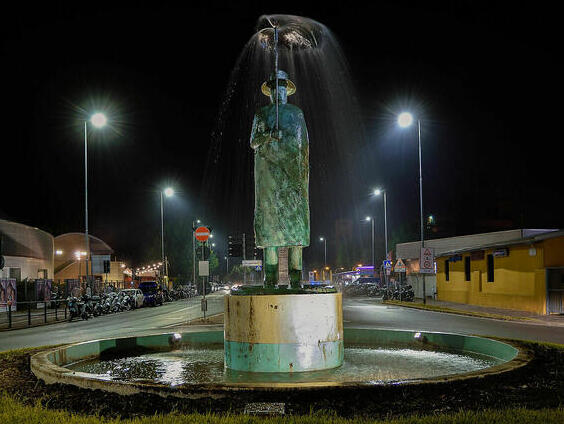

In the heart of Florence, where history meets modernity, stands the Rainman Fountain (L'Uomo della Pioggia), an artistic marvel that embodies the spirit of the city. Created by the celebrated Belgian artist Jean-Michel Folon, this contemporary masterpiece was inaugurated just before the Florence Social Forum held from November 6-9, 2002. The bronze sculpture, towering over 3 meters, features a figure holding an umbrella from which water cascades, creating a mesmerizing display that captures the essence of Florence's connection to both nature and art.
The origins of this fountain are steeped in the rich tapestry of Florentine history. Founded in the 1st century BC, Florence has undergone significant transformations, from a Roman settlement to a hub of the Renaissance. The city has been a canvas for countless artists, architects, and thinkers, and Folon's work reflects a modern interpretation of this artistic legacy. The Rainman Fountain stands at a crossroads between Lungarno Aldo Moro and Viale Enrico de' Nicola, not far from the historic Ponte di Varlungo, making it a vital part of the city's contemporary landscape.
Architecturally, the Rainman Fountain breaks away from traditional forms, showcasing Folon's signature style. His works often incorporate elements that provoke thought and emotion, and this fountain is no exception. The flowing water symbolizes renewal and the connection between humanity and nature, inviting onlookers to reflect on their own relationship with the environment. The use of bronze, a material that withstands the test of time, also speaks to the enduring legacy of art in Florence.
Local culture thrives around the Rainman Fountain, with residents and tourists alike embracing the site as a gathering place. Florence is renowned for its rich traditions, including the Calcio Storico, a historic football game played in Piazza Santa Croce, and the Festa di San Giovanni, celebrating the city's patron saint. Festivals often incorporate elements of the arts, showcasing music, dance, and visual arts, echoing the sentiments of Folon's work.
When exploring culinary delights in Florence, one cannot overlook the traditional Bistecca alla Fiorentina, a thick, grilled T-bone steak that is a local specialty. Pair this with a glass of Chianti, a robust red wine produced in the surrounding Tuscany region, for an authentic experience. For those with a sweet tooth, the local cantucci—almond biscuits often enjoyed with Vin Santo—provide a delightful ending to any meal.
Among the lesser-known curiosities about the Rainman Fountain is the fact that the water's flow and the umbrella's design were inspired by Folon's childhood memories of the rain in Belgium, symbolizing hope and protection. The fountain also features subtle details that many tourists overlook, such as the intricate patterns on the statue's surface that tell stories of human resilience and connection to the elements.
For visitors to Florence, the best time to admire the Rainman Fountain is during the spring and early fall when the weather is pleasantly mild. Arriving early in the morning allows for a quieter experience, perfect for reflection and photography. Take a moment to sit on one of the nearby benches and observe the interactions of people with the fountain—it's a living piece of art, constantly changing with the light and the crowds.
As you explore the vibrant neighborhoods surrounding the fountain, keep an eye out for local artisans and shops that reflect the city's commitment to craftsmanship and creativity. Each corner of Florence offers a glimpse into its rich past while celebrating its contemporary spirit.
In conclusion, the Rainman Fountain is not just a piece of art; it is a bridge between Florence's storied past and its dynamic present. Its significance extends beyond aesthetics, serving as a reminder of the interconnectedness of human experience and the natural world.
To truly appreciate all that Florence has to offer, consider using the Secret World app to craft a personalized itinerary that will guide you through this enchanting city.


