



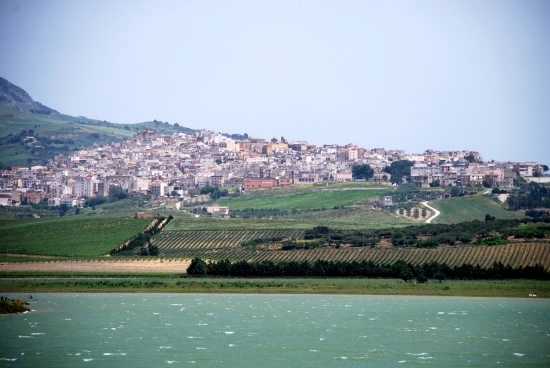
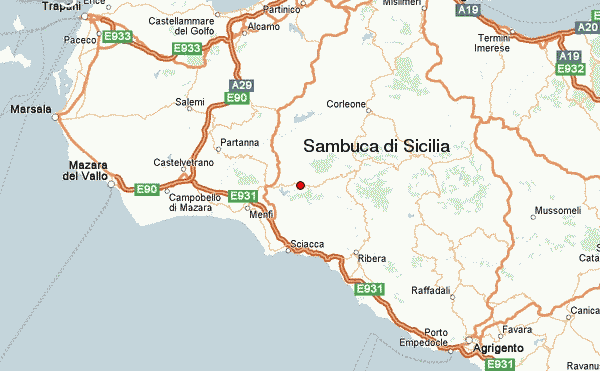
Sambuca di Sicilia is 350 meters above sea level. Until 1921 the town was called Sambuca Zabot.
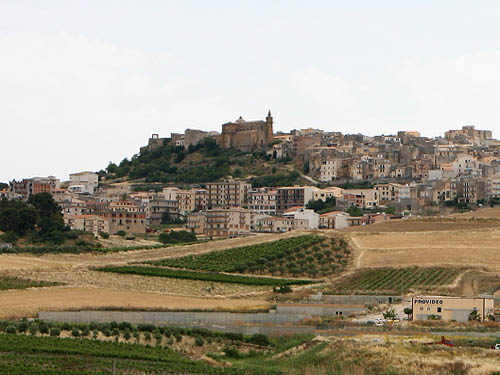
The town's birth was due to the arrival of the Muslims in Sicily in 827, but even before that period the area saw the arrival of the Elymians and Sicans, as attested by some findings in the archaeological area of Mount Adranone. Over the centuries, beginning in the 1200s, the city experienced considerable building expansion.
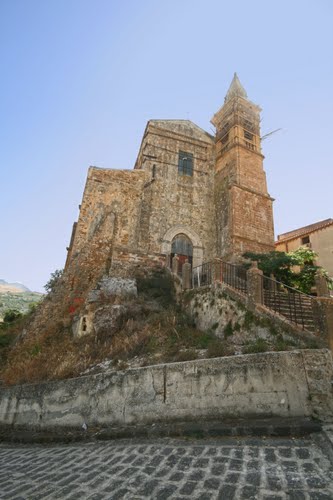
From the cultural point of view, Sambuca offers the possibility of admiring the Church of the Conception, the 16th-century Church of the Carmine - today the church is dedicated to Maria Santissima dell'Udienza and presents some works of considerable artistic interest, starting with the marble statue representing the Madonna dell'Udienza attributed to Antonello Gagini and a 17th-century wooden Crucifix - and the 17th-century Mother Church, built in the area of the Zabut Castle.
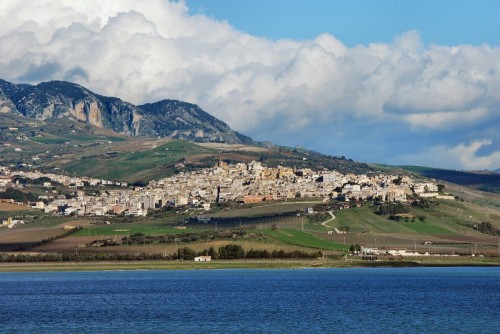
Among the town's civic buildings are the 19th-century Municipal Theater, the 18th-century Palazzo Navarro, the Palazzo Panitteri, the 17th-century Palazzo Fiore and the remains of the Castle - built by Emir Zabuth, it was the property of William II and later of the Monreale Convent; it was also used as a prison; currently its structure is in ruins and only the Arab farmhouse with the remains of a tower is preserved.
The town planning also has interesting implications, starting with the charming Saracen quarter recently restored and consisting of short streets, low dwellings and courtyards.
From the archaeological point of view, one certainly cannot forget the archaeological zone of Mount Adranone.
Excavations of Mount Adranone - The 6th-century B.C. Greek settlement overlaps with an older, indigenous one. The site, at the top of the mountain, in a dominant position. It is naturally defended on one side and is surrounded by mighty walls on the other two to form a vaguely triangular space. The city, identified with Adranon of which Diodorus Siculus tells us, was probably destroyed in 250 B.C. during the First Punic War.
Visit - Outside the walls, to the southeast, was the necropolis, with chambered hypogeic tombs among which stands out the so-called Queen's Tomb, made of squared tufa ashlars. A little further on is the South Gate, flanked by towers, to which a building identified as a farmhouse is leaning. Climbing toward the acropolis one encounters, on the right, a large rectangular building of probably public use and, further on, a complex of warehouses, workshops and dwellings. At the top stands the acropolis, in a position of dominance over the whole,Ia valley of which there is a 360-degree view, with the village of Sambuca and Lake Arancio. The most important building is the large Punic temple flanked to the right by a large cistern. Rectangular in plan, the temple possessed a central open-air space overlooked on the east by the cella.
In terms of nature and landscape, the town also has much to offer its visitors. Worth mentioning is the town's location on the southern slopes of Mount Genuardo, which is currently undergoing reforestation and characterized by the presence of Mediterranean scrub, and in the vicinity of Lake Arancio.
The geo-morphological characteristics of the area are reconnectable to those of the Belice Valley. The naturalistic importance of the whole area has been further recognized by the institution of the Oriented Nature Reserve of Monte Genuardo and Santa Maria del Bosco and the Arancio Lake.
