
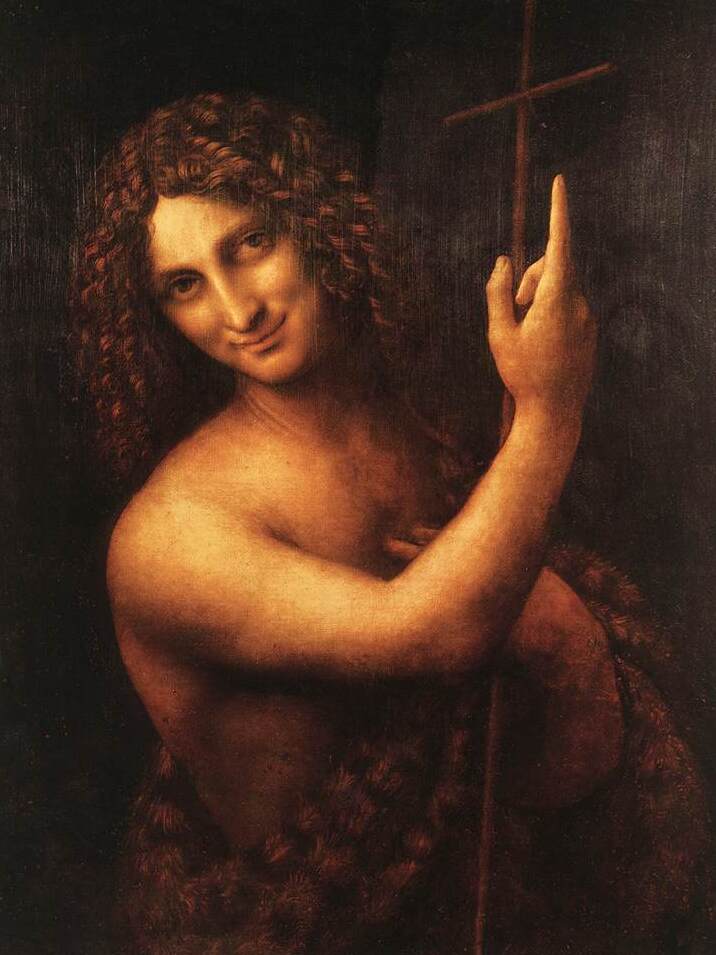

Entering the hallowed halls of the Musée du Louvre in Paris, visitors are greeted by an array of masterpieces, yet few evoke the same sense of reverence as St. John the Baptist, painted by the legendary Leonardo da Vinci between 1513 and 1516. This captivating oil painting on walnut wood is believed to be da Vinci's final work, created during a pivotal moment when the High Renaissance was beginning to transition into Mannerism.
The painting, measuring 69x57 cm, portrays John the Baptist in a striking pose, pointing toward the heavens, a gesture that symbolizes the significance of salvation through baptism. This subtle yet powerful orientation has inspired countless artists in subsequent generations, particularly those within the late Renaissance and Mannerist movements, who often sought to incorporate similar gestures into their religious works.
To fully appreciate the artistic significance of St. John the Baptist, one must delve into the historical context in which it was created. The early 16th century was a time of great change in Europe, marked by the flourishing of the arts and the emergence of new ideas that challenged traditional norms. Leonardo, who was not only a painter but also an inventor and scientist, infused his works with a profound understanding of human emotion and the natural world. St. John the Baptist is no exception; his expression is one of serene contemplation, inviting viewers to ponder the deeper truths of faith and existence.
In terms of art and architecture, the Louvre itself is a masterpiece. Originally built as a fortress in the late 12th century, it has undergone numerous transformations, evolving into a grand palace before finally becoming a museum in 1793. Its architectural styles range from medieval to Renaissance, and its glass pyramid entrance, designed by I.M. Pei, is a modern addition that contrasts beautifully with the building's historical elements. The Louvre houses over 35,000 works of art, making it the world’s largest and most visited museum, but St. John the Baptist remains a highlight for those seeking to understand da Vinci's genius.
The culture surrounding the Louvre and St. John the Baptist is richly layered. Paris is known for its vibrant artistic community, which thrives on the legacy of its past. Throughout the year, various festivals and events celebrate this artistic heritage, including the Nuit Blanche, where the city transforms into a canvas for contemporary artists, and the Fête de la Musique, where music fills the streets. Local customs, such as leisurely evenings spent at bistros near the museum, provide an authentic Parisian experience that complements the grandeur of its art scene.
When it comes to gastronomy, the area surrounding the Louvre is a treasure trove of culinary delights. Indulge in traditional French baguettes or savor the rich flavors of coq au vin at a nearby café. The pâtisserie scene is also noteworthy—be sure to try a macaron from the famous Ladurée or a tarte Tatin at any of the local eateries. Pair your meal with a glass of fine Bordeaux or a refreshing pastis, and you’ll find that the flavors of Paris are as captivating as its art.
For those looking to explore lesser-known curiosities, consider the hidden details within St. John the Baptist. While the painting is often admired for its aesthetic beauty, art historians note the meticulous brushwork that da Vinci employed to create lifelike textures in the figure's hair and skin. Additionally, the choice of walnut wood as a canvas was unusual for da Vinci, who typically favored poplar; this choice adds a unique aspect to the painting's allure.
Visiting St. John the Baptist and the Louvre is best done during the shoulder seasons of spring (April to June) and autumn (September to October) when crowds are thinner, and the weather is pleasant. Arrive early to beat the rush, and don’t forget to take a moment to sit in the museum’s courtyard, where you can reflect on the art you’ve just seen.
As you stand before St. John the Baptist, let yourself be enveloped by the emotions conveyed through da Vinci’s brush. This masterpiece is more than just a painting; it is a window into the soul of one of history's greatest artists. With its profound messages and the stunning backdrop of Paris, it is an experience not to be missed. Use the Secret World app to plan a personalized AI itinerary to fully explore the artistic wonders of this magnificent city.


