
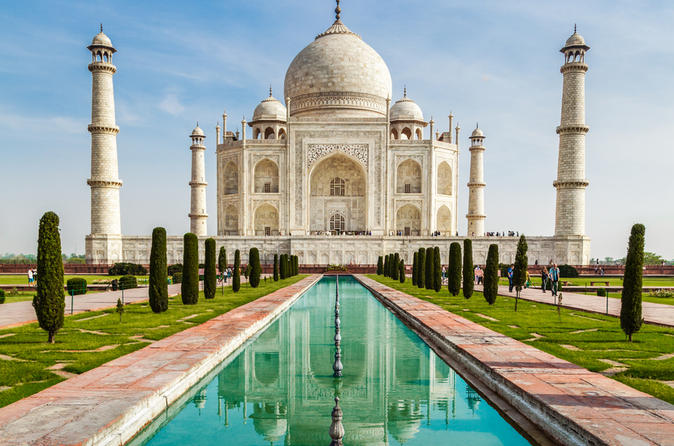

The Taj Mahal, which literally translated means “the palace of the crown” or “the crown of the palace”, è the name given to a stupendous construction located in the Indian town of Agra, whose origins are very uncertain.
According to tradition, the'work was desired by Indian emperor Shah Jahan, to fulfill one of the promises he made to his wife while he was still alive.
The work, which began in 1632, was not completed until 1654 and employed the labor of many craftsmen, some of whom came from Europe and even one from Italy named Geronimo Veroneo, who made use of various materials from all parts of India and Asia.
Totally there are 28 different types of precious and semi-precious stones, set in white marble as a decorative motif of the entire structure.
During the 20th century, the building was very well cared for: in fact, in 1942, during World War II, the Indian government erected scaffolding around the structure to defend it from any damage caused by air strikes, and this precaution was also taken during the war between India and Pakistan, between 1965 and 1971.
In recent years, however, the Taj Mahal has faced a much more devious enemy: pollution.
Because of fine dust, in fact, the snow-white marble it è covered with is turning yellow.
In order to solve this problem, in addition to the regular cleaning operations regularly commissioned by the Indian government, special treatment would also have to be done on the marbles, which would require a great sacrifice of economic resources, so much so that the local authorities, just to curb the costs, have decided to opt for preventive measures, such as the law prohibiting the construction of polluting industries in the area around the Taj Mahal.
The architectural complex of the Taj Mahal consists of five main elements: the darwaza (gateway), the bageecha (garden), the masjid (mosque), which is the place of worship for pilgrims and the structure that sanctifies the'entire complex, the mihman khana (“guest house”, also called a jawab) and finally the mausoleum (i.e., the tomb of Emperor Shah Jahan.
Additional secondary structures rise against the walls that divide the complex from the outside (they encircle it on three sides, as the northern side facing the river è free) and are: the two secondary portals and eight octagonal towers.
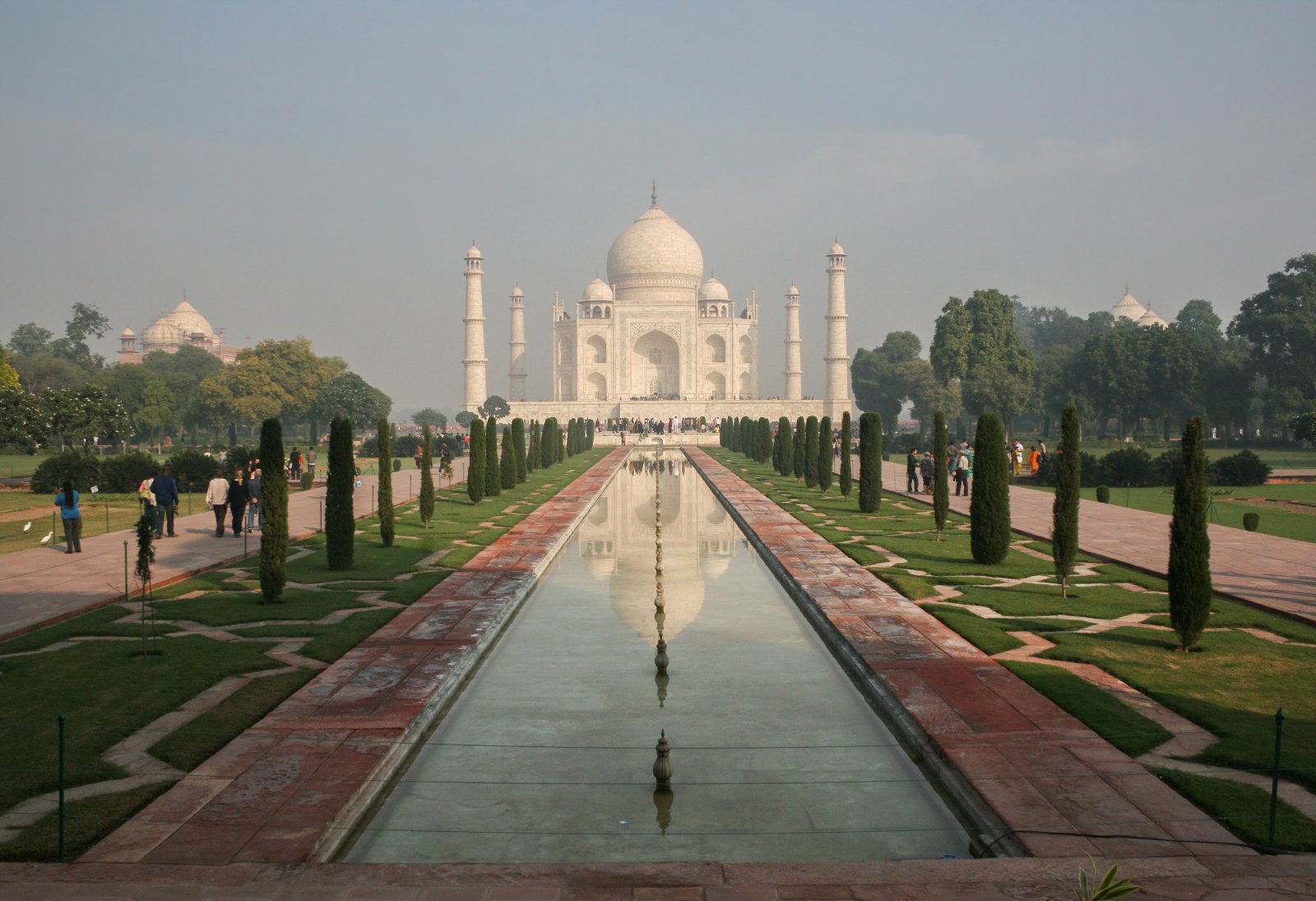
Inside the garden, there are flower beds, water channels reflecting the image of the Taj and tree-lined avenues.
Esso è divided into four parts by two canals that intersect orthogonally at the center; each of the four parts è in turn divided into four more parts by walkable avenues.
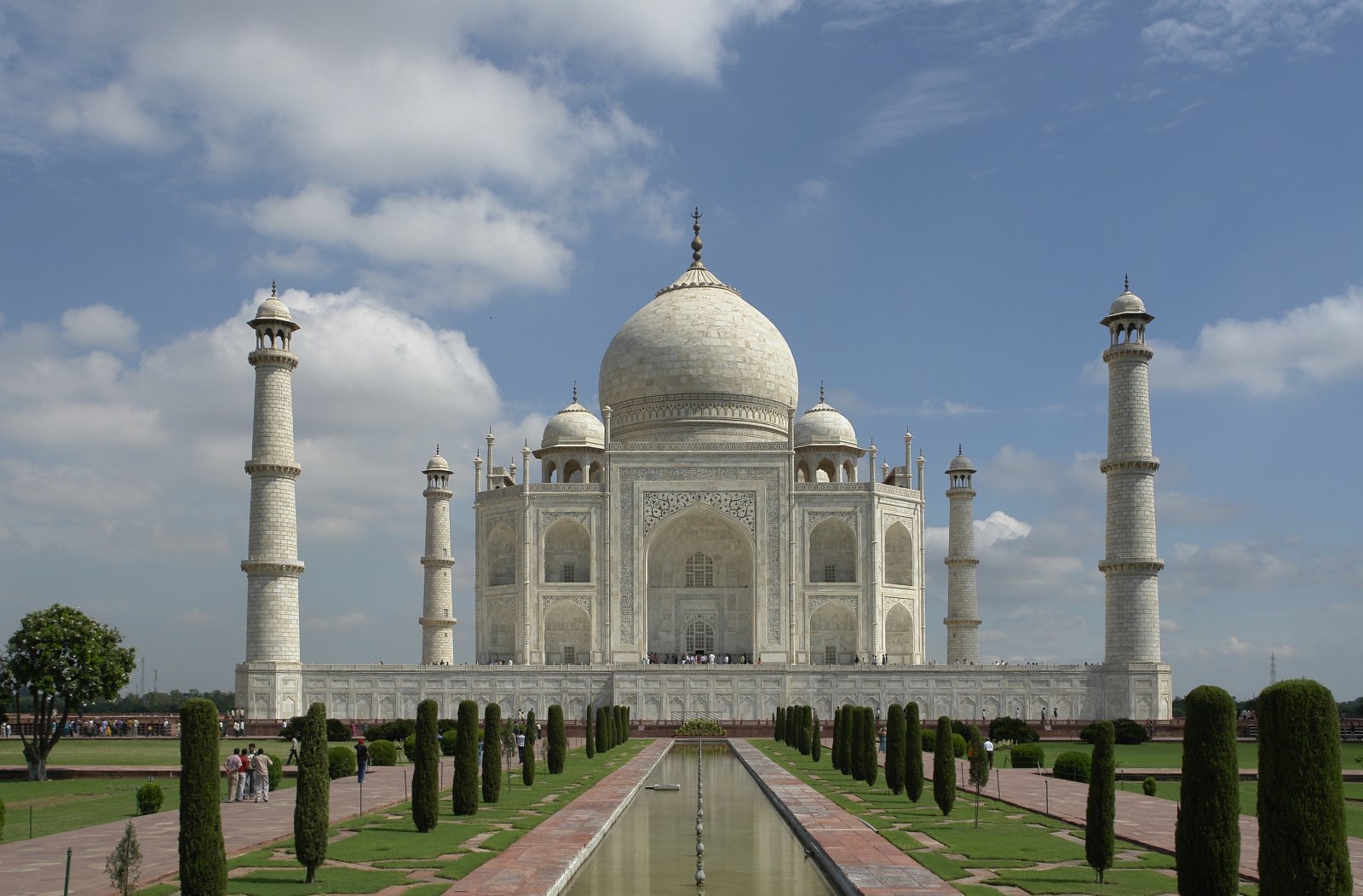
The mausoleum proper, on the other hand, è a structure 68 meters high at its highest point and è placed above a square-shaped elevation where four minarets are placed at its four vertices.
We can say that seen from the front the building è in its maximum simplification, a rectangle surmounted by an ogival arch whose form is taken up, then, in every part of the structure: see, for example, the niches present along each face of the building and taken up in all the structures of the Taj Mahal complex.
With this solution of self-replicating geometry, precisely a certain continuity is maintained between the various parts of the'building and between the'building and the rest of the complex.
At the sides of each opening of the'building also è placed a tall and narrow octagonal pinnacle that exceeds in height the roof.
Although the walls are entirely covered with marble, the supporting structure è was made of red sandstone è and is topped by five domes.
The structure also features several minarets, inside of which a spiroidal staircase is placed that crosses it along its entire height to thus allow one to reach even the top.
For all these elements and the remarkable beauty that flows from them, the building è was declared a UNESCO World Heritage Site in 1983 and included in 2007 among the new seven wonders of the world.


