
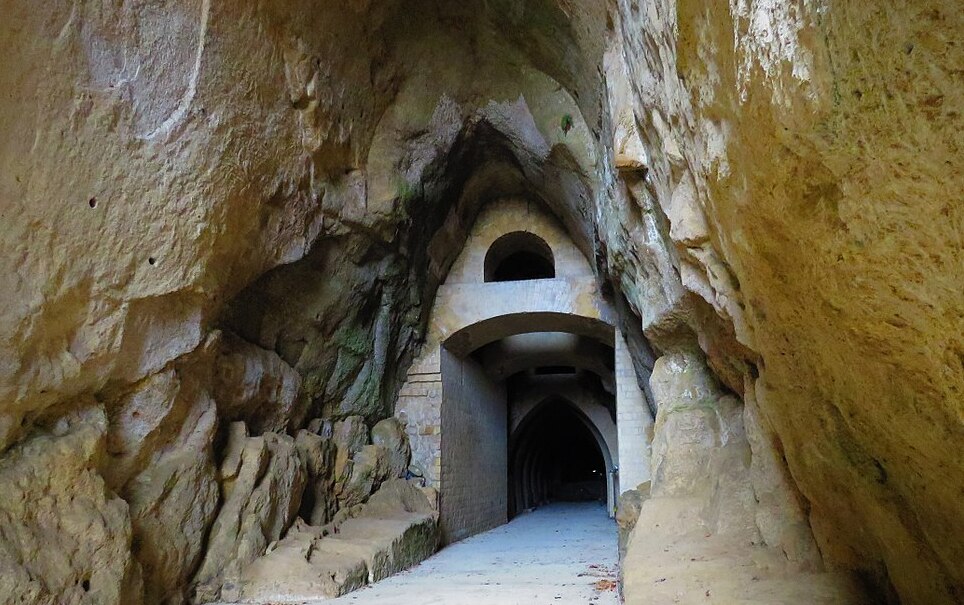

The Neapolitan Crypt, also known as the Old Cave of Pozzuoli, was built in the Augustan age by the freedman L. Cocceio Aucto, architect of Agrippa, admiral of Octavian, according to Strabo (V, 4, 6) who also designed the Portus Iulius, the "Cave of Cocceio" and the Roman Crypt at Cuma. Mentioned in the Tabula Peutingeriana (a map with road itineraries of the late imperial age) and mentioned not only by Strabo but also by Donato, Seneca, Petronius and Eusebius, the tunnel is excavated entirely in tuff for a length of 705 m, an original width of 4.50 m and a height of about 5 m, illuminated and ventilated by two oblique shafts of light. The poor visibility inside the structure already during the Spanish viceroyalty led to the construction of a lighting system consisting of lanterns supported by ropes stretched between poles; in 1806, with Giuseppe Bonaparte, two rows of lanterns kept constantly on were installed, while from the middle of the nineteenth century gas lights were used, one of which, at the end of the century, was found in recent rearrangement works. Following the works of widening and lowering of the street level, as well as the paving carried out in several stages by Alfonso of Aragon in 1455, by Don Pedro of Toledo in 1548, by Charles of Bourbon in 1748 and by the City of Naples in 1893, the cave has lost much of its ancient appearance. At the sides of the entrance there are two frescoed niches: the one on the left with a representation of the Madonna and Child dating from the fourteenth century, the one on the right with the face of the Almighty of uncertain date. Petrarch in the Itinerarium Syriacum recalls a small chapel called Santa Maria dell'Idria, built by a hermit just near the entrance to the cave. During the Aragonese restoration or during the works carried out at the time of the Spanish viceroyalty, a white marble bas-relief was found with the representation of Mithras dated between the end of the 3rd and the beginning of the 4th century A.D., kept in the National Archaeological Museum of Naples. Evidence of the eastern god Mithras is known in Campania from the 2nd century A.D., as opposed to the increasingly widespread Christianity; the presence of the relief in the Crypta has led to the hypothesis that we are in front of a place of worship mithriac: the mithraea is usually identified in the spelaeum, the cosmic cavern, inside which, since the oldest iconographic evidence, is depicted the sacrifice of the bull. It is probable that mysterious cults have influenced popular superstition, which has always associated something mysterious and magical to the cave, to the point that just crossing it unharmed was considered a real miracle.


