
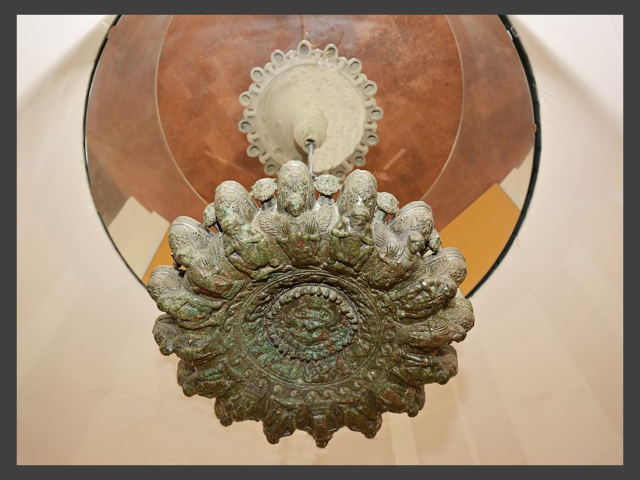

The Maec-Museum of the Etruscan Academy and the City of Cortona in Tuscany, Italy, houses a remarkable Etruscan-era bronze chandelier, a testament to the rich history and craftsmanship of the Etruscan civilization. This masterpiece was discovered in 1840 near Cortona by Marco Antonio Fabroni, who announced the find in the "Bullettino dell’Instituto di Corrispondenza Archeologica."
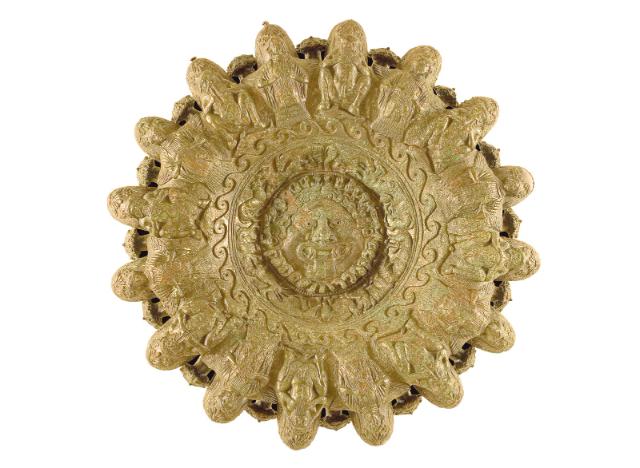
The chandelier initially belonged to the noblewoman Luisa Bartolozzi Tommasi and was later acquired by the Etruscan Academy in 1846, thanks to financial aid from the Municipality of Cortona and a loan from the Monte dei Paschi di Siena. The chandelier was made using the lost-wax casting technique and is believed to have originated from a workshop in Velzna (Orvieto) during the last three decades of the 4th century BCE.
The lamp is decorated with intricate designs, including protomes of Acheloo, mythological sirens, and sileni playing double flutes. The central section portrays dramatic scenes of animal battles, while the lower part of the basin features a "Gorgoneion" (the face of a Gorgon).

The chandelier has been the subject of much speculation regarding its original placement, with theories suggesting it could have adorned either a monumental tomb or a temple. The latter seems most likely, possibly located in the area of Camucia.
An inscription referring to the god Tin, the chief deity of the Etruscan pantheon equivalent to Zeus, was added approximately a century later, possibly during a re-sacralization of the chandelier.
This Etruscan bronze chandelier not only serves as a stunning example of ancient craftsmanship but also provides valuable insights into the religious and cultural practices of a civilization that significantly influenced the Roman Empire.


