
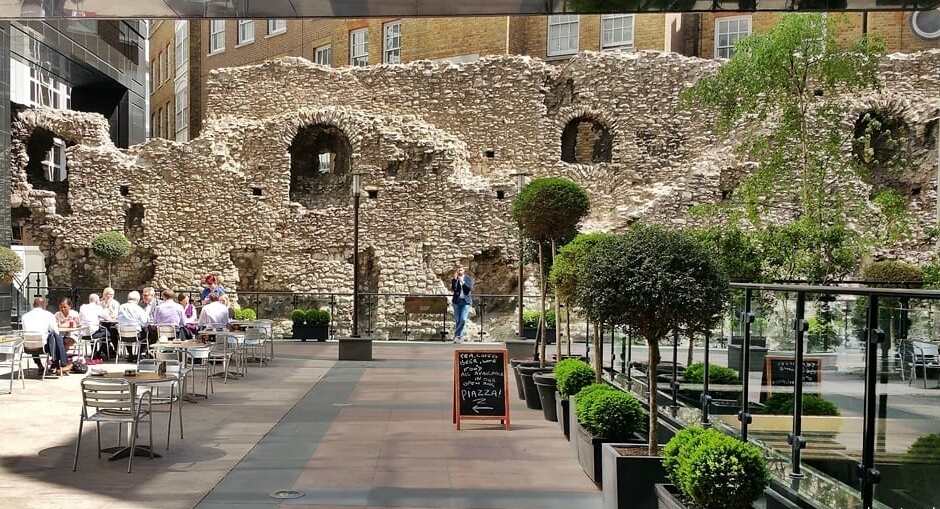

Nestled within the bustling streets of modern London lies a fragment of the city’s ancient past: The London Wall. This monumental structure, constructed by the Romans in the late 2nd century or early 3rd century, stands as a testament to the resilience of a city that has witnessed centuries of transformation. Although it may not fit the traditional definition of a building, the wall is widely regarded as the oldest structure in London, a silent guardian of its storied history.

The origins of the London Wall trace back to 120 CE, shortly after the Romans established Londinium as a thriving port town. Designed primarily for defensive purposes, the wall stretched approximately 4 km (2.5 miles) and enclosed a significant area of 134 hectares (330 acres). This grand construction was one of the largest projects in Roman Britain, symbolizing not only military might but also the administrative prowess of the Roman Empire. As the years unfolded, the wall adapted to the changing hands of power, remaining a crucial boundary for the city throughout the medieval period.
After the fall of the Western Roman Empire, the wall continued to serve its purpose, repaired and maintained by various occupants of London, including the Saxons and Normans. It delineated the boundaries of the city for centuries, witnessing pivotal events like the Great Fire of London in 1666, which devastated much of the old city within its confines. Despite the destruction of the seven city gates in the 18th century, remnants of the wall have endured, with sections preserved as protected historical landmarks. Visitors can marvel at these ancient stones that echo the city’s illustrious past.

The architectural style of the London Wall showcases the practical yet robust design common in Roman fortifications. Constructed using local materials, it features a mix of flint, limestone, and brick, with portions exhibiting Roman engineering techniques, such as the use of opus caementicium (Roman concrete). Notable remnants of the wall can be found at various sites, including Tower Hill, where a section remains visible near the Tower of London, and at Bishopsgate, where visitors can see a well-preserved stretch alongside the bustling streets.
While the wall itself may not be adorned with traditional artworks, its historical significance has inspired a vibrant cultural tapestry in London. The traditions surrounding the wall have evolved, yet it remains a focal point for local customs. Festivals celebrating the city’s heritage, such as the London Festival of Architecture, often highlight the wall’s importance as a cultural icon, inviting artists and historians to reflect on its legacy through contemporary art and performance.
When exploring the area surrounding the London Wall, one cannot overlook the vibrant gastronomy of the East End. Traditional foods reflect London’s rich history, with dishes like pie and mash, served with a side of liquor (a parsley sauce), echoing the working-class roots of the city. Additionally, the Borough Market, not far from the wall, offers a plethora of artisanal foods and local delicacies, including fish and chips, and English cheeses. Pair your meal with a pint of London ale from a local pub, where the atmosphere is steeped in history and camaraderie.
One lesser-known curiosity about the London Wall is its connection to the London Stone, a significant artifact that symbolizes the city’s authority. The stone, believed to have been part of the Roman fortifications, has been relocated several times but remains an emblem of London’s historical governance. Additionally, a walk along parts of the wall reveals a series of plaques detailing the history and significance of various sections, enriching the visitor’s understanding of this ancient boundary.
The best time to visit the London Wall is during the spring and early autumn months when the weather is mild and ideal for walking. The wall is accessible at various points throughout the city, with informative displays that provide context for its historical relevance. Be sure to take your time exploring the nearby Museum of London, which offers extensive exhibits on the city’s history, including the Roman period.
For those wanting a more personalized experience, consider using the Secret World app to craft an itinerary that highlights the captivating history and hidden gems of the London Wall and its surroundings. Embrace the stories etched in stone and let them guide your exploration of this ancient relic in the heart of a modern metropolis.


