


Nestled in the heart of India, in the small town of Chhatarpur in Madhya Pradesh, lies one of the most unique and paradoxical spiritual sites in the world: the Temples of Khajuraho. At first glance, the intricate, erotic carvings that adorn the temple walls may seem incongruous with a place of worship. Yet it's this very juxtaposition that makes Khajuraho a profoundly compelling destination, bridging the gap between the earthly and the divine.

Built between the 10th and 12th centuries by the Chandela dynasty, the temples represent a zenith of Indian art and architecture. Once a complex of 85 temples, about 25 remain today, each a masterpiece of craftsmanship. Divided into Western, Eastern, and Southern groups, the temples are dedicated to different deities from the Hindu and Jain pantheons.
While the temples are renowned for their explicit sculptures, it's worth noting that these constitute only a fraction of the artwork displayed. They appear alongside a multitude of other scenes—of war, everyday life, and divine beings—that capture the human experience in its totality. The erotic art itself is far from gratuitous; rather, it's symbolic of various spiritual and philosophical ideas. Some interpretations suggest they represent the union of the individual soul with the divine, or demonstrate the transient nature of worldly desires.
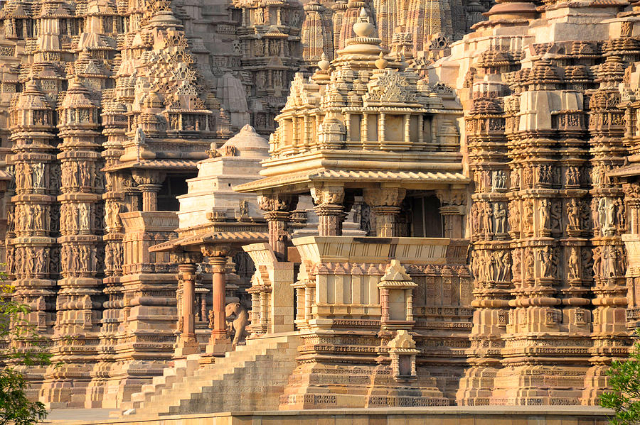
The intricate carvings are also a celebration of life and fertility. Given that many ancient cultures held the act of creation as one of the most sacred rituals, the explicit nature of these sculptures could be interpreted as an embodiment of the divine in the earthly realm. In Hinduism, sensuality and spirituality are not mutually exclusive but are seen as integral parts of the human experience.
The temples themselves are architectural marvels. Built in the Nagara style, they feature intricately carved exteriors and sanctums that house the deity idols. The main temples have a hall, a vestibule, and a sanctum crowned by a spire. The symmetry and geometric precision with which these structures were built attest to the advanced understanding of mathematics and architecture of the time.

The Temples of Khajuraho are not just remnants of a bygone era, but living monuments that continue to be places of worship and pilgrimage. They also host the annual Khajuraho Dance Festival, where classical dancers from all over India come to perform, bringing the sculptures to life and blending the ancient with the contemporary.
When visiting Khajuraho, one is compelled to ponder the complex interplay between the sacred and the profane, the flesh and the spirit. It is a place that challenges conventional perceptions of spirituality, urging you to think more deeply about the relationship between human desire and divine aspiration. In doing so, Khajuraho offers a profound lesson: that in embracing and understanding our earthly selves, we may find a path to the divine.


