


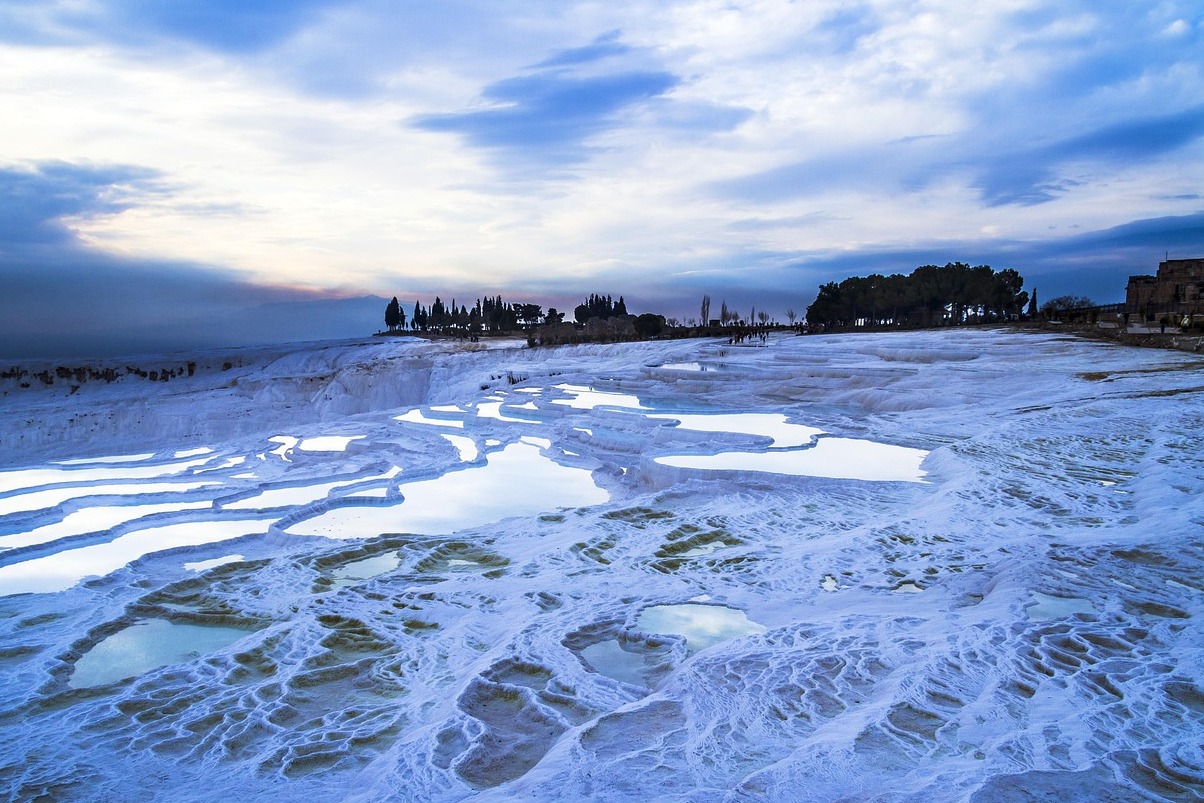
Pamukkale, meaning 'Cotton Castle' in Turkish, is a breathtaking UNESCO World Heritage Site nestled in southwest Turkey, famed for its dazzling white travertine terraces and ancient ruins of Hierapolis. This unique location has been a sanctuary for countless civilizations, dating back to the 2nd century BC, when it was founded by Eumenes II of Pergamon. The ancient city flourished due to the thermal springs that attracted visitors seeking healing, and it became a significant cultural hub during the Roman Empire.

The history of Pamukkale is intertwined with the rise and fall of Hierapolis, a city that became a place of pilgrimage and healing. The Roman period marked its zenith, with the construction of grand structures such as the theatre, the temple of Apollo, and the Colonnaded Street. Today, the ruins of these structures stand as a testament to its glorious past, providing a glimpse into the architectural ingenuity of the time. The theatre, which could seat up to 20,000 spectators, is particularly noteworthy for its stunning views overlooking the travertine terraces.
Art and architecture at Pamukkale reflect a rich tapestry of influences, blending Hellenistic, Roman, and local styles. The Necropolis, one of the largest ancient cemeteries in Anatolia, showcases intricate tombs and sarcophagi, revealing the artistic flair of its inhabitants. The Martyrion of St. Philip, a site believed to house the remains of the apostle, adds a religious dimension to the site, drawing both pilgrims and tourists alike.
Culturally, Pamukkale is a vibrant reflection of Turkish traditions, where local customs are celebrated through various festivals. The Pamukkale Thermal Springs Festival is a highlight, usually held in June, featuring traditional music, dance, and crafts that celebrate the region's heritage. Visitors can experience local crafts such as handwoven textiles and ceramics, deeply rooted in the area’s history.
Gastronomically, Pamukkale offers a delightful array of local delicacies that reflect the flavors of the region. Kebabs, particularly the Adana kebab, are a must-try, alongside pide, a Turkish flatbread topped with various ingredients. For a sweet treat, indulge in clotted cream served with honey, a local specialty that pairs perfectly with a glass of Turkish tea. Don’t miss out on sampling simit, a sesame-encrusted bread that is a popular snack among locals.
Among the lesser-known curiosities of Pamukkale is the fact that the travertine terraces were formed over thousands of years as mineral-rich waters flowed over the cliffs, depositing calcium carbonate. The site is not just beautiful but also ecologically significant, as it provides a habitat for various species of flora and fauna. Interestingly, the thermal waters have been used since ancient times for their healing properties, and many visitors still partake in the therapeutic baths, claiming benefits for ailments such as arthritis and skin conditions.
For those planning a visit, the best time to explore Pamukkale is during the spring (April to June) and autumn (September to November) when the weather is mild and the crowds are smaller. It is advisable to wear comfortable footwear, as the terraces can be slippery. Be sure to bring a swimsuit for a dip in the thermal pools and a camera to capture the breathtaking views.
Visitors should also take the time to explore the nearby Karahayit, known for its red thermal waters, which are said to have greater healing properties than those at Pamukkale. Another hidden gem is the Cleopatra Pool, an ancient pool filled with submerged Roman ruins, where you can swim amidst history.
In conclusion, Pamukkale is not just a natural wonder but a cultural and historical treasure, offering an enriching experience to all who visit. Whether you’re marveling at the stunning terraces, exploring the ancient ruins, or indulging in local cuisine, Pamukkale promises an unforgettable journey through time.
For a personalized itinerary that captures the essence of Pamukkale, consider using the Secret World app for planning your visit.


