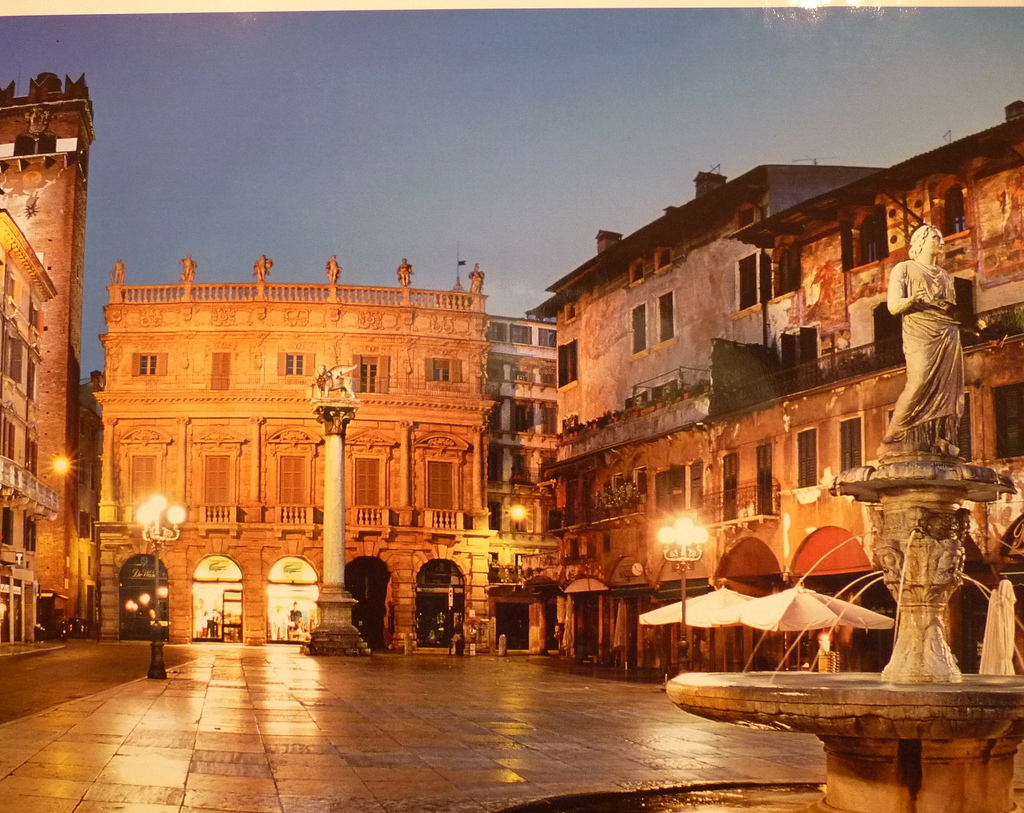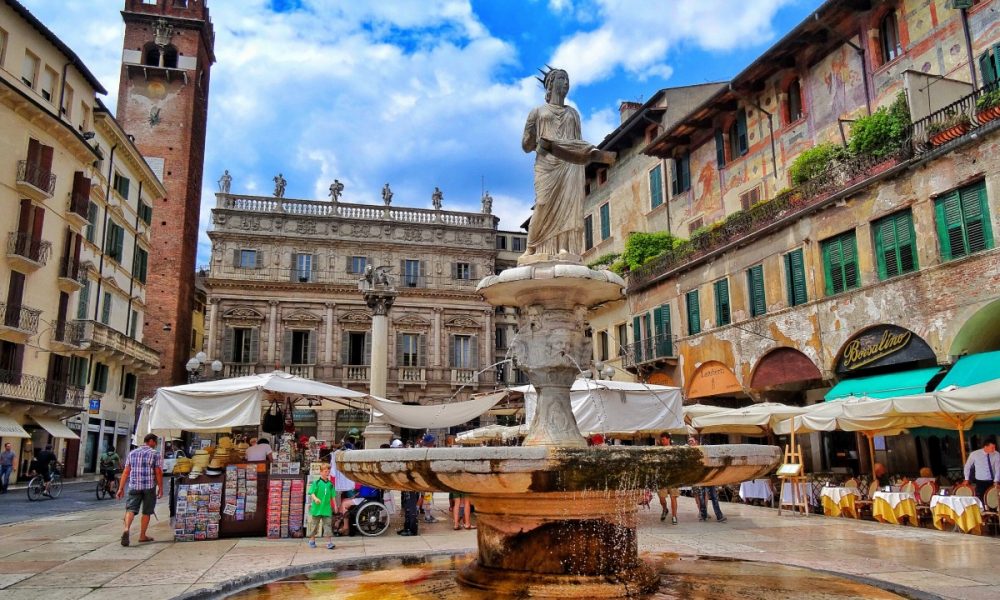

For many centuries Piazza Erbe è was the hub of Verona's social, economic and religious life. In Roman times it housed the Forum, of which the present square preserves the original length: there were the Capitol, Temples and Baths, connected by an arcade that housed numerous stores. In the communal period it was the seat of political power, and with the Scaligeri it became a lively center of arts and commerce. During first Venetian and then Austrian rule, it housed the civil and criminal courts, but always remained the favorite meeting place and marketplace for the people of Verona. roven from Via Mazzini are: the market column (1401), surmounted by a’gothic aedicule (in whose niches are carved figures with religious subjects added in 1930) and commissioned by Gian Galeazzo Visconti to display the insignia of his lordship; the berlina or capitello, a square marble canopy existing from the 12th century, under which the podestà sat; at the installation ceremony and which bears on its steps and pillars Veronese commercial measurements; the fountain of Madonna Verona (erected in 1368 by Cansignorio), which features basin and stem decorated with relief heads and symbolic figures (possibly the work of Bonino da Campione) and is surmounted by the figure of Madonna Verona, a Roman statue from the 1st cent. A.D. (whose missing parts of head and arms were had completed by Cansignorio when the fountain was made); St. Mark's column from 1523, in white marble, on top of which was hoisted the lion symbol of the Republic of Venice (destroyed by the French, the present one is from 1886). The square è framed by palaces and buildings that have marked the history of Verona. Still coming from Via Mazzini, at the southeast corner of the square one can observe a series of buildings that still preserve the structural lines of tower-houses from the communal age, a remnant of the ancient ghetto. Next comes the Domus Mercatorum (House of the Merchants) rebuilt in masonry in 1301 by Alberto I della Scala; the palace has a portico supported by columns and pilasters, wide mullioned windows with two lights and battlements; in the 19th century a renovation altered its original Romanesque forms and the building became the seat of the Chamber of Commerce. This is followed by a series of Renaissance houses on which stands the crenellated, brick Del Gardello Tower, erected by Cansignorio in 1370 to place the oldest bell clock in Verona. Next to the Tower is Palazzo Maffei: an imposing building from 1668 in late Baroque forms, è equipped with a terrace (originally with a hanging garden) with a balustrade adorned with 6 statues of pagan gods (Hercules, Jupiter, Venus, Mercury, Apollo and Minerva).To the right of the square are the 16th-century Case Dei Mazzanti (once the Scaligera Domus Blandorum, which, in the 14th century, housed workshops and private dwellings on the first floor, while the upper floor was used as a granary), joined by a portico; the facades on the square and Corso Santa Anastasia were richly frescoed by Alberto Cavalli in the first half of the ‘500s. The last section of the square is occupied by the back of the Domus Nova and the neoclassical side elevation of the Palazzo della Ragione or City Hall, in the midst of which rests the Costa arch (so called because of the presence, since the mid-1700s, of a whale rib hanging from the vault) from which one enters Piazza dei Signori. Towering over the two squares is the Lamberti Tower.