
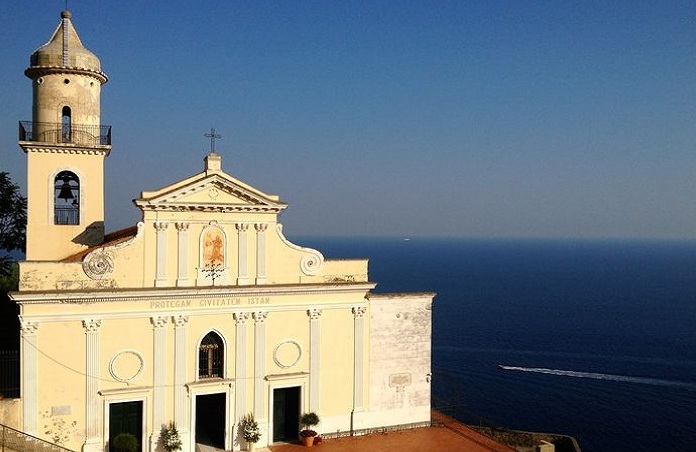

The beautiful Conca dei Marini, one of the most suggestive places of the Amalfi Coast, is a place rich in religious monuments (and not) of great historical and cultural interest. Considered one of the pearls of the Coast and declared in 1997 by UNESCO as World Heritage Site, Conca dei Marini is also historically known as the "City of sailors". There are many symbolic places of Conca, also home of the famous sfogliatella Santarosa: beautiful beaches, high towers that once served as lookout points to protect the city, numerous natural caves such as the Emerald Grotto and, of course, spectacular sacred buildings. One of the most famous churches in Conca dei Marini, as well as the main sacred building, is the Church of San Giovanni Battista. This beautiful church is also known as the Church of St. Anthony of Padua, officially declared the patron saint of Conca dei Marini in 1694. The origins of the construction of this sacred building are not known precisely, although they must be very remote, since among some official documents concerning the church there is a report dating back to 1416. It seems that in this date a local lord, Giacomo Sarcaya, enjoyed the special right to appoint the rector of the parish of San Giovanni, a practice that went on for a long time, remaining firmly in the hands of the Sarcaya family and then passing to the Paolillo family. Apart from the ancient origins of the building, the beauty of the construction of the Church of St. John the Baptist and its particular location should be emphasized. The church rises in fact on a very high point from which it dominates all Conca and, thanks to this privileged position, the Church was spared from the Saracen invasions that instead destroyed other places of prayer in Conca dei Marini, such as the Church of San Pancrazio Martire. Restored twice during its "life", the first time in 1909 and the second time in 1990 (after having suffered heavy damages caused by the 1980 Irpinia earthquake), the Church of San Giovanni Battista is composed of three naves separated by two rows of columns. Above the columns one can admire some round arches decorated with stuccoes and decorations of Baroque origin, but there are also some details recalling the medieval style in the rest of the building. On the left aisle there is the baptismal font, the crucifix, the altar dedicated to the Madonna of Montevergine and the altar dedicated to the Madonna of Carmine, to Bonaventura of Potenza and to Saint Anthony of Padua. In the right aisle there are the chapels dedicated to St. Francis of Assisi and to St. Joseph; on the right side there is the sacristy made up of a big square hall surmounted by a dome vault in the middle of which there is the dove of the Holy Spirit. Very beautiful then the picture that is in correspondence of the main altar and that represents the Madonna together with San Giovanni Battista and Sant'Andrea apostle, enclosed between precious stuccos and surmounted by a veil. Finally, we must mention the bell tower which completes the Church of San Giovanni Battista in Conca dei Marini, characterized by a spire vault covered with majolica and embellished by a Baroque facade with the image of the patron saint of Conca, that is St. Antonio.


