


Four hundred and ninety-eight worn stone steps rise among centenary cedars before the vermilion silhouette of the Chureito Pagoda emerges against the sky. From that precise point on the slope of Mount Arakura, in Fujiyoshida, one of the most studied visual compositions of Japan unfolds: the five-story pagoda in the foreground, the almost perfect cone of Mount Fuji in the background, and between the two subjects only air and, in spring, a pink curtain of cherry blossoms. It is not an architectural coincidence — it is a deliberate choice that reveals how the Japanese building tradition has always considered the surrounding landscape as an integral part of the work itself.
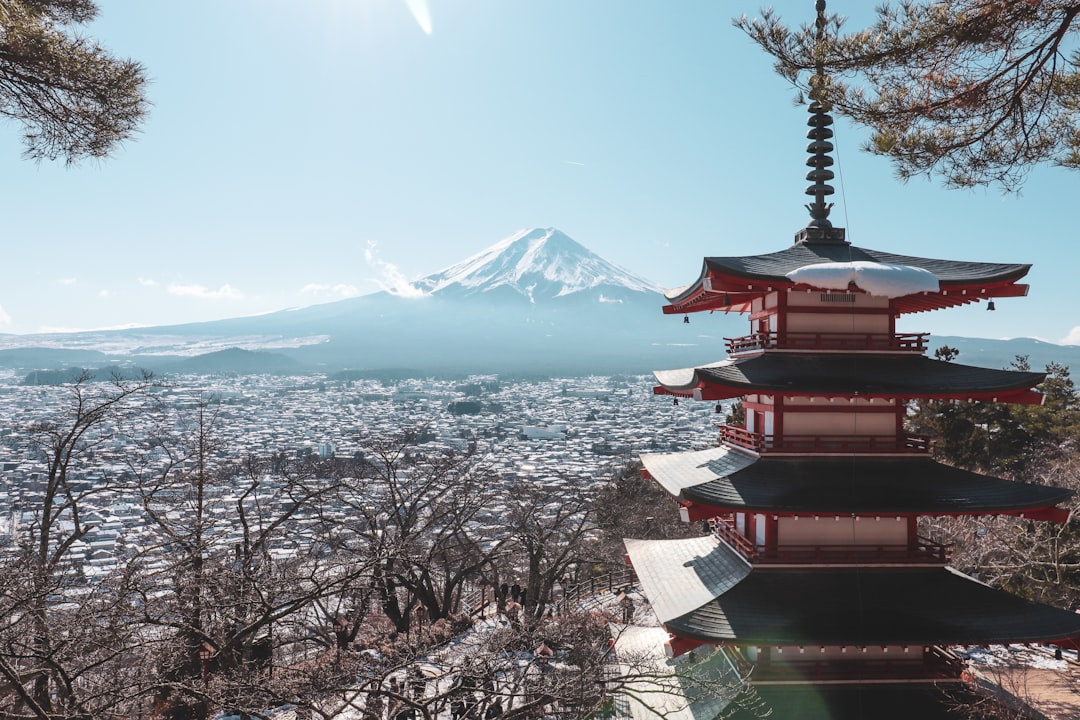
The pagoda was erected in 1958 as a memorial monument for peace, in honor of those who fell in World War II, and belongs to the complex of the Arakura Sengen Shrine, a Shinto shrine whose origins date back centuries earlier. This overlap of functions — religious, commemorative, aesthetic — is emblematic of Japanese sacred architecture, where every built element dialogues with the sacred, with memory, and with nature in the same breath.
The structure: five levels of red geometry

The Chureito Pagoda is a gojūnotō, that is, a five-story pagoda, an architectural type derived from the Indian Buddhist stupa and profoundly reworked by Japanese aesthetics over the centuries. Each level is topped with a multi-sloped roof with characteristic upward curves at the corners — a detail that traditional Japanese carpenters call soribana — and the entire structure is coated in vermilion lacquer, the quintessential color of Shinto and Buddhist sacred architecture. At the top rises the sorin, the metal pole with overlapping rings that crowns every Japanese pagoda and symbolizes the cosmic levels of the Buddhist universe.
Observing the structure up close, one notices how the levels progressively narrow towards the top following precise proportions, creating an optical illusion that makes it appear even taller than its actual height of about thirteen meters. The red lacquer is not simply paint: it is a traditional protective layer that requires periodic maintenance and that under direct sunlight takes on orange hues, while in the shadow hours it shifts to an almost blood-red. This chromatic play radically changes the appearance of the pagoda depending on the time of day.

The path: 398 steps as a rite of approach
Access to the pagoda begins at the Arakura Sengen Shrine, the shrine at the foot of the hill, and continues through 398 stone steps that rise unevenly through the cedar forest. This number is not random in Japanese tradition: the ascending path is conceived as a mental and physical preparation for the sight of the sacred place, a form of miniature pilgrimage. The steps are ancient, some worn in the center from the passage of generations of visitors, and flanked by stone lanterns that add an almost unreal atmosphere to the walk on foggy days.

The ascent takes an average of 20-30 minutes at a moderate pace, with some steeper sections requiring attention. Those suffering from knee problems should consider that the descent, on uneven stone steps, can be more challenging than the ascent. There is no elevator or alternative route: the 398 steps are the only way.
When to go and how to organize the visit

The most photographed period is that of the cherry blossom, between late March and early April, when the trees lining the steps and opening onto the pagoda platform are covered in pink flowers. During that time, however, the crowd is considerable and arriving at dawn — around 6:00 — is the only way to find the terrace with few people. Autumn, between October and November, offers red and orange foliage with fewer visitors. In winter, with fresh snow and a clear sky, the visibility of Fuji is statistically better than in summer, when humidity often creates haze.
To reach Fujiyoshida from the Kawaguchiko station, you can use the local bus or a taxi; from Fujiyoshida station, the shrine is reachable on foot in about 10 minutes. Entrance to the shrine and the pagoda is free. It is recommended to wear non-slip shoes for the often damp stone steps and to check the weather conditions in advance: Fuji is only visible with a clear sky, and completely clear days are more frequent in winter and spring compared to summer.
Architecture as a Point of Observation
What makes the Chureito Pagoda architecturally interesting is not just the structure itself, but its calculated position. Those who placed it on that precise spur of Mount Arakura chose the only angle from which Fuji appears centered with respect to the vertical axis of the pagoda. This practice — building in relation to the landscape rather than despite it — is a constant in Japanese sacred architecture, where the concept of ma, the space between things, is considered as important as the thing itself.
Standing on the platform in front of the pagoda and looking towards Fuji means concretely understanding this principle: the mountain is not a backdrop, it is a co-protagonist. The pagoda does not impose itself on the landscape, it organizes it. It is a lesson in architecture that requires no captions.


