
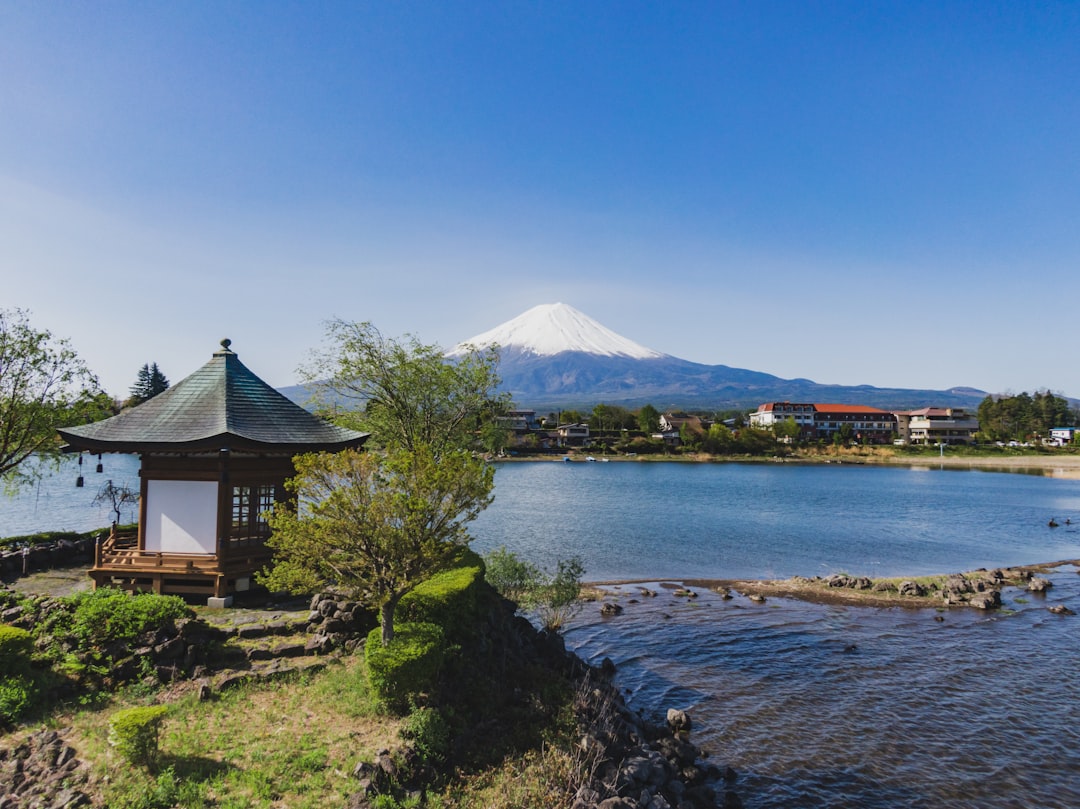

At the first light of dawn, when the surface of Lake Kawaguchi is still as still as a mirror, the unmistakable profile of Mount Fuji is reflected in the waters with an almost unreal precision. This is the moment that thousands of photographers and travelers chase every year, waking up before sunrise to position themselves along the shores of what is considered the most accessible of the five volcanic lakes at the foot of Fuji, the so-called Fuji Go-Ko.

Lake Kawaguchi is located in the municipality of Fujikawaguchiko, in Yamanashi Prefecture, about 100 kilometers west of Tokyo. With an area of about 5.7 square kilometers and a perimeter of nearly 20 kilometers, it is the second largest lake among the five, but the first in terms of visitors due to its relatively convenient location to the Japanese capital. The altitude of about 830 meters above sea level helps to make the air particularly clear, an ideal condition for observing the peak of Fuji, which rises to 3,776 meters.
The seasons that transform the landscape

The beauty of Lake Kawaguchi changes radically with the seasons, and each period offers a different spectacle. In spring, usually between the end of March and the beginning of April, the cherry blossoms along the northern side of the lake create an extraordinary chromatic composition: the branches laden with pink flowers stand out against the white silhouette of the still snow-capped Fuji. The tree-lined avenue near the Chureito Pagoda — a five-story pagoda that is reached by climbing about 400 steps in the nearby Arakurayama Sengen park — is one of the most famous photographic spots in Japan.
In autumn, between October and November, the colors of the foliage ignite in shades of red, orange, and yellow, reflecting in the waters of the lake with an equally hypnotic effect. Winter brings snow and the clearest days of the year, when the likelihood of seeing Fuji completely free of clouds is highest. Summer, on the other hand, is the busiest season and not always the most favorable for reflections, as the heat often creates morning haze.

What to observe along the shores
The northern side of the lake, accessible by foot or by bicycle, offers the most classic perspective of Fuji. Here you can find several wooden piers and small lakeside beaches from which you can rent a rowboat or a pedal boat to venture into the center of the lake. The view from the center of the water, with Fuji dominating the horizon and the wooded shores all around, is a completely different experience compared to that from the shore.

On the southern side lies the town of Kawaguchiko, with its traditional ryokan, restaurants, and souvenir shops. It is worth visiting the Kawaguchiko Music Forest, a theme park dedicated to mechanical music with automatic organs and music boxes, which also offers a beautiful perspective of the lake. Along the pedestrian path that runs alongside the water, you will encounter small Shinto shrines almost hidden among the vegetation, a testament to the sacred character that the Japanese have always attributed to Mount Fuji and the landscape that surrounds it.
How to get there and practical tips
From Tokyo, the most convenient way to reach Lake Kawaguchi is the Keio direct bus from Shinjuku station, with regular frequency and a travel time of about two hours, depending on traffic. The indicative cost is around 1,800-2,000 yen per trip. Alternatively, you can take the train to Otsuki and then the Fujikyu Railway to Kawaguchiko station, a longer route but one that passes through very picturesque rural landscapes.
The best time to photograph the reflection of Fuji is in the early morning hours, preferably before 7:00 AM, when the wind is still absent and the surface of the lake is perfectly flat. On spring weekends and during the autumn foliage period, the shores quickly become crowded: arriving the night before and staying in one of the local ryokans is the wisest choice. Avoid Japanese national holidays, such as Golden Week at the end of April and early May, when the influx of visitors makes it difficult to find space even just to stop along the shore. A minimum stay of two nights allows you to enjoy at least two sunrises, increasing the chances of finding ideal weather conditions.


