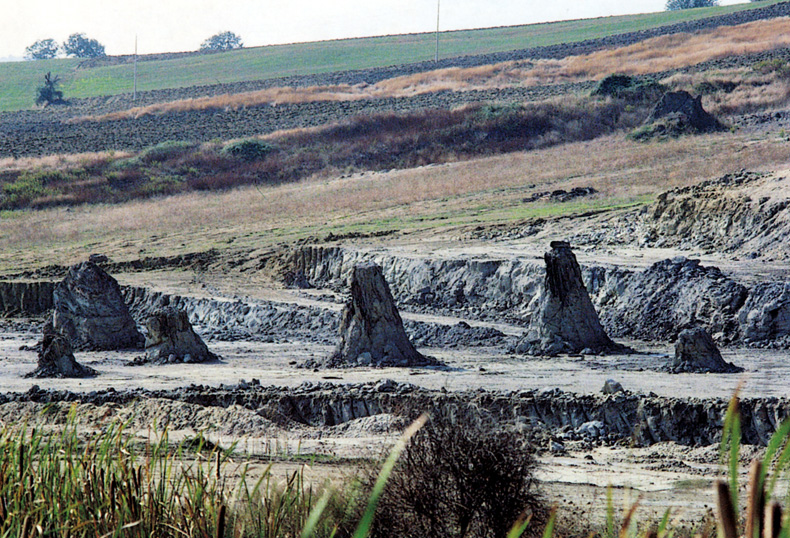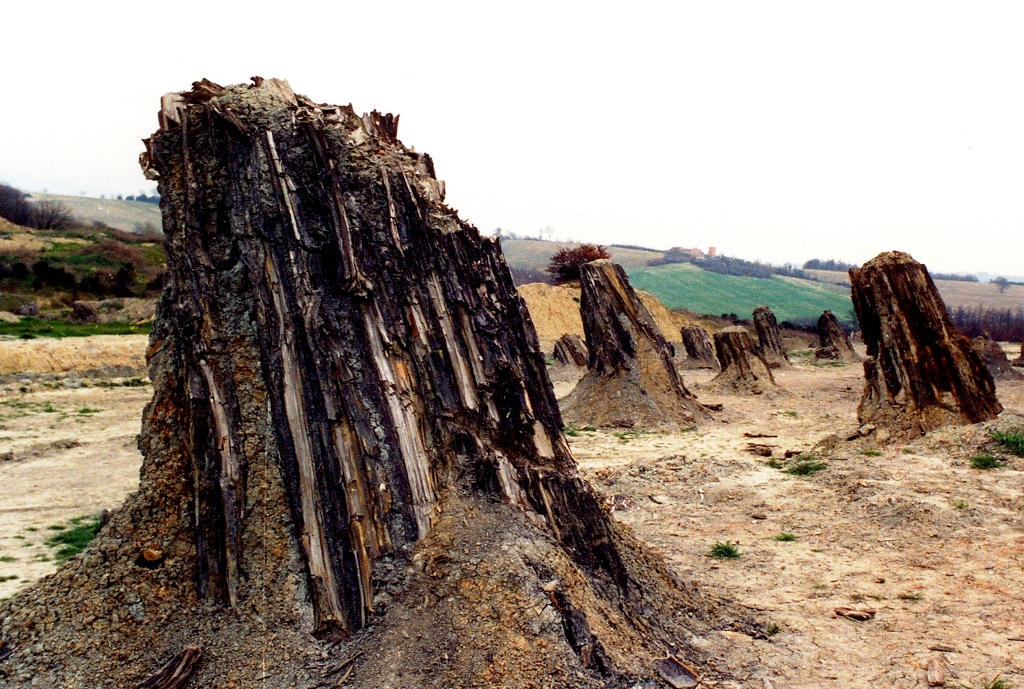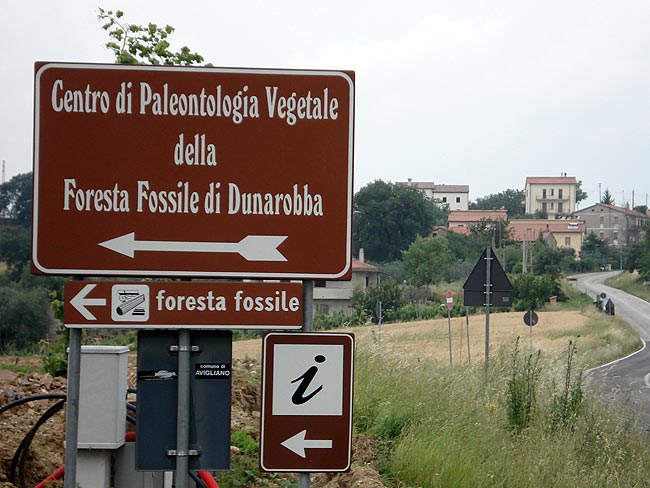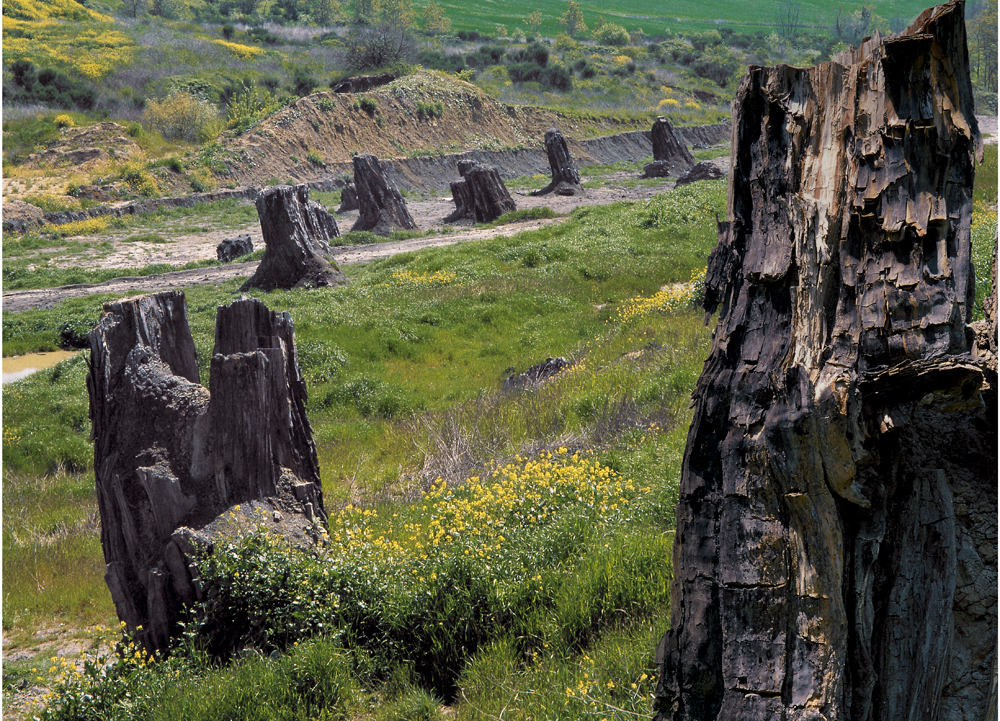

Already from 1600, for work of the Prince Federico Cesi, it was to acquaintance of recoveries of fossil woods in the countries of Avigliano Umbro.\nDunarobba, whose name probably derives from the Latin Gens Dunnia, made part of that immense territory that Ottone I king of Italy donated the 13 February 962 to Arnolfo, capostipite of the Arnolfi, one of the most important families of the Middle Ages. It was fortified by his descendants around the year one thousand. Between 1282 and 1284 this place was plundered by the Narnesi who made sudden raids, then defeated and dispersed by the Todina cavalry. As all the castles of the time, also Dunarobba had to resolve problems of defense: to such purpose it is read in the "reformanze" that in 1591 the Commune of Todi gave license, through the Massari, to build a door with bridge levatoio. Particularly curious is a story that tells that in 1605 to Dunarobba lived a certain woman Ursina, daughter of a certain Gregorio, which with secret words and through the use of medicines, syrups and potions prepared by her managed to cure ills considered incurable by the doctors of the time. From this activity Ursina obtained a certain wealth for herself and her family, attracting suspicions of being a witch. Dunarobba remained under the jurisdiction of the Commune of Todi until 1816 when under the new Commune of Montecastrilli, with which it remained until 1975, year in which the Commune of Avigliano Umbro was constituted. An important mine of lignite has determined the economy of Dunarobba and of the near centers up to the years 50. The Fossil Forest of Dunarobba was found in the first years Seventies during the excavations effected in the quarry of clay that served to feed a furnace of bricks. \The Fossil Forest of Dunarobba lived 3 million years ago, at the end of the Cenozoic and precisely in the superior Pliocene, when between the Amerini and Martani Mountains extended a vast lacustrine mirror which has been given the name of Tiberino Lake. On the shores of this immense lake, that furrowed all the Umbria, a luxuriant forest of temperate-warm-humid climate developed, where lived mamuth and other prehistoric animals. The dominant arboreal species was represented by a great conifer. These were imposing trees that exceeded 30 m in height; the preferred environment was that of the marshes, of extensive quagmires placed at the margins of the lake itself, deeper. The trunks are still formed by their original wood which has allowed, through studies of both histology and pollen, fruit and leaf imprints, to be able to say with certainty that this is a forest of conifers of the Taxodion genus, probably an extinct form of Sequoia very similar to the current Sequoia sempervirens. The landscape of the Dunarobba Forest is strangely "lunar": the enormous gray trunks measure over one and a half meters in diameter, by more than eight meters in length. The majestic plants were probably overwhelmed by a catastrophic event when they had reached an age to be measured in millennia. Towards the end of the Pliocene, shortly after two million years ago, a global cooling of the climate, accompanied by a lowering of the sea level and the uplift of the land, triggered a consistent process of erosion on the mountain slopes, up to produce the opening of a passage in the Amerini Mountains, through which the waters of the Tiberino Lake flowed to the sea, which, at the end, emptied and left its space to a river that flowed into the sea in correspondence of the San Pellegrino Pass (on the Amerina Road in the territory of Narni). This climatic crisis and the emptying of the lake, with the consequent changes of the environment and the landscape, have determined the extinction of the Forest of Dunarobba: with it the great conifers have definitively disappeared from the European scene. The exceptionality of the finding is due to the fact that the trunks of the fossil forest maintain an upright position and have a non-petrified wooden structure; they are not "petrified", that is, their original substance has not been replaced or mineralized by other chemical compounds. Incorporated by the clays, these finds have undergone a process of fossilization that has allowed them to maintain almost unchanged the wooden structure; it is a fossilization occurred by a process of mummification, in other words by a dehydration of the wood. The peculiarity of Dunarobba Forest is that the trees are fossilized in vertical position and not horizontal as in other fossil forests, already very rare, arrived to us. This feeds the theory that a flood has submerged the trees in life, preserving them until our days in the real conditions of the time.