
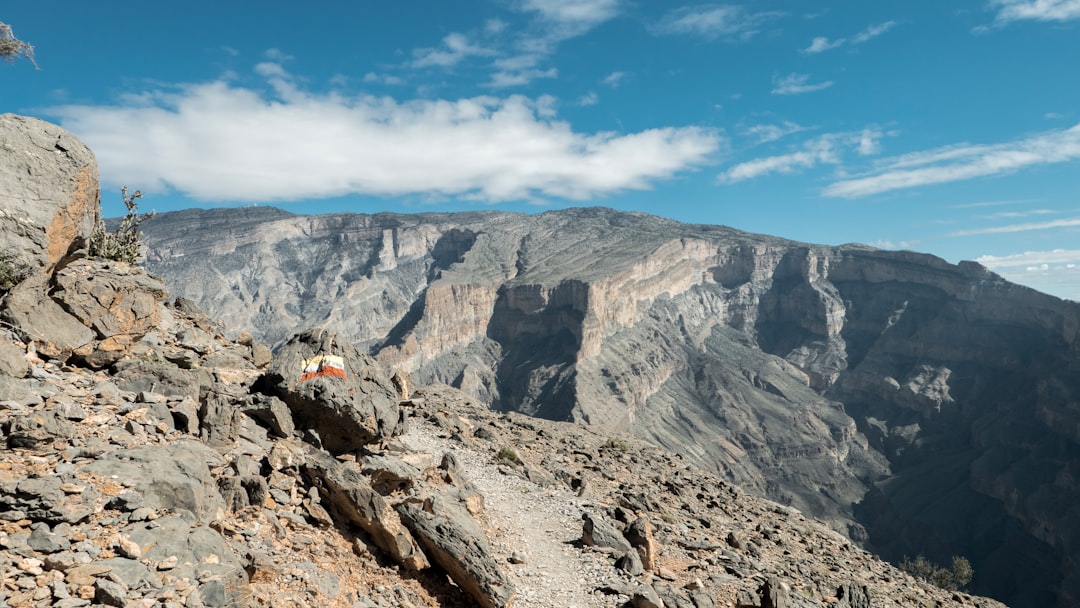

The edge of the cliff appears suddenly, without warning. One more step on the red gravel path and the ground disappears beneath your feet for over a thousand meters: Wadi Ghul opens below like a wound in the limestone rock, earning the nickname Grand Canyon of Oman. Jebel Shams, which in Arabic means Mountain of the Sun, is the highest peak in Oman at 3,009 meters above sea level, and from its plateau, one overlooks one of the most vertiginous landscapes in the entire Arabian Peninsula.
What makes this place different from any other viewpoint in the Middle East is not only the scale of the canyon but the combination of absolute silence, shifting light, and the remnants of abandoned villages clinging to the rock. Those who arrive here without specific expectations are faced with something difficult to frame: it is not a developed park, there are no guardrails, there are no crowds. There is only the wind and the void.
The colors of the canyon at different times of the day
At dawn, the limestone walls of Wadi Ghul take on a burnt orange hue that fades to pink as the sun rises on the horizon. The shadows cast by the geological layers — visible as horizontal lines along the vertical walls — create a natural geometry that changes appearance every fifteen minutes. It is the moment when the depth of the canyon is best perceived, because the slanting light enhances every relief and every crevice.
By mid-morning, the landscape transforms: the limestone becomes almost white under the direct sun, and the bottom of the wadi, still in shadow for a few hours, appears like a distant dark ribbon. In the late afternoon, however, the tones return to warm — ochre, terracotta, antique gold — and the walls seem to catch fire for about thirty minutes before sunset. Those who manage to stay until that moment take away an image that is hard to forget.
The W6 Trail and the Abandoned Villages
Along the edge of the canyon runs the W6 trail, also known as the Balcony Walk, one of the most scenic routes in Oman. The trail stretches for about 9 kilometers with a modest elevation gain, and along the way, one encounters the remains of Al Sab and Sap Bani Khamis, two abandoned stone villages that once housed communities of farmers and herders. The houses, built directly on the rock with the same limestone as the canyon, are almost invisible until one is just a few meters away.
Within the ruins, there are still traces of daily life: small irrigation channels carved into the rock, agricultural terraces that are now out of use, and some wooden beams worn by time. No signs explain the history of these places, which makes them even more evocative. The silence is such that one can hear their own breath quickening while walking along the edge, with the void of a thousand meters just a few steps away.
How to get there and practical advice
Jebel Shams can be reached by car from Nizwa, the nearest city, traveling about 100 kilometers northwest through the Al Dakhiliya region. The paved road goes up to the plateau, but the last kilometers to the highest viewpoints require a 4x4 vehicle: the high-altitude tracks are unpaved and steep in some sections. It is not advisable to tackle them with a regular car, especially after the rare winter rains that can make the ground slippery.
The best time to visit is between October and March, when temperatures on the plateau are bearable — in summer they can rise above 35°C even at altitude, while in winter it can easily drop below zero at night. For the Balcony Walk, it is advisable to start at dawn, both for the light and to complete the route before the sun is high. Bringing at least two liters of water per person is essential: there are no supply points along the trail. Entrance to the area is free, but some high-altitude accommodations require advance booking, especially on weekends when visitors come from Muscat.
Why the trip is worth it
Jebel Shams is not a place you visit to check off a box on a list. It requires some logistical effort, a guide or at least a good offline map, and the willingness to stand on the edge of a cliff with nothing to hold you back. In return, it offers a perspective on the scale of nature that few places in the Middle East can provide with the same intensity.
The abandoned villages remind us that this extreme landscape has been inhabited for centuries, that someone built their home on a sheer cliff over nothingness. Looking at those stone walls and then raising your eyes to the canyon is an experience that puts many things into perspective. No grand words are needed to describe it — just stand still for a moment and look down.


