
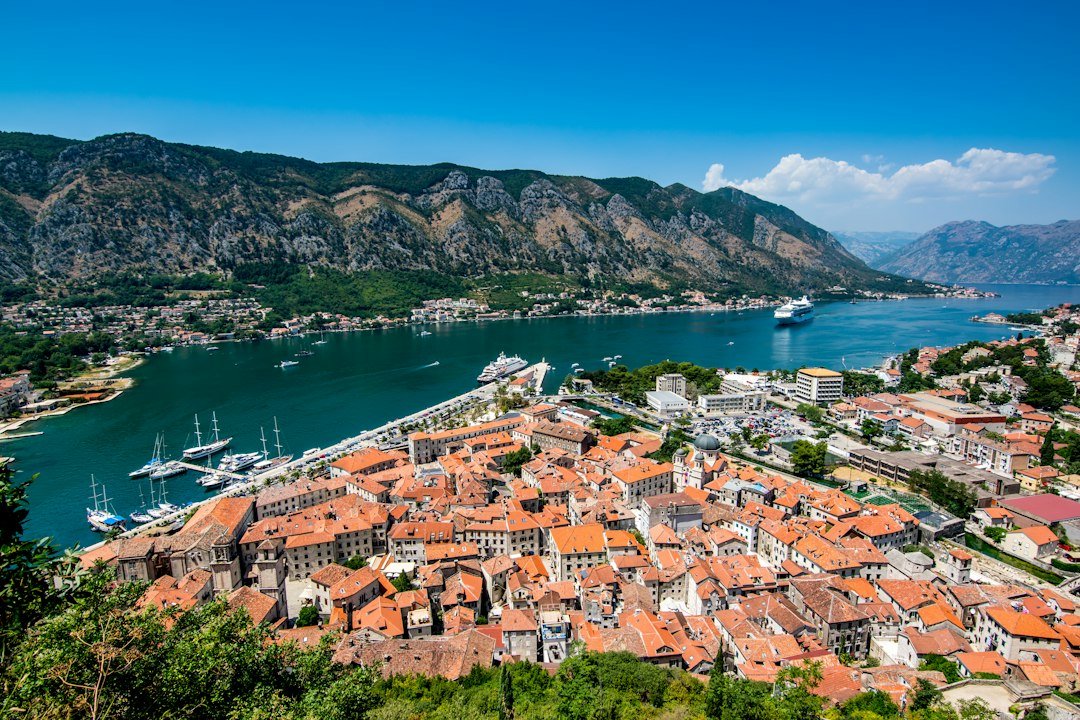

One thousand eight hundred and fifty meters of white limestone walls embrace the old town of Kotor like a medieval hug, rising vertically up the karst rock to the Fortress of San Giovanni, about 260 meters above sea level. This defensive system, built and expanded during the Venetian domination between the 14th and 18th centuries, is one of the most intact examples of Adriatic military architecture that has survived to this day. Walking along its perimeter means reading centuries of stratifications: reused Roman blocks, Byzantine towers incorporated into Venetian bastions, Latin inscriptions worn by salt and wind.
The ascent begins at the Riviera Gate, on the northern side of the walls, and winds through a series of natural terraces and irregular staircases that require about two hours of walking round trip at a moderate pace. The path is not equipped with handrails for a good part of the route, and some sections feature steps of varying height and depth, carved directly into the living rock. It is this irregularity, paradoxically, that makes the experience authentic: each step tells of a different intervention, a different era, a different hand that laid the stone.
The Venetian military architecture: towers and bastions
The most studied section by architectural historians is the one that connects the Campanara Tower to the Chapel of Our Lady of Health, a small rock church embedded in the rock about halfway along the route. The walls in this sector reach a thickness of over three meters at the base, with gun ports oriented towards the Bay of Kotor to cover access by sea. The Serenissima invested significant resources in strengthening defenses after the Ottoman threat of the 15th century, and the signs of these interventions are visible in the different types of masonry: the local gray-blue stone alternates with sections of Venetian red brick.
Along the route, three main towers still stand: the Tvrdalj Tower, the one of San Giovanni, and the corner tower that guards the highest point of the system. The latter still retains the stone brackets that supported the beams of the upper floors, which have now disappeared. The carved capitals visible in some openings testify that these structures were not conceived as pure utilitarian military architecture, but integrated decorative elements typical of Venetian Gothic.
The Fortress of San Giovanni and the View of the Fjord
The Fortress of San Giovanni, which crowns the summit of the path, dates back in its foundations to the Illyrian and Byzantine periods, but the current structure is the result of successive Venetian transformations. Today it presents itself as a consolidated ruin: the perimeter walls are largely intact, while the internal volumes have collapsed, leaving visible the traces of the original rooms on the stone floor. From here, the view of the Boka Bay — technically a karst fjord, not glacial — is completely unobstructed: the old town appears as a network of orange roofs nestled between the mountains and the dark water of the bay, with the bell towers of the Cathedral of Saint Tryphon and the Church of Saint Luke clearly distinguishable from above.
The cathedral, dedicated to the patron saint of the city and consecrated in 1166, is visible directly in line with the main gate of the walls. This alignment is not accidental: the religious and military topography of Kotor was designed to visually interact, with the bell towers also serving as landmarks for the defenders on the walls.
Artistic details along the path
Those who climb carefully will notice, engraved in the stone about a hundred steps from the start, a commemorative plaque with an inscription in Latin that recalls a restoration intervention from 1667, the year in which a devastating earthquake struck the Dalmatian and Montenegrin region, significantly damaging the structures. This date is crucial for understanding the current appearance of the walls: many sections visible today are post-seismic reconstructions, not original medieval ones.
In the small rock chapel halfway along the path, there are ex-votos made of ceramics and some locally crafted icons, probably from the 18th and 19th centuries. The interior is tiny — no more than four people can enter at the same time — but the accumulation of votive objects left by pilgrims over the centuries creates a dense and layered visual effect, very different from the architectural sobriety of the outer walls.
Practical Information for the Visit
The entrance ticket to the walls costs approximately 8 euros for adults, with reductions for children and seniors. Access is available from early morning, and the most useful advice is to climb by 8:00 during the summer months: after 10:00 the limestone rock reflects heat intensely and the climb becomes physically demanding, as well as crowded with organized groups. Hiking shoes with non-slip soles are essential, not just a generic recommendation: the stone steps smoothed by use are dangerous with smooth soles, especially on the descent. Bring at least one liter of water per person: there are no refreshment points along the path to the fortress.
The minimum realistic time for a complete visit, round trip with photo stops, is two and a half hours. Those with mobility difficulties can still access the first section of the walls and enjoy the view of the old city without tackling the full climb: the first 200 steps already offer architecturally interesting perspectives.


