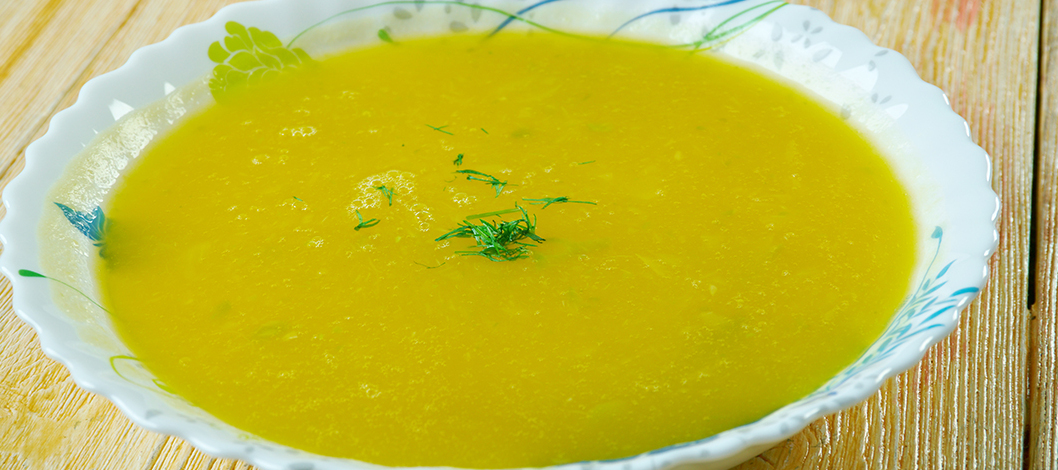

The ginestrata is a typical soup of Chianti that has spread also in Valdarno and Val di Chiana, between the provinces of Florence, Arezzo and Siena.And let's start immediately from the name that is linked for its color to the yellow of the broom flowers, but it was also known as Cinestrata. Its first appearances are lost in the Mediterranean: it is present in a Catalan recipe book as early as the fourteenth century and, a century later, it appears in the books of Messisbugo. Today we find it in the cookery books of eminent oenogastronomers such as Giovanni Righi Parenti in his La cucina toscana and in Il grande libro della vera cucina toscana (The great book of true Tuscan cuisine) by Paolo Petroni; the first defines it as an ancient potion, invigorating and aphrodisiac, originating in the Chianti area but also widespread in the Val di Chiana and Valdarno, the second writes that "It is a soup which has now been forgotten, today the combination of sweet and savoury is no longer current, but for the rest it is an advisable dish".The presence of various spices leads us to believe that it originated in the Renaissance and was prescribed, due to the presence of eggs and wine and sugar and chicken broth, as a "sana malato" (health remedy for the sick) to recover from convalescence or exhausting work, even in love. It seems, in fact, that it was offered to newlyweds after the first nights of marriage. It is associated in some recipe books with Zabaglione, "and one could see the latter as an evolution of the former, due to the presence, together with eggs, sugar, spices, of wine, a typical element of the cited "Zabaglon" of Codex Bühler 19, an anonymous recipe book from the end of the 15th century in the Neapolitan area, which is, however, missing from the ginestrata". So writes Maria Attilia Fabbri Dall'oglio in "Civiltà della tavola". To underline another particularity in the definition of this dish: some call it soup, others soup, others still cream, and others still drink, so much so as to serve it in a cup. In the Florentine Valdarno, for example, it is preferred to sweeten it with very little sugar and flavour it with cinnamon and nutmeg; while in the Sienese Chianti there is a version of ginestrata which is more congealed (very similar to stracciatella) and enriched with all the spices typical of panpepato (or panforte) originating in Siena. Also in the Valdichiana the ginestrata has its own variant: the quantity of ingredients is doubled and the pan is put to congeal in a warm oven that makes it a sort of pudding and then served on a small tray made with the stems of the broom woven like a mat, just as it was once done! In Lucignano the ginestrata is prepared and served in the food stands on the occasion of the Maggiolata, a festival that celebrates the arrival of spring with parades, historical processions, marching bands and flowered floats. During this period, the entire town is decorated with broom flowers. So, whether you try it at home or you go to taste it in these fascinating places, do not forget to accompany it with a nice glass of red wine, maybe just a Chianti and, why not, toast in joy!