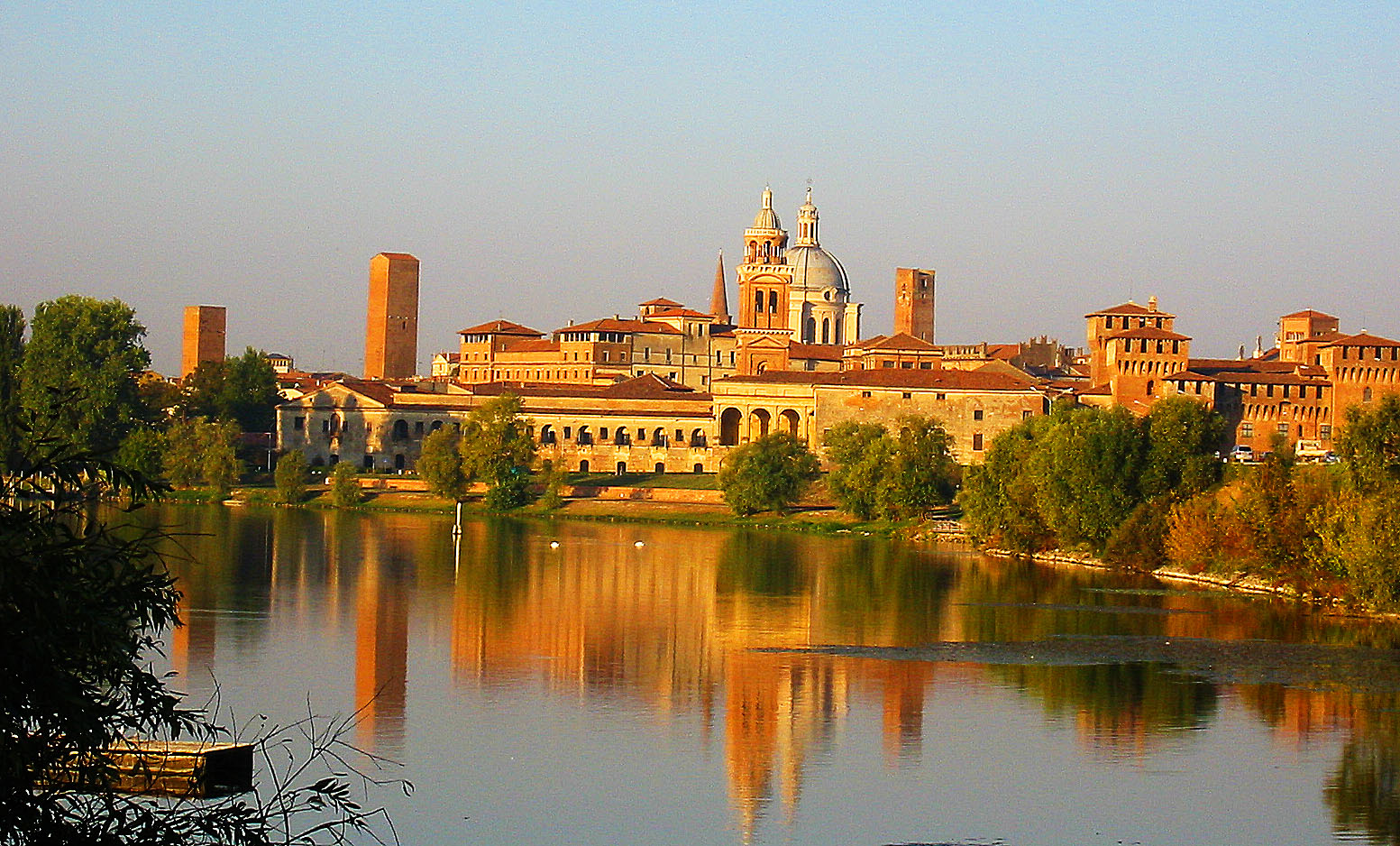
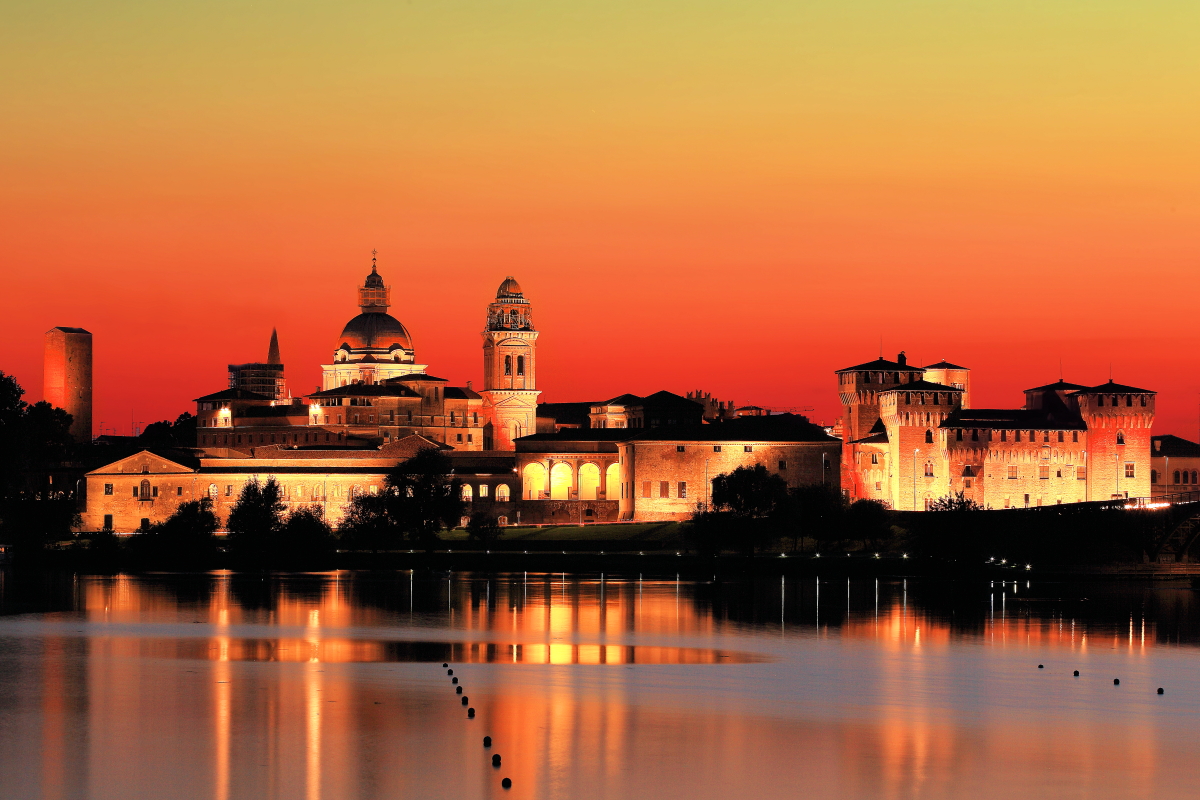
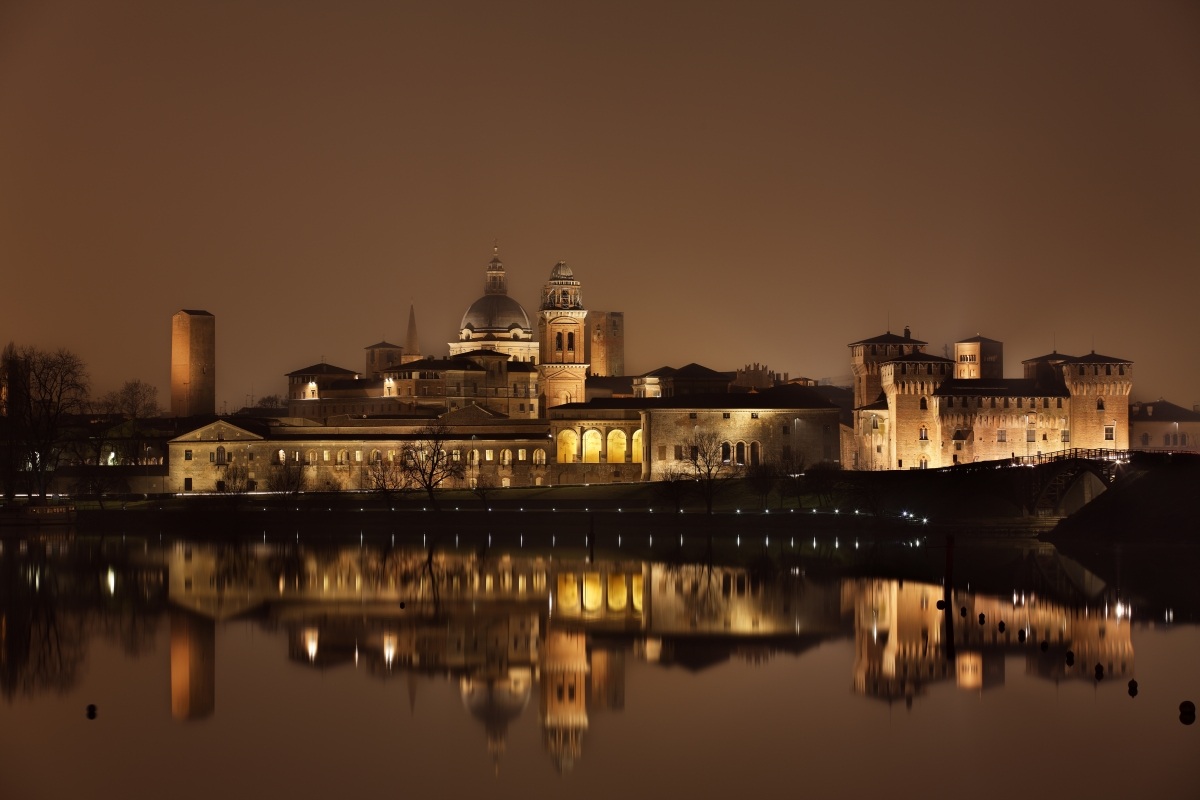
he historic center of Mantua, known as "Paiolo" from the name of the lake buried in the mid-18th century, was flanked to the south by modern neighborhoods of relatively limited extent only in the early 20th century. è this is the area called "of the third circle" which now houses modern residential neighborhoods and sports facilities. The main monuments of Mantua's historical past are preserved mainly in the first two walled areas. The splendid Ducal Palace, formed by numerous buildings built between the 13th and 18th centuries, partly overlooking the vast Piazza Sordello and enclosing gardens and internal squares. Inside è it houses a remarkable art heritage, including, among other things, works by Pisanello ('400), frescoes by Giulio Romano, an altarpiece by Rubens, and, in the nearby late 14th-century castle of San Giorgio, the famous Camera degli Sposi (Bridal Chamber), frescoed by Mantegna between 1465 and 1474. Also very important is the medieval complex of Piazza delle Erbe, which brings together the Romanesque Rotonda di San Lorenzo, the Palazzo della Ragione, flanked by the Clock Tower, and the Palazzo del Podestà; the Duomo, rebuilt in the 16th century, with an 18th-century facade; the churches, designed by Leon Battista Alberti, of San Sebastiano (1460) and Sant'Andrea (1472-1699; the dome of the latter, eighteenth-century, è the work of Filippo Juvara); the house of Andrea Mantegna (1476); the Palazzo Te (1525-1535), located beyond the third line of walls in a place formerly known "tejeto" from the huts that stood there, designed and suggestively decorated by Giulio Romano, with beautiful loggia connecting it to the garden exedra; the Museo civico, with sections on Egyptian, modern and numismatic art; the neoclassical Palazzo d'Arco (1782-1784), with rooms with fine furnishings; the baroque scientific or academic theater, also known as "the Bibiena" by architect Antonio Galli Bibiena (1769); and finally, the Diocesan Museum, in the large Piazza Virgiliana open to Lake Mezzo, which preserves sacred jewelry and armor from the 15th and 16th centuries. In the Palazzo del Podestà è a small museum has been set up dedicated to the great car driver Tazio Nuvolari, who was born in Mantua. The origin of the cityà of Mantua è possibly of Etruscan origin. Ancient Mantua was a small fortified center, probably located on the area that was later occupied by the early medieval city, at the northeastern end of the present town. In 70 B.C. Virgil was born there. When the long period of barbarian invasions ended, in the 10th century it became the dominion of the Canossa family, then, from the first half of the 12th century, it gave itself municipal ordinances and was able to expand southward thanks to a grandiose hydraulic work, which in 1190 limited and mutated the nearby marshes, formed by the Mincio River, into four lakes. The second line of walls, erected to the south of the first, served to defend the city, now made insular by the excavation of the Rio, the canal, still partially extant, which, crossing the town, joined Lake Superior to Lake Inferiore and on whose shore the Catena port was built. From the year 1273 until 1328 Mantua was ruled by the Bonacolsi, who had it in lordship of the cityà. In the beginò the era of the Gonzaga family, which lasted almost four centuries. Under the Gonzaga lordship, the city of Mantua became one of the greatest centers of art in Italy. Meanwhile, a gradual southward expansion continued that ledò Mantua to endow itself with a third line of walls, at the height of what is now Viale Risorgimento. The Gonzaga, marquis since 1433, dukes since 1530 (Duchy of Mantua), created there a vast and sumptuous court that hosted great artists, including Pisanello, Alberti, Andrea Mantegna, Giulio Romano. A war of succession, looting by foreign mercenary armies (1630) and the plague, however, caused Mantua's decline and brought it under the rule of Austria (1707). During this domination, it was transformed into one of the Quadrilateral citiesà-fortresses, until 1866.