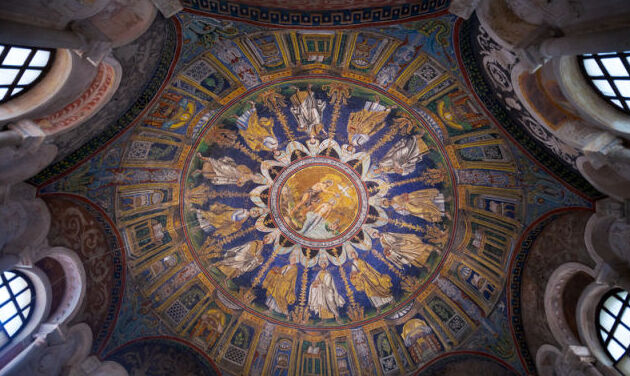

The Neonian Baptistery, also known as the Baptistery of the Orthodox, is a baptistery in Ravenna which dates back to the 5th century and takes its name from the bishop Neon who continued its construction after his predecessor Orso († ca. 396). The appellation of the Orthodox should instead be understood according to the meaning of the time, which meant Christians of the "righteous" doctrine as opposed to the Arian heresy. The baptistery has been included, since 1996, in the list of Italian UNESCO World Heritage Sites, within the serial site "Early Christian Monuments of Ravenna". he Baptistery was started in the very first years of the 5th century and finished around 450. Neone, in about 458, carried out important structural works, and in particular the construction of the dome which was decorated with rich mosaics which are still visible today. Because of the subsidence typical of Ravenna, today it is buried about 2 metres underground; in plan it has an octagonal shape, according to the numerology that associated eight with the resurrection, being the sum of seven, time, plus one, God. Externally it has a simple brick covering, in which the apses date back to the 10th century, while the pilasters and blind arcades date back to the original construction and were taken from northern models (cf. the Palatine Basilica of Constantine in Trier or the Basilica of San Simpliciano in Milan). An old tradition, without historical foundation, has it that the building was built over the calidarium of the ancient Roman baths. The ceiling, originally flat, was replaced by a dome (lightened by clay pipes) on the initiative of Neone, who also had it decorated with mosaics. The walls were also decorated at the time and present on the lower floor blind arches on small columns, inside of which are placed slabs of porphyry and green marble within geometric panels; the archivolt is occupied by mosaics; in the upper register there are the same small arches, but they contain three smaller arches each, with the central one occupied by a window, while the two lateral ones are decorated with stuccoes of the sixteen major and minor prophets (a wretched restoration of the early twentieth century, believing that these were later additions, removed them, but then we realized with regret that they were instead original of the fifth century, so today we can only admire the reconstructions); Above the small arches are frescoes with vine-shoots, peacocks and other symbols. The most important masterpiece preserved here, however, is the ceiling mosaic, where within three concentric rings various subjects are represented: The outer ring, with a blue background, presents a series of faux tripartite architectures, with a niche or exedra at the centre of each, flanked by two structures carried by four columns at the sides, which create an effect of alternation between concave and convex; these kinds of "theatrical wings" are found in Roman art, for example already in the frescoes of Pompeii; at the centre of the niches are altars for mass or empty thrones with the insignia of Christ. The second band is the most interesting and presents the twelve apostles on a blue background, with their robes (toga and pallium) alternating in white and gold, and holding crowns to offer to Christ. The images still present a notable plastic consistency and a sense of movement, which testify to the uninterrupted relationship with the Roman environment; at the same time the lively polychromy, the monumentality and the hieratic nature of the figures are indicative of relationships with the Byzantine world. The apostles are interspersed with candelabras and white drapes hang from the upper circle, which when seen from below form the shape of a flower corolla. Among the preparatory rites for baptism, in Christian initiation, the main one was that of the traditio symboli, i.e. giving the Creed to the catechumenal candidates, i.e. teaching, learning and handing over for life the fidei card. In the central tondo, on a gold background, is the scene of the Baptism of Jesus with St. John the Baptist in the act of administering the sacrament to Christ immersed to the waist in the Jordan. A personification of the river also appears on the right, underlined by the inscription Iordañ n (the deity Jordan), while above Christ stands the dove of the Holy Spirit. The faces of Jesus and the Baptist were redone in the 18th century, so that the central part of the scene, with its clearly visible contours, is no longer the original.